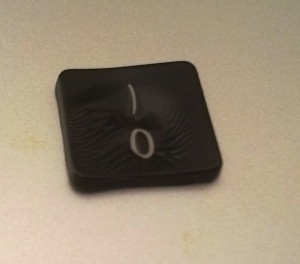
Late last night I looked down at my unibody Macbook’s keyboard and, shock-horror, the zero key had melted! There was no obvious color degradation – in other words, no sign of external burning as if something scorchingly hot had been dropped on it (I don’t smoke anyway) – but either way, the key had definitely melted. But how?
At this moment, I still have no idea. What I do know is that no other keys have been affected, but I’m guessing that the rubberized keys on the latest Apple Macbooks don’t need much heat to cave in, literally (see pic above). This, naturally, brings into question Apple’s build quality.
Or does it?
Let me know your own theory to explain the Macbook Melted Key Mystery by leaving a comment.
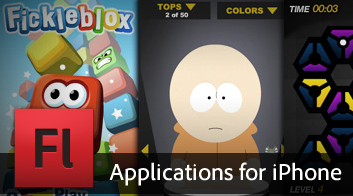
No, Adobe isn’t bringing Flash player support to iPhone. That would require cooperation from Cupertino, something that Apple CEO Steve Jobs is unlikely to sanction. Instead, the upcoming version of the latest Flash developer tools – Adobe Flash Professional CS5 – will offer Flash developers a way to output their finished creations as a native app for iPhone and iPod touch.
Since the source code is iPhone OS native, presumably through an Actionscript to Objective-C bridge, the resulting apps should qualify for submission to the iPhone App Store just as they would if they’d been built using Apple’s own development tools. This means that developers can re-factor their Flash creations for the iPhone and iPod touch, with Apple remaining in control of distribution.
Adobe has long talked up its ambition to have Flash running on all manner of screens, not just the humble PC, and today the company got a lot closer to walking the walk not just talking.
Through the Open Screen Project, Adobe was already known to be working with smartphone platforms from Palm (WebOS), Nokia (Symbian) and Microsoft (Windows Mobile), along with a raft of content providers, chip makers and consumer electronics companies. Today, the company added Google and Research In Motion to the list, with relation to Android and Blackberry-powered smartphones respectively, leaving Apple’s iPhone as the odd one out regarding planned support for full Flash (or any Flash support at all).
Following yesterday’s news that mobile carrier Orange are to begin selling the iPhone here in the UK, Vodafone have announced that they too are jumping on the Cupertino bandwagon, albeit not till early 2010.
And with O2’s two-plus year monopoly on Apple’s iconic device therefore well and truly broken, overpaid analysts and most of the tech press/blogosphere have been quick to predict a pending price war for the iPhone and associated tariffs this side of the pond. However, I’m still not convinced that this will be the case.
Exclusive handset offerings are certainly good for carriers and are probably good for handset makers too as they help drive up the price during negotiations – presuming there is a demand for said device in the first place. But it’s hard to see how they are ever in the interest of consumers who end up paying more through higher tariffs via the subsidy merry-go-round.
That’s because exclusives create a monopoly by any other name. In the case of the iPhone, if you want Apple’s iconic device here in the UK, you have no real choice but to become a customer of O2. Thankfully, that’s set to change with rival carrier Orange announcing that they have partnered with Apple to officially offer the iPhone.
With Apple stuck between the FCC, Eurpean Union regulators and a hard place, I’m not that surprised to see the approval of music streaming service Spotify’s iPhone app. Apple today confirmed to paidContent that Spotify (currently Europe-only) has been given the green light and will be available in the App Store “very soon”.
While many had speculated that the app might be rejected by Cupertino on the grounds of ‘duplicating’ (read: competing with) the iPhone’s built in functionality — iTunes — I was confident that, especially in the current climate, Spotify would be approved.
I predict that Apple will in the end give Spotify the green light based on several factors. Avoiding monopoly accusations being one. Spotify’s pricing model being another (the iPhone app will only be available to premium subscribers so it’s far from a free-for-all). And then there’s Apple’s kludgy multitasking solution. The latter of which means that Spotify on iPhone will be unable to run in the background. Switch to a different app and the music stops.
One thing we don’t yet know, however, is if Apple has in anyway restricted any of the features of the Spotify iPhone app, in particular the ability to cache playlists for off-line playback. This feature alone means that Spotify competes more heavily with iTunes than other streaming music apps that already exist for the iPhone.
Overall though it looks like great news for Spotify and bodes well for the future of Rhapsody’s iPhone app, which is currently pending Apple’s approval.
Adopting a similar PR strategy to Spotify, U.S.-only music subscription service Rhapsody ($14.99-a-month) has published details of its iPhone app, mid submission process to Apple’s App Store. While submitting an app alone far from guarantees that it will ever see the light of day through Cupertino’s official channel, by showing off the app now, including a video demo (below), it does ensure that any dirty linen on Apple’s part is aired in public. It also helps to build consumer demand from existing Rhapsody subscribers who also own an iPhone in preparation for a backlash should the app be rejected.
It’s now official: The Palm Pre will launch exclusively on Telefonica-owned O2 here in the UK.
When?
“In time for the holidays”, say Palm and O2, with no word yet on pricing. My guess is that we’re talking early October, enough time to ramp up for Christmas spending.
Either way, it’s a pretty long time to wait, especially since O2 will have been busy pimping its other flagship exclusive. Apple’s newly launched iPhone 3GS.
When news first hit that three of the leading mobile phone industry organizations had agreed on micro-USB as a mobile phone charging standard, Apple was notably absent. The iPhone maker is particularly fond of its proprietary Universal Dock Connector, you know the one that enables all sorts of third-party after market device goodness and also generates the company a nice little revenue stream through its ‘Made for iPod’ program. Today, however, the European Union (EU), after applying pressure to the industry, announced that Apple had joined competitors, Nokia, Sony Ericsson, Motorola, LG, Research in Motion, Samsung and others, in agreeing to switch to the micro-USB standard from next year.
This one feels like a bit of a re-announcement but over time could well amount to more. Chip maker Intel and handset maker Nokia held a joint press call today to tell the world about a new “long term relationship” to share R&D and key technologies to develop a new mobile platform or range of devices that “go beyond today’s smartphones, notebooks and netbooks”.
Oh and said devices will be powered by future Intel processors, of course.
Which, as The Register points out, sounds a lot like the Mobile Internet Devices (MIDs) Intel has been to touting for years, and very similar to Nokia’s own – albeit non-Intel based – N810 Internet tablet (see my review).
Vudu (U.S.-only) is to offer new Disney HD releases for purchase through its set-top box movie service on the same “day and date” as their competing DVD/Blu-ray release. It’s the first time that Disney has broadly licensed its content in HD for sale through an online video service, beyond one-off offerings or ‘rental-only’, says Vudu. Alongside new releases, 60 library films are also being added to Vudu’s ‘for purchase’ HD catalog. Disney chose to work with Vudu, says the company, “in large part because of the [picture] quality” offered by the service.
Interestingly, Steve Jobs, the guy who runs Apple, is also Disney’s majority shareholder after the motion picture company bought animation studio Pixar a few years back. Therefore, I wonder how long it will be before iTunes secures the same access to Disney’s HD library as Vudu, if it hasn’t already.
After weeks and weeks of speculation, the cat is finally — and I mean finally — out of the bag. The Palm Pre will go on sale in the US on June the 6th, with the Sprint exclusive, for now at least, costing $200 after a $100 mail in rebate with a 2 year contract. If you’re lucky enough to be based in the states, you’ll be able to purchase a Pre at Sprint stores, Best Buy, Radioshack, select Wal-Mart stores and through Sprint’s own website. That’s a pretty decent lineup of distributors and should give the device plenty of shopping mall exposure, presuming of course that Palm can meet the initial demand. And then there’s iPhone.