Back in August, I was pretty bullish when Hutchison-owned INQ announced the INQ Chat 3G, a follow-up to the INQ1, the company’s so-called Facebook phone.
The updated device adopts a BlackBerry-esque form-factor in favor of the INQ1’s candybar, adding a full QWERTY keyboard to support a host of social messaging capabilities, including ‘push’ email (via Gmail), Facebook access, Instant Messaging through Windows Live Messenger, Skype, and a Twitter client that provides ‘always-on’ connectivity to the micro-messaging social network so that updates are pushed ’straight to the homescreen’.
That’s a lot of functionality for a fairly low-cost device – it retails for £99 on a pre-pay (PAYG) tariff on 3UK – leading me to describe the INQ Chat 3G as taking aim at overpriced QWERTY touting smartphones.
It wasn’t until a couple of weeks ago, however, that I actually got my hands on the phone. Read on for my thoughts…
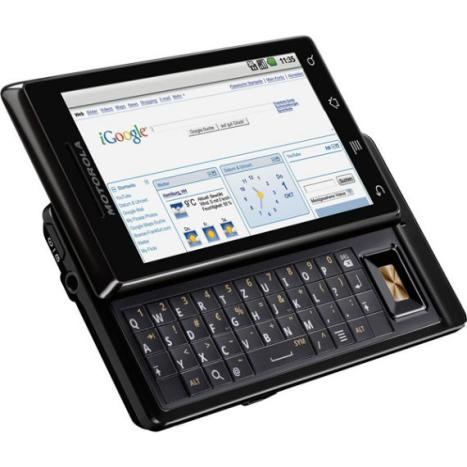
It seems that 2009 is the year of the comeback handset. Palm saw its Second Coming with the Palm Pre (review). Sony Ericsson relaunched with the Symbian-powered Satio (for what good that did them) and a new slogan. And Motorola, after years in hibernation and having completely missed the smartphone boat, unveiled its first Android-powered device, the Motorola DEXT as it’s known in Europe or CLIQ in the states.
The DEXT isn’t just any old Android handset, either. Shunning the standard out-of-the-box Google OS experience, the device introduces MotoBLUR, the handset maker’s own social networking UI layer and service. A unified address book that syncs Google, Facebook and Twitter contacts, updates pushed to the home screen, support for photo sharing via various third-party sites, with all of a user’s settings and data backed up on Motorola’s own servers.
It’s closest in its thinking to Palm’s Synergy feature, but also reminiscent of INQ, HTC’s Sense, Vodafone 360, with a bit of Nokia’s Ovi Share thrown in. In fact, as 2009 draws to a close, social networking integration is fast becoming just another tick-box requirement rather than a headline feature outright. On the other hand, no one has yet to perfect the concept, Motorola included, so there’s still plenty to play for. But before we dive into MotoBLUR, let’s take a look at the phone’s hardware.
First, a quick confession: I had no intention of reviewing the HTC Tattoo. Why? On paper at least, it’s a poor man’s HTC Hero. Yes it does feature the same HTC Sense UI, which greatly improves on the stock version of the Google-led operating system, but the Tattoo lacks some of the hardware features to match. However, following a mix up with a courier and a serendipitous email from HTC’s PR firm, a Tattoo for review was sent my way.
What I’ve come to realise in the few weeks that I’ve had the device on loan is that the HTC Tattoo, while not especially exciting in itself, points to Android’s mass-market future, and why rival platforms, along with the plethora of dumb-phone OSes, need to sit up and take notice.
What’s different and/or missing
Screen size. Gone is the Hero’s 3.2 inch screen. Instead, the Tattoo uses a smaller 2.8 inch display. It’s considerably lower resolution too. Down from 320 x 480 (HVGA) to a more feature phone-like 240 x 320 (QVGA) resolution. The most noticeable difference is that web pages and lists require more scrolling because of the reduction in vertical screen real estate. Images also look less sharp. The upside – and this shouldn’t be underestimated for some users – is that the device is smaller and more pocketable. In other words, it feels more like a phone! As a result, it’s a little more comfortable to hold too and that bit easier to operate one handed.
July 29th, 2009 | Posted in Mobile, Review | Comments Off
SugarSync is my backup to the Cloud and sync service of choice (see How I replaced Apple’s MobileMe at half the price) and today the company added Android to its range of supported mobile phones. SugarSync was previously only available on iPhone, Windows Mobile and BlackBerry.
As readers will know, I recently jumped on the Google Phone bandwagon with the purchase of a HTC Magic (also also known as the T-Mobile myTouch in the USA) and so it’s pretty good timing to see SugarSync pushed out for Android shortly thereafter, although I’m still waiting for a S60 (Nokia) compatible version.
It goes by many names. The HTC Magic on Vodafone here in the UK, Google Ion, when handed out as a freebie at the search giant’s developer conference, and the myTouch 3G on T-Mobile in the states. But, whichever way you slice it, the second Android-powered Google phone, manufactured by HTC, is an improvement over the original T-Mobile G1 in almost every way.
Where the original G1 is clunky, in part due to its death-trap of a slide-out keyboard – OK I exaggerate but only slightly – the HTC Magic is relatively slim with subtle curves and a much reduced “chin”, which is a universal complaint of the G1.
Having only had around 10 minutes hands-on time with Nokia’s new flagship mobile phone, the N97, at a recent press event in London in which my initial impressions were largely positive, I was really keen to source a loan unit for some quality time with the device. Thanks to Nokia’s PR reps in the UK, I did just that, taking delivery of an N97 on Friday. There is of course a world of difference between living with a phone for any meaningful length of time and having a quick play at a press event or trade show. And after 3 days of ‘real world’ use, I’ll offer up the first mea culpa: the keyboard isn’t nearly as good as I’d first reported (see below). Read on for a more in-depth review of the Nokia N97…
I’ve had just over a week to test out LG’s latest flagship phone – the LG Arena KM900 – a device that I first set eyes on at last month’s The Gadget Show Live. The touch screen phone has a lot going for it, but like many post-iPhone offerings, doesn’t quite live up to the promise based on technical specs alone and at times has the potential to frustrate.
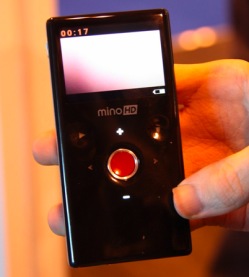
Flip’s (Pure Digital in the US) Mino HD is the follow up to the popular Mino “point and shoot” camcorder – a product category that the company practically invented – this time upgrading the video quality to High Definition or 720p MP4 to be precise. From the industrial design alone, however, you’d be hard pressed to tell the difference.
The Mino HD shares the exact casing as its standard definition relation, weighing in at just 94 grams and not much bigger than a typical candy bar cell phone. The device also features the same iconic flip out USB connector – hence the ‘Flip’ name – which makes it convenient to transfer clips shot on the Mino HD to a PC as well as providing the sole means for charging the non-removable battery.
In place of a view finder is a tiny 1.5 inch LCD screen (made smaller yet by the 4:3 aspect ratio despite the Mino HD shooting in 16:9), which, thankfully, is bright enough to be seen in the sun. Just below the screen is a large red record button surrounded by six touch sensitive controls (play/delete/up/down/left/right), and down the right hand side is the power button. On the left is a TV-out (no HDMI just composite), and on the rear is a standard tripod mount.
The Mino HD has 4GB of built-in flash memory – enough for about an hour of video – and Flip quotes the battery life as 2 hours between charging, more than enough to match the camcorder’s storage capacity.
Over the last week I’ve been playing with the INQ1, the so-called ‘Facebook phone’. Designed by the same team behind mobile carrier 3’s original “Skype Phone” (see last100’s coverage), like its predecessor, this fairly nondescript 3G candy bar slider masks plenty of innovation on the software side.
Integrated into the handset, for example, is Facebook, Skype and Windows Live Messenger, along with various widgets, such as Yahoo Weather. Just don’t call it a smartphone, says the company. Instead, the INQ1 is billed as a low cost device, designed to appeal to a broader and, perhaps, younger market than existing smartphones from the likes of Apple, RIM, Nokia and HTC.
Late yesterday afternoon I purchased one of the new Macbooks (announced on Wednesday) and in the process finally retired my trusty 12 inch Powerbook from daily blogging duties.
I’ve only really had the new machine fully set up and operational for about a day (after transferring over my user accounts/data, and installing essential apps such as Firefox, Skype etc.), and while I may get around to doing a full review, I wanted to first share my initial impressions, a few of which have surprised me.
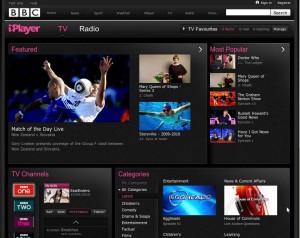
It’s no secret that I’m a huge fan of the BBC’s TV catch-up service iPlayer (UK-only), which I regularly access on my laptop, cable television set-top box, and of course my trusty iPod touch. The problem with the latter version, however, is that it offers streaming only not downloads, which doesn’t sit well for a mobile device as it prohibits off-line access such as when traveling on a plane or train or anywhere without WiFi access. It isn’t the BBC’s fault but the fact that Apple doesn’t license the iPod and iPhone’s proprietary DRM solution – so-called FairPlay – to third-parties. DRM is a necessary evil, says the public broadcaster, in order to meet its obligations to copyright holders who require that programs only be made available for up to seven days after broadcast.
In contrast, the newly released version of iPlayer for Nokia’s latest flagship handset, the N96, doesn’t suffer the same problem, offering both streaming and downloads. Earlier this afternoon I got some hands-on time with iPlayer on the Nokia N96.
It’s certainly a noble notion — and here’s to the success of the Featured Artists’ Coalition, even if it does appear to be a longshot.
Dozens of UK pop and rock stars, including Radiohead, Pink Floyd’s David Gilmour, Kate Nash, Gang of Four, and The Verve, are among the acts who have signed on to a new music-industry pressure group, the Featured Artists’ Coalition [via the BBC and others].
As the music industry continues to shuffle, kicking and screaming, into the digital age, the FAC seeks to protect the artists’ rights over their own music, in addition to having a greater say in how their songs are sold and getting a bigger slice of the profits.