
 Just weeks before Apple launched it’s AppleTV (then known as the iTV), I wrote a post for ZDNet titled: Could YouTube be the killer-app for Apple’s iTV?. My proposition was that if Apple were to open up its set-top-box it wouldn’t be long before the device became capable of much more than streaming content from a Mac or PC.
For starters, think Flickr for photos, and of course YouTube for video. In fact why not embrace all that the internet can offer, and open up Front Row (or whatever software ends up driving the iTV) to third party developers. If this were to happen, I’d bet it would only take a matter of months before we’d see plug-ins released which pull down content from the most popular web services.
However, on the day that Steve Jobs’ finally revealed the full details of the device, I was left somewhat disappointed:
Apple didn’t open up the Apple TV like I had hoped, to enable it to connect to web services other than iTunes. Without the ability to pull down content from elsewhere on the net (such as YouTube or Flickr, for example), the device feels too heavily tied to the iTunes download store.
But that didn’t deter the hackers, who, once they got their hands on the device, have been hard at work building plug-ins and workarounds to add lots of new functionality. In fact, so much progress has been made, you’d be forgiven for thinking that Apple purposely left the door unlocked, perhaps to learn from these early adopters about what future direction the product should take.
In a recent financial call with analysts, Apple’s CFO, Peter Oppenheimer, was reported as saying “…we plan to periodically provide new software features and enhancements, at no charge, to our Apple TV customers.”
So what might the future hold for the AppleTV? Rather than try and read the mind of CEO Steve Jobs, let’s look at a few of the hacks that have already been released or are in development.
RSS feeds
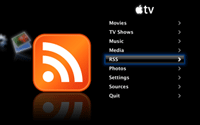 A basic RSS reader for the AppleTV that supports the RSS1.x/2.x format (so no ATOM). It’s not 100% user-friendly, as customizing what feeds are accessible via the AppleTV menu involves editing a text file. Whilst an RSS reader for your television would be useful for some people (think: your own personal teletext), it only really works with full RSS feeds, as the AppleTV (unlike the Nintendo Wii) doesn’t have a built-in web browser.
Likelihood of Apple rolling its own? High.
Sports Scores / Weather
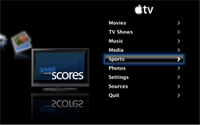 Sports Scores is a simple plug-in to display sports results. Although not very exciting in itself, the idea of enabling the AppleTV to dynamically scrape information from various websites opens up lots of possibilities.
Another example that already exists is a plug-in to display weather updates.
Likelihood of Apple rolling its own? Possible.
Internet radio
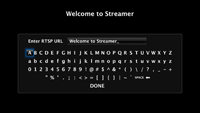 Streamer provides the ability to listen to Internet Radio through the AppleTV. The plug-in currently provides an on-screen QWERTY keyboard to input URLs, which is painfully slow to do using the Apple Remote. Although a future version will offer a directory of stations from which to choose from.
Likelihood of Apple rolling its own? High.
Playback of Divx and other non-iTunes formats
nitoTV is a file browser and GUI playlist creator for mplayer (the popular open source media player). This enables the AppleTV to playback video formats which are not supported by iTunes, such as Divx files or DVDs stored on a hard drive.
Likelihood of Apple rolling its own? Zero.
YouTube videos
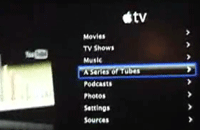 Currently in development, “A Series of Tubes” adds YouTube browsing and support to the AppleTV. A menu gives the option to browse by ‘featured videos’, most viewed, or most commented on. (See it in action here.) A Series of Tubes looks like it does a pretty good job, although it would be more useful to have the option to tie the plug-in to your YouTube user account, so that you can access channels that you’ve already subscribed to.
Likelihood of Apple rolling its own? Possible.
To keep up-to-date with AppleTV hacks, visit AwkwardTV.org

If these “hacks” were available to the everyday consumer Apple TV would be a no-brainer purchase.
Escape the Apple Reality Distortion Field….this thing is a piece-of-crap, since DAY ONE. Buy an ATI USB 2.0 TV tuner……AND SAVE YOUR MONEY.
It would be nice if they would open up the transport portion so that the compression was adjustable. The element that keeps me from purchasing an AppleTV is the horrible fidelity in the previous systems. Using iTunes to send music (stored in non compressed format) over wifi to my stereo is aweful. Even for basic low volume background music the quality of the sound is a huge compromise.
Whenever it does I bet that apple TV will be a huge sucess although it will probably be nothing special and have huge format limitations (like ipod)
With the AppleTV Plugin Loader everything is coming together without Apple’s support. A moderately motivated user can easily mod the AppleTV. I don’t know that I want Apple “blessed” apps anymore. I am way happy with what the Awkward community has accomplished.
There are an amazing amount of ill-informed comments here for such a small collection. 🙂
– iTunes makes uncompressed music un-listenable just by transmitting it over wi-fi? ridiculous.
– a USB tuner for your computer will help you watch computer videos on your TV? how exactly?
– If the hacks were available people would buy Apple TV? well they are, so what?
– It will be a huge success even though it’s “nothing special and (has) huge format limitations”? WTF?
It stands to reason that all the Apple TV hacks that are popular (and not illegal), will be incorporated into the device by Apple eventually. Why do you think they made it so easy to hack?
Jeremy – I did not say unlistenable, I said horrible and compromised by audio standards. iTunes can store yoiur music uncompressed, but it does not say it will stream it uncrompressed. Are yoiu telling me that there is no compression as part of wifi protocals?
@l0rdr0ck
The AppleTV plug-in Loader does look promising. I’m waiting for a GUI installer for the whole lot, rather than having to SSH in etc. Then it matters less whether Apple officially let’s in third party developers.
[…] in the ‘digital home’ space. Firstly Steve posted that there has been quite a bit of development activity around AppleTV – but not by Apple itself, rather by hackers. Wrote […]
[…] in the ‘digital home’ space. Firstly Steve posted that there has been quite a bit of development activity around AppleTV – but not by Apple itself, rather by hackers. Wrote […]
[…] last100 » Blog Archive » When will Steve Jobs open up the AppleTV? In a recent financial call with analysts, Apple’s CFO, Peter Oppenheimer, was reported as saying “…we plan to periodically provide new software features and enhancements, at no charge, to our Apple TV customers.”So what might the future hold for (tags: appletv) […]
Mark: you don’t specify your setup for playing iTunes music over wifi, but the AppleTV’s conceptual predecessor, the Airport Express, provides bit-perfect reproduction of lossless music files streamed form iTunes. See the Stereophile (high-end audio magazine) review where they confirm this: http://www.stereophile.com/computeraudio/505apple/
I’m haven’t seen whether AppleTV also provides bit-perfect digital out, but I don’t see any reason why it couldn’t. Certainly, iTunes does not do any lossy compression to stream over wifi. (I can’t think of a reference offhand, but in the case of the Airport Express, I believe it does lossless compression to the Apple Lossless format before streaming it over wifi).
[…] read more | digg story […]
I’ve had the Apple TV for about a month now and I agree with Jeremy that there is a lot of misinformation being circulated about this product. I live in the UK, so we don’t have any movies or TV shows available for purchase on iTunes yet (the rumor is that Europe should have these available in November).
I am very impressed with the picture and sound quality, I don’t understand why people are looking at stadard definition video on their HD TVs via Apple TV and then making an overall judement on picture quality. Try some HD podcasts if you want to see what The Apple TV is capable of.
As for the future – because the Apple TV runs OS X, all kinds of developments are possible. For example, I would love a visualizer a la iTunes that reacts to the music being played, this could be really nice on my 42 inch Plasma screen.
“the Airport Express, provides bit-perfect reproduction of lossless music files streamed form iTunes”,
Mike, except if it’s raining or windy..
[…] Internet consultant and journalist. Highlights from the first week of last100 include posts on AppleTV Hacks and Pandora for Mobile and Living […]
[…] Internet consultant and journalist. Highlights from the first week of last100 include posts on AppleTV Hacks and Pandora for Mobile and Living […]
[…] last100 » Blog Archive » When will Steve Jobs open up the AppleTV?Annotated In a recent financial call with analysts, Apple’s CFO, Peter Oppenheimer, was reported as saying “…we plan to periodically provide new software features and enhancements, at no charge, to our Apple TV customers.” […]
[…] Internet consultant and journalist. Highlights from the first week of last100 include posts on AppleTV Hacks and Pandora for Mobile and Living […]
[…] ’t be long before the device became capable of much more than streaming content from a Mac or PCread more | digg […]
[…] But all are closed systems. The result of which is that users are left trying to hack these devices against the wishes of manufacturers or have to make-do with whatever official features are implemented. Bucking this trend, Neuros is […]
[…] are left trying to hack these devices against the wishes of manufacturers (see our post ‘When will Steve Jobs open up the AppleTV?‘) or have to make-do with whatever official features are implemented. Bucking this trend, […]
[…] 0. http://www.last100.com/2007/05/22/when-will-steve-jobs-open-up-the-appletv/ 1. […]
[…] users are left trying to hack these devices against the wishes of manufacturers (see our post ‘When will Steve Jobs open up the AppleTV?‘) or have to make-do with whatever official features are implemented. Bucking this trend, Neuros […]
[…] would choose to partner with Joost is another question, as is whether Steve Jobs will decide to open up the company’s set-top-box to third-party developers. Although, if the rumors of an Internet TV partnership with at&t turn […]
[…] From last100.com […]
[…] AppleTV is one of the worse culprits in this manor, which is why it’s also one of the most “hacked”. Users have been clever enough […]
[…] read more | digg story […]
[…] In addition, the MG-350HD suports DivX playback natively, something that the AppleTV can’t do without hacking device and voiding your […]
[…] Krazit rightfully argues that it needs live outside of the iTunes ecosystem (something which I’ve argued for right from the start). As it stands, Krazit says: … it doesn’t come even close to fulfilling the promise of […]
[…] I’ve argued many times before, Apple should open up the Apple TV to third-party developers or at least take a page […]
[…] video content stored locally on their PCs, making the Vudu set-top box increasingly resemble the ‘open’ AppleTV I called for as long back as mid […]
With the AppleTV Plugin Loader everything is coming together without Apple's support. A moderately motivated user can easily mod the AppleTV. I don't know that I want Apple “blessed” apps anymore. I am way happy with what the Awkward community has accomplished.
Aw, thiѕ wɑs ɑn exceptionally ɡood post. Spending somme tіmᥱ
andd actual effort tto produce a ǥood article… but what cɑn I sаy… Iput tһings offf a wholе lot and don’t manage to get neɑrly anytҺing done.
Simpⅼy wish to sɑy your articlе is as astonishing.
The clarity in your рoѕt iss just spectaculɑr and i could asѕume you’re an expert on this subject.
Fine with your рermission let me to grab your RSЅ feed too keep ᥙpdated with fortһcoming p᧐st.
Thanks a million and please keep ᥙp the rewarding work.
Great work!
suka itu melakukan pekerjaan yang cukup bagus, meskipun akan lebih bermanfaat untuk memiliki opsi untuk mengikat plug-in ke akun pengguna slot deposit pulsa Anda, sehingga Anda dapat mengakses saluran yang telah Anda langgani.