
 The mobile Web is dead! The mobile Web is dead! The mobile Web is dead!
Or says Chicken Little, aka Russell Beattie, the founder of Mowser, a Menlo Park, Calif., startup focused on mobile Web browsing. Beattie delivered the news Monday that Mowser “is at the end of its life in its current form.”
For that, I am truly sorry. Beattie, who has invested everything he has in Mowser for the past year, is a gutsy entrepreneur who knows a little something about mobile. From November 2004 to September 2006, Beattie worked at Yahoo! creating mobile products and content.
Beattie left to launch Mowser, a Web site focused on content adaption for mobile phones. You can read about his experiences on his blog, but what it all comes down to after a year of intense work is that “I don’t actually believe in the ‘Mobile Web’ anymore” and the market “is limited at best, and dying at worst.”
Beattie got caught up in the mobile hype of the past few years, hype he no doubt contributed to creating. As he notes, the argument for mobile went something like this: three billion phones in operation, when they get on the Internet, their numbers will vastly outweigh PCs and the market will tilt toward mobile.
“The problem is that these billions of users *haven’t* gotten on the Internet,” he wrote.
Of course they haven’t. Those three billion phones were mostly crap for mobile Web browsing, especially in the United States, which sports a vastly different mobile mentality than, say, South Korea or the rest of the world.
 When so-called smart phones came along (think devices using the Microsoft Windows Mobile operating system or Research in Motion BlackBerry products), mobile Web browsing was supposed to drastically improve and the market would skyrocket. Never mind the fact that the experience, overall, was still crap, the devices were more enterprise than consumer, and they cost a boatload of money.
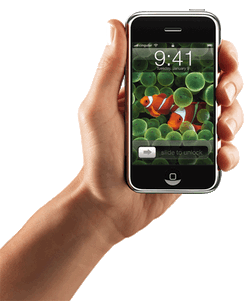
Of course, the iPhone came along last June — talk about bad timing for Mowser — and everything changed. The future isn’t in companies and initiatives like Mowser any more. It’s in the iPhone SDK, the devices being made by Nokia, and in the promise of Android, Google’s open-source mobile operating system. It’s in the new networks that the carriers, especially in the U.S., are beginning to build.
Whether Apple, Nokia, the G-phone manufacturers, and the carriers deliver, well that remains to be seen. One thing is for sure, though: The mobile Web is not dead. It’s just starting.
Beattie, and those who have eulogized the eventual passing of Mowser, note in passing — like it’s an after thought — that the mobile Web won’t happen until there are “better devices” and “full browsers.”
 No kidding. The technology is just getting here that will make mobile Web browsing actually feasible — larger, crisper screens; faster processors; improved memory; a mix of connectivity; the right size; faster and more reliable data networks, and so on.
Next up are better user interfaces (like “full” browsers) and applications that are actually worth using — ones that can access our information no matter where it resides (the desktop or the Web). In the labs are networks that we, as cell phone users, can’t even begin to fathom — ad hoc social networks, location-based mobile services, proximity and awareness, and so on.
No, the mobile Web isn’t dead. It’s just starting.

Wow – one guy decides that startup life isn’t for him and this is supposed to throw a whole shadow over the industry…..hmmm I don’t think so.
I like Russell, I’ve been a long time reader of his blog and an occasional user of his Mowser application.
I think the key point here is that….”Mowser was filling a temporary problem”, with the release of the iPhone and the imminent massive model variants of the Android OS on the Horizon and the sure but steady improvements in the Windows Mobile 6 OS I think Russell is throwing in the towel as handsets are getting “good enough to no longer need Mowser”.
Now do I think he threw it in too early with only 12 months operation – sure but thats because I’m a serial startup entrepreneur with 2 listed companies under my belt.
As an employee of http://www.Amethon.com one of the worlds first mobile browser specific analytics applications I for one am seeing huge growth in mobile content.
Amethon’s clients are seeing traffic build month on month, and yes I think a lot of that has to do with better quality handsets and better quality browsers and most importantly higher data speeds with somewhat more reasonable flat rate unlimited data plans.
With a better user experience more people are finding the convenience of accessing content on the move …..or standing still but getting it right where they are standing with a mobile device never far from their hand ….
The best part about this mobile content is the volume of advertising coming into the space is funding a better user experience, and with tools like Amethon Mobile Analytics users analytics information and a solid roi can be demonstrated against this advertising spend.
Am I sad to see Mowser go, yes – Will Russell bounce, for sure – one of the smartest pioneers in the mobile business, Do I think USA consumers are a little behind eastern consumer patterns in mobile content consumption – YES but that has more to do with carriers and handsets than personal desires and usage patterns.
The mobile space is just taking off, with all the fallouts and successes that there was in the desktop browser wars in the 1990’s.
Watch this space and get in early……your customers are waiting.
Regards,
Dean Collins
http://www.Amethon.com
Personally, I don’t want or need my mobile to be “better” or my browser to be “full”. I love my Panasonic VS2 phone, its bundled browser, and long screen with easy to use haptic buttons. I read text and images quite easily on this device as long as the information is not clouded by heavy headers and sidebar information. Google Reader Mobile, also does a pretty superb job of parsing this information so it’s easier for me to rifle through stories on a smaller device. I use it a *lot*. I also use mobile Twitter and Google Calendar SMS a *lot*.
No one seems to have brought up the discussion about our behavioral use: Desktop computers have dictated how we consume digital information not just on the desktop screen, but on other devices as well. I don’t think we should be forcing our desktop behaviors into the phone. If anything we should be forcing our mobile behaviors onto our desktops!