Author Archive

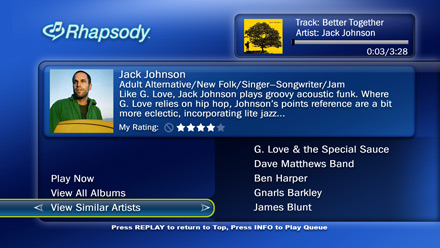
Rhapsody music service comes to TiVo

Rhaposody music service comes to TiVoTiVo continues to add web services to its line of broadband-connected DVRs, with today’s announcement that the Rhapsody music service can now be accessed through the company’s set-top-box.

From The Associated Press:

The new feature announced Tuesday means TiVo subscribers with broadband-connected set-top boxes will be able to listen to music streamed over the Internet from Rhapsody’s service. The service, now part of Rhapsody America, a new joint venture between RealNetworks Inc. and Viacom Inc.’s MTV Networks, has a catalog of more than 4 million songs.

In an attempt to distinguish TiVo from more generic DVR offerings, the addition of Rhapsody joins other integrated web services including Amazon’s television and movie download service, UnBox; Yahoo! Photos, Weather, and Traffic; movie booking service, Fandango; and the Internet radio network, Live365.

Rhapsody on TiVo

(via Zatz Not Funny)

Vuze opens up platform; claims 10 million "viewers"

Azureus announced today that it has opened up its online video distribution platform, Vuze (see our earlier review), offering content producers, big and small, the chance to distribute and monetize their content in a variety of ways including ad-supported streaming and download-to-own. The company also revealed that it has reached the milestone of 10 million unique downloads for its Mac and Windows-based client, with the company adding 2 million new “viewers” in September alone.

Dubbed the Vuze Open Entertainment Platform, content creators can mix and match from a variety of business models: free or ad-supported streaming and downloads, as well as paid-for rental and download-to-own. Additionally, producers can decide whether or not to employ Windows Media DRM, and Vuze soon hopes to be able to offer watermarking as an alternative.

In a phone briefing, Azureus CEO Gilles BianRosa told me that since we’re in the very early days of online video, the Vuze platform is designed to help content creators experiment with digital distribution and the various associated business models. For example, a producer might choose to offer a lower quality version of their program as a free download and charge for the HD-version.

Vuze’s PC-to-TV strategy

I asked BianRosa if, like a number of its competitors, the company had any plans to offer its service via a set-top-box, in order to make it easier to get Vuze content onto a television. BianRosa explained that there a number of reasons why doing so was not currently a priority.

Continue reading »

Weekly wrapup, 1 – 5 October 2007

Here’s a summary of the week’s digital lifestyle action on last100. Note that you can subscribe to the weekly wrapups, either via the special weekly wrapup RSS feed or by email.

Enter your email address:

Top digital lifestyle news

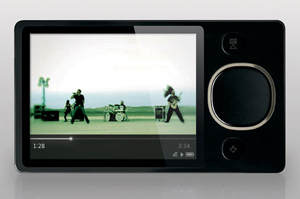
The major digital lifestyle news this week on last100 was Microsoft’s announcement of second generation Zunes, the company’s line of digital audio players. New flash-based models were introduced, along with a beefed up 80GB hard drive-based version. The company also announced that its online music store, Marketplace, will offer 1 million DRM-free songs for purchase, and that the company is launching a music-based social networking site called “Zune Social”. In a follow up post titled ‘Zune 2: five things Microsoft got right’, last100 editor Steve O’Hear wote: “while the new Zune lineup is at best evolutionary rather than revolutionary, especially when compared to the User Interface innovations found in Apple’s iPhone and iPod Touch, Microsoft has made some significant improvements — and, dare I say it, done a few things from which even Apple might learn a thing or two.”

Continue reading »

Why have media extenders failed to take off?

Why have media extenders failed to tke off?“PC-to-TV”-type devices, often referred to as media extenders, have been around for a number of years, and yet have failed to reach anything like mass adoption. The reason, argues Tim Lee over at TechDirt, is that unlike the “open” MP3 format, which in the early 90s acted as the catylst for a burgeoning digital audio player market, there hasn’t been an equivalent standard for streaming content from a PC to the television.

I think the big difference is that the lack of DRM on CDs allowed the industry to standardize on the open MP3 format, despite the music industry’s best efforts to shut down the makers of the first MP3 players. Once the courts confirmed that CD ripping was legal, it created a thriving ecosystem of software and hardware around the MP3 format, and it made it easier for startup firms like iRiver to jump into the market quickly and produce innovative new products. On the other hand, because DVDs are encumbered with DRM, firms wanting to make digital video devices have to kowtow to Hollywood to get permission to make devices that can play their content—even if the user has already paid for it. Getting Hollywood’s permission requires the sort of endless negotiation and bureaucracy that is fatal to a high-tech startup.

Lee then gives the example of the original XBox “games console”, which has been hacked beyond all recognition to bypass the limits Microsoft placed on the device’s original media extender capabilities, so that it supports almost any video and audio format.

While I don’t quite follow Lee’s first example, since lots of software exists for ripping a DVD to a user’s computer (although such functionality is notably missing from iTunes), it’s certainly true that DRM and the need to pander to Hollywood has held back the adoption of video downloads, and therefore media extenders. And, perhaps as a result, too many hardware offerings are “closed” in the sense that users are stuck with the audio and video formats, and Internet services, which are supported “right out of the box”.

Continue reading »

Zune 2: five things Microsoft did right

Zune 2: five things Microsoft did rightThe unveiling of Microsoft’s generation 2 Zunes has largely been met with a lukewarm reception from analysts and pundits alike. And while it’s true that the new Zune lineup is at best evolutionary rather than revolutionary, especially when compared to the User Interface innovations found in Apple’s iPhone and iPod Touch, Microsoft has made some significant improvements — and, dare I say it, done a few things from which even Apple might learn a thing or two.

Continue reading »

First look: Adobe Media Player disappoints

First look: Adobe Media Player dissapointsEarlier this week Adobe made available for download a Beta version of its new desktop video player based on the company’s Adobe Integrated Runtime (AIR), a cross-platform technology designed to bring web-based applications to the desktop.

Adobe Media Player menu optionsThe Adobe Media Player combines a channel guide, streaming video player and video podcast client into a single desktop application, which, since it’s built on top of the AIR platform, runs on both a Mac or PC.

For publishers, of which CBS, PBS, Yahoo! Video, Blip.tv and others have already signed on, Adobe is offering “sophisticated” measurement tools, monetization through targeted advertising, as well as customized branding and copy protection.

After taking the application for a spin, here are my initial thoughts…

Continue reading »

New Zunes to be announced tomorrow?

New Zunes to be announced tomorrow?BetaNews reports that Microsoft is to hold a special event in Redmond tomorrow, in which Bill Gates and Design and Development chief J Allard will announce a major update to the company’s line of portable media players.

Dubbed the Zune 2, one new model is reported to be flash-based and “will measure 3-inches by 1.25-inches” and look “much like the iPod nano”.

“The smaller Zunes will be video capable, and are rumored to include Wi-Fi and higher storage than competing products”, according to BetaNews.

Updated Hard drive-based models are also expected, which will look much the same as the current range, except for offering greater storage and being slightly slimmer.

In our recent analysis of Microsoft’s Zune platform (‘Is the Zune doomed?‘), Mack D. Male wrote that a major weakness, compared with Apple’s iPod, was the existence of only a single model, but also noted that there are still gaps in the market that the Zune could exploit, such as the need for high-capacity hard drive-based model with a large widescreen display suited to video. In comparison, Apple’s widescreen iPod, the Touch, is flash-based and offers a measly 16GB of storage.

Perhaps we’ll see such a model unveiled tomorrow?

Joost on a set-top-box within 18 months

Joost on a set-top-box within 18 monthsEarlier today I asked the question: how long before we see Internet TV service, Joost, running on some kind of a set-top-box? Within “the next 18 months”, answers CEO Mike Volpi, during a video interview conducted by Liz Gannes over at NewTeeVee*, to coincide with Joost’s full public launch.

Volpi explains that Joost’s current user base is made up of a younger “early adopter” demographic who are comfortable with viewing content from the Internet TV service on a PC or Mac, as they already do when “popping in a DVD” or browsing sites like YouTube. However, for Joost to go mainstream, the service will need to run on other platforms.

Continue reading »

Internet TV's future: PC or set-top-box?

Internet TV's future: PC or set-top-box?Two seemingly unrelated announcements last week have got me thinking about whether the future of “full screen” Internet TV applications, such as Joost or Babelgum, reside on a PC or, instead, some sort of set-top-box which connects to a TV.

Microsoft launched a Beta version of its new MSN Video-based “Internet TV” service, compatible with “Extenders for Media Center” devices from Cisco, D-Link, and HP; and Jaman published a software hack — albeit, unsupported — to enable content from its movie download store to work with the AppleTV.

Other online video services to have already aligned with hardware manufacturers include BitTorrent, which released an SDK for set-top boxes, Network-Attached Storage (NAS) devices, and media extenders; Google-owned YouTube with their strong partnership with Apple; and DivX who are busy shopping around their “Connected” media extender hardware reference design to Asian consumer electronics companies.

What all of the above companies are betting, to varying degrees, is that for all the social and interactive advantages of online video, certain kinds of content, particularly long form programing, still wants to be viewed from the couch on a large widescreen TV.

Continue reading »

Weekly wrapup, 24 – 28 September 2007

Here’s a summary of the week’s digital lifestyle action on last100. Note that you can subscribe to the weekly wrapups, either via the special weekly wrapup RSS feed or by email.

Enter your email address:

Top digital lifestyle news

The biggest news this week was Amazon’s entry into the digital music download space. Amazon MP3 finally launched, offering DRM-free downloads with a catalog of over 2 million tracks. Can it compete with iTunes? See our full review.

The other major announcement of the week came from the DigitalLife trade show held in New York, where Microsoft made a number of Windows Media Center-related announcements: New media extenders from its hardware partners Cisco, D-Link, Niveus and HP, along with the Beta launch of a new Internet TV service called — wait for it — “Internet TV”.

Continue reading »