
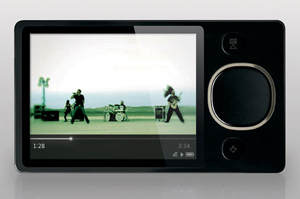
 The unveiling of Microsoft’s generation 2 Zunes has largely been met with a lukewarm reception from analysts and pundits alike. And while it’s true that the new Zune lineup is at best evolutionary rather than revolutionary, especially when compared to the User Interface innovations found in Apple’s iPhone and iPod Touch, Microsoft has made some significant improvements — and, dare I say it, done a few things from which even Apple might learn a thing or two.
1. WiFi music syncing.
The original Zune’s WiFi functionality was seriously underutilized, with the biggest omission being wireless music library syncing. Zune 2 devices can automatically sync over a wireless network any time the device is placed in its dock or plugged in to charge. In comparison, Apple’s iPod Touch, despite featuring WiFi, can’t sync wirelessly with iTunes.
2. Support for audio and video podcasts
OK, podcast support is something which iPod/iTunes has had for years, so in this regard Microsoft is definitely playing catchup. Having said that, it’s still great to see the Zune Marketplace offering links to thousands of free audio and video podcasts — both amateur and professional — as well as the Zune software adding support for podcast subscriptions and the codecs required for native playback (e.g. H.264).
3. Windows Media Center TV recordings support
Having written before about Microsoft’s wider Internet TV strategy and the company’s ambitious plans for Windows Media Center, we’re not surprised to see better integration between the Zune and Windows Media Center. The Zune software can now automatically import television recordings made through Media Center for Windows Vista Home Premium or Ultimate editions, so that those recordings can be transfered to and synced with a Zune.
4. Social networking
The Zune’s tag line has always been “welcome to the social”, and now Microsoft is to roll out its own social networking site for Zune owners, called “Zune Social”. On the site Zune users will be able to create a customizable “Zune Card” that automatically updates to reflect the music they are listening to on their Zune or with Zune software on their computer.
From the release: The Zune Card shows most recently played tracks and highlights that person’s all-time music favorites. Other members of Zune Social can play samples of the songs a user has been playing directly from a friend’s Zune Card or link to Zune Marketplace, where they can buy or download the music.
“Zune Social” will also offer standard social networking features such as profiles, messaging, friend lists, and so on. Eventually, a widget will be available so that “Zune Social” users can display their “Zune Card” on other social social networking sites e.g. MySpace or Facebook.
Dedicated music-based social networks such as Last.fm and iLike already plug into the iPod/iTunes ecosystem, and it might be better if the Zune software integrated with existing sites rather than Microsoft rolling one of their own. Having said that, others have called for Apple to add better social features to iTunes.
5. Backward-compatible firmware update
Microsoft co-founder and CEO, Bill Gates, has openly called the original Zune “just so-so on the software side”, and the company is putting its money where its mouth is. In a free firmware update, version 1 Zunes will get all of the new features offered by the second generation devices (all of the software-related ones anyway). As Gizmodo says, this is how you should treat your existing customers.
More work to do
There are of course still a number of things about the Zune which are disappointing or damn right baffling. Number one on my list is the Zune’s approach to DRM and wireless sharing. Tracks that are shared over WiFi, Zune to Zune, can only be played three times (though they no longer expire after three days), regardless of whether they were bought from the Zune Marketplace or not, presumably at the request of the major record companies. However, this restriction also applies to podcasts that are shared wirelessly, since the software has no way of distinguishing between DRM-free music and podcasts.
I also think that Microsoft missed a trick by not releasing a hard drive-based Zune with a slightly larger widscreen display. As Mack. D. Male noted earlier on last100, such a device would fill a void currently left by Apple.

But it’s still not as good as an iPod…
WiFi syncing when it is plugged into an adapter or dock? What?
Support of Podcasts? Mean the podcast I have going to my iPod video aren’t real?
Firmware that makes the previous version of the Zune not suck so much?
These are things they should have done at the BEGINNING!
Question, were you PAID for this “review” by Microsoft?
Can’t wait for the web browser edition…if it’s built on Windows Mobile, it’s only a matter of time!
Yay! Wireless Syncing, now I can be disappointed when I put stuff on it and the battery dies because:
a) I didn’t charge it when I was syncing
b) Using wireless uses even more battery
Awesome.
Eric, you are a retard for starters.
Yes, the Zune can sync wirelessly and will do so any time power is provided to the unit (dock, charger, etc.) It can also sync wirelessly when you tell it to… Can your iPod/iPhone do that… NO!
When was the last time Apple gave something free to its last generation iPod users? The 6th gen “iPod Classic” doesn’t sport any new hardware (except the larger HDD), yet the 5th gen and the 5.5 don’t get any of the new features…
While we’re on the topic, I’d like to commend MS for releasing an 80GB mp3 player that supports more codecs than Apple’s iPod for $100 less than the iPod (and with a larger screen too!)
You’d probably see all this if Job’s splooge wasn’t in your eyes.
“Question, were you PAID for this “review” by Microsoft?”
I sense an apple fanboy.
The wifi synching just means that whenever it is left to charge (plugged into a wall or perhaps sitting and waiting in the car while the zune is docked in the car), the zune can sync up. It’s a good feature.
As for Microsoft having to get it right from the beginning, Apple didn’t get everything right from the beginning either. The iPod used to be only for the Mac, remember? That was a mistake which they later fixed.
Gizmodo consists mostly of iPhone fanboys (hence why they call it the Jesus Phone). The fact that they actually liked the Zune says something.
I ride the NYC subways everyday, and I can say that I don;t think I have ever seen someone listening to a Zune. There are always about a dozen or so folks bobbing their heads with white ear buds. The Zune 2 is priced the same as the iPod for just about the same features so I can’t for the life of me think that anyone would consider buying this POS. It is obvious from the market share that very few people care about the WiFi features – you have to dock both to get a battery charge – there is your sync.
Brad, because you don’t see them they must not be good devices right?
You’re such a fucking sheep its almost funny….Almost
Lets face it reason #6 is the new Zunes look much better than the classic and fatty iPods…
http://www.macproguide.com/zune_dell.jpg
To those talking about the syncing – you can sync anywhere with a wireless connection, you just have to intialize it manually. If you plug it in/put it on a dock anywhere (i.e. not using the battery), it will sync automatically.
Good job missing the point completely Brad; the Zune 2 hasnt been out as long so why would people all over have them already? It was already stated once but Ill restate it; the zune 2 can be synced without docking it, you can manually engage the sync or sync while plugged into power. It amazes me how you can read the article and still not figure out what its saying; grow up and learn some comprehension.
You are so foolish:
1) Wifi syncing when plugged in or docked – Research more and realize you have the option to
sync without being plugged in if you choose.
2) “Support if podcasts?” This article is called “five things MS did right”, not why the Zune is better than the iPod – stop being so defensive.
3) “Firmware that makes the previous version…” I am sure there a millions of iPod users that WISH jobs would release firmware upgrades to that of the most current models, but he does not so you lose.
As for you Joel –
” Yay! Wireless Syncing, now I can be disappointed when I put stuff on it and the battery dies”
It sounds to me like someone is justifying the lack of a feature on their unit. If you need a battery charge and to sync, you can do so at the same time, but if you choose only to sync no need for cables.
You mac guys LOVE cables and old firmware.
The main reason the ipod will never die is because people are lazy/stupid. They just want to plug in their toy and have it do everything for them. I think the world might end if you actually had to hit “sync” or if some minor inconvenience popped up like it took more than .2 milliseconds for your music to transfer. Not to mention that Apple started the pricing crap by taking in 200% profit, way to go Apple, way to screw over your customers. I’m glad morons pay so much for them and get nothing but an ugly ass white music player. I’ve never owned an Apple, and never will. I’m glad MS came out with something for the rest of us that don’t want to all look the same.
I LOVE MY IPOD AND NOTHING ELSE WILL EVER FILL THE VOID FOR ME. IT IS BY FAR THE BEST WITH ITS SMALLER SCREEN AND FATTER EXTERIOR. I LOVE IT EVEN THOUGH IT HAS FAR LESS FEATURES THAN THE ZUNE AND HALF THE OTHER MP3 PLAYERS ON THE MARKET.
WHAT I REALLY LOVE IS MY 300 IPHONE THAT HAS LESS THAN 10 GIGS OF MEMORY! I KNOW I COULD HAVE JUST BOUGHT A POCKET PC AND A HUGE SD CARD THAT WOULD DO EVERYTHING THE ITOUCH DOES AND MORE FOR LESS MONEY, BUT ITS NOT APPLE, SO I HATE IT.
I definitely like where this thing is going as it has immense possibilities.
To say that nobody on the Subway is using them is a great nod to the other device manufacturers as they have a stranglehold on the market; in a sense the same stranglehold that is on the Desktop PC market.
A good way for the Mac FanFag’s to understand it is, the Mac computer is slowly growing in populartity the same way the Zune is growing in popularity; one difference is the Zune has been around for a year or two while the Mac OS has been around about 20 years or so.
To top that off the OS is written off of the Open Source KDE kernel, modified and closed off (how fucking cheap is that). Now the iPod has a very critical flaw in its’ functionality that anyone outside of the FanFag world knows about…..the impossibility of syncing an iPod with nothing but iTunes software (which eats more memory than the Ebola Virus!!!).
If I can drop music on the Zune via drive letters than it’s a damn wonderful world and I have no reason to even contemplate an iPod.
What a bunch of loser Windoesn’t fan boys here. You are all obviously missing the point. Microsoft is way too late to the game – this corner is Apple’s.
Go ahead and bash truthful points with childish profanity and just lose all cred.
Brad was Right – you are missing the point – we are not iSheep willing to buy everything Steev Jobs throws our way. Instead we will buy what we want, when we want – unlike you though, we will not have to buy the newest version to be able to take advantage of all the newest features.
BTW – I do own a Zune and an Archos 605, I am not a fanboy, just an educated consumer.
Tom: “I’ve never owned an Apple, and never will.”
Great, now we know you’re an authority on the subject! We should all turn to you for an unbiased opinion regarding PMPs!
“I’m glad MS came out with something for the rest of us that don’t want to all look the same.”
In the mean time you continue to use MS Windows, just like the other 90+% of PC using sheep out there. You can criticize Apple/Mac/iPod fanboys any way you like, but as an MS lover, one thing you can’t criticize them for is being a “sheep”.
Why do people compare products to Apple’s i-pod lineup? Quite frankly, the majority of their products. . . well. . . suck. I could write ten pages on the flaws of itunes alone.
I can name about 5-6 different products which are far superior to Apple’s. They cost less, have a much better interface, and have a ton more features. While Microsoft and Apple openly engage in a pissing match between themselves, there are a bunch of companies who are quietly moving beyond what they’re currently offering.
Here’s a hint – Cowon.
Apple is so closed minded that it even turned its customers to think the same way. It’s like a cult. They seem to troll the web to bash anything that competes with Apple. Stop being such a tool and pay attention to what’s really important here. This media player competition will only benefit the consumers. Buy the player you feel is best fit for your lifestyle and stop criticizing others for their choice of PMP. At any rate, kudos to MS for including the 1st gen Zune adopters as part of their next release. This should wake up other major competitors to follow suit. I’m curious as to how the new Zune will feel in hand, as it is already an attractive buy on paper.
@ Apple Lover X
Obviously, apple lovers want the others to know how awesome caps lock is…because we must not have known based on Apple Lover X’s remark.
I’ve owned the 1st gen iPod and the 1st gen video iPod. I’ve also owned a Toshiba Gigabeat. That said and knowing the capabilities of the Zune 2, I know what my next option will be. Personally, I’m not a big fan of iTunes either and would much rather use a subscription based service like Napster for music.
The Zune 2 gets a thumbs up from me.
Being a user and administrator of both, I don’t have this retarded bias of PC sucks or Mac sucks, they both have their ups and downs, and the whole Microsoft sucks thing is weak also, people need to get over theirselves and get away from the fanboy tendancies.
The Zune 2 is a quality piece of hardware, period.
Hey, I bet the Zune 2 at least won’t catch you on fire like an iPod.
http://www.wsbtv.com/news/14271878/detail.html
“Hey I’m a Mac fan boy and everything I say bad about Microsoft becomes true, because I own a Mac, therefore, I know how to use a computer and know everything about electronics”
Sadly, that statement is not true ladies and gentlemen. Apple has become rich playing off the fact that most of the consumer market are idiots about technology. So they make products that are aesthetically pleasing and have no room for customization what so ever. Last time I checked adults don’t play with Fisher-Price toys, so why would someone who knows a thing or two about technology want to use a device using Fisher-Price’s new OS?
I actually think that the Zune is made for people who don’t conform to standard and like to tweak or customize their products. One example is the fact that you can change the background on the zune and you cant do that on the iPod. I own both an iPod Video and a Zune and i by far like my zune much more just for the plain fact that it has many more features and its much more customizable then the iPod. oh and also you can take music off the Zune and you cant do that for some wierd reason or the iPod is also disappointing.
But the choice always has been and always will be yours. if you like things to be more automated then you go with the iPod but if you like to mess customize your product to what you want it to be and not get penalized for it like in case of the iPhone you get the Zune.
My only problem with the Zune 2 is that its not compatible with a Mac…I guess thats understandable, but they are kind of forcing the Mac users to just buy a iPod. I would think they would want to compete a little more.
interesting link proving my point
http://diveintomark.org/archives/2007/10/04/if-wishes-were-iphones?retitled
about time we seriously consider a zune … eh ?
Hey Eric….your a giant douche
think the zune 2 looks great… i just got a question… can i use a default media player like WMP on windows to sync it? or do i have to install their Marketplace application to sync it. if that’s the case isn’t it as inconvenient as the ipod.
i own a nano 1st gen. by far the nicest looking nano ever. but im pissed with itunes. doing software dev myself, i cannot understand why itunes such a sucky piece of software. like seriously… and a > 40MB download??!? like seriously… i could use like iTunes 5 for the functionality i need. why force me run such a shit piece of sluggish software. i’m annoyed. i used the trial version of MGTEK’s dopisp or something to sync it with WMP… better experience.
and i hate you shallow apple fan boys. it’s like talking to a 3yr old kid or you stubborn little wife. grrr!
I know most people wouldn’t believe it, but i’ve been waiting for years for a player large enough to hold my collection.
The Apple Classic (160gb) just met that criteria. Unfortunately, the new UI does not appeal to me, and i’m left still without a music player.
The Zune 2 really impressed me, and I’d buy one in a second, if they had a 160gb (i’d even be willing to settle for a 120gb).
/sigh
Lets hope they release a Zune 2.1 with a larger HD (and a larger screen :))
“As for Microsoft having to get it right from the beginning, Apple didn’t get everything right from the beginning either. The iPod used to be only for the Mac, remember? That was a mistake which they later fixed.”
Actually, the Mac-only iPod was a conscious decision by Apple for two reasons. First off, it allowed far greater control over the hardware to software link. It allowed them to fully control the experience and ensure there were no gaps for the end user before expanding the operating system requirements. Secondly, this was a selling point for the entire iTunes Music Store (as it was known back then). Record companies were uneasy about the concept of digital music and allowing it to be downloaded through an online store. With the iPod and iTunes Music Store only being available on Mac computers for the foreseeable future at this time, many of the decisions to take part in the store by labels were based on the fact that were any problems to arise, or at worst, the entire digital music platform fail head over heels, the tainted pool would be entirely Macintosh-based, which was at the time some 3% of the entire computing industry. It was a success, of course, and pioneered the way digital music is accessed today. The decision to move the iTunes Music Store to PC and allow PC compatibility was not a light hearted one. It would need to be fully backed by the labels and Apple would need to ensure a seamless experience; something they did, and something the labels did do because they realised this was a potentially very profitable source for them.
Just thought I’d point that out! Kind of concerned me that people think the iPod was made for Mac only originally as some kind of mistake or laziness. There was a true meaning behind it.
Last time I checked you can’t use regular Microsoft DRM (Digital rights management) products on the Zune. This was about 6 months ago. I find that very frusturating. Microsoft not allowing you to use Microsoft protected products on the Zune.
I am now wondering if you buy a Zune if you have to purchase all your digital rights managed products through them.
If so, it seems like Apple and Microsoft are doing the same crap, forcing you to use buy music from them so they can corner the market. I much prefer the open approach where others can compete.
There are so many MP3 players out there I have 2 iPods the mini and the Nano. I got them both as gifts. They do look nice.
I think though next time when I buy one for myself I am going to look around at other manufacturers that users open standards rather than proprietary crap that puts me in a box so i have no choice but to buy their stuff.
Screw the fanboys on either side of this topic. I use a mac. All I want is a solid way to use my zune with my apple. I don’t care what the apple zealots say, the zune is a nice device, and it just got better. (PS – Just because I use an apple product does not mean I’m stupid, only buy apple products, or have the inability to USE anything else.) Some of us bought apple computers because they are pretty. Doesn’t mean I don’t know Windows, or linux.
As far as this discussion goes, the apple tards (first post and Apple Lover X — which I think are both actually trolling this comment section) are ignorant sheep who only help exact the rage of those who don’t use apple projects. Apple is a company, not a religion. Do you worship Toyota or Ford? I hope not… get a life.
Microsoft has a great product here. I’m thinking about buying one for the hell of it.
I have an ipod…. two actually. And my friend boasts about his iphone every day. It is awesome to play with, but would i use it, or happily use my ipod as a music player everyday? No. I have my first ipod from a gift a few years ago, and at the time it was great. I got my new one(30g video) a year ago, but not because i wanted it, only because it was compatible with my current audio system in my car. Now that i have it I can’t stand it… it is slow as hell. Every time a song changes it takes about 7-8 seconds to start playing a new song. Not only that most of the songs in my library freeze the ipod every time they come on. It is not a certain few, its a majority. Maybe i just got unlucky with my ipod but I know I will be buying a zune next. Not only (from my experience, not that I have owned one) do they have superior performance, but the features seem to be much greater…. Will apple offer me the kind of support that allows me to have the next gen. features on my old product? The answer to that is no, because my current ipod still freezes on more than half the songs i play.
Criticize me all you want on grammar and spelling… i am really not very sober at the moment of writing this. The point remains the same, my new device will be the zune and not apple because apple fails to support their product like the zune appears to due.
Pat, valid point – my 80 Gig video takes a second or two to change songs, but 4-5 seconds for a video. Though I think this has more to do with the fact that I’ve copied and deleted lots of stuff from the hard drive in it and it’s due in for a format, which I haven’t done in close to a year (ever in its life actually).
I don’t think you will find a car audio system that will integrate well with a Zune for some time, or ever. I have a 7″ Pioneer system that has beautiful on-screen interface and exceptional audio quality with any ‘dockable’ iPod.
“When was the last time Apple gave something free to its last generation iPod users? The 6th gen “iPod Classic” doesn’t sport any new hardware (except the larger HDD), yet the 5th gen and the 5.5 don’t get any of the new features…”
Apple updated all of their older iPods with AAC, Audible, and Apple Lossless support when they introduced those new features for new iPods.
Last year when Apple introduced the 5.5G iPods, the new features that were added from the original iPod with Video were:
1. Improved battery life for video (hardware and software improvements)
2. Support for better resolution video when using video out
3. Support for games
4. Scrolling through the song list put a letter overlay
5. Searching the song list by typing the name
6. Adjustable brightness control
All of those features were added to the original iPod with video except for the hardware improvments in battery life (obviously) and #5.
It was this or the iPod Touch, and I chose the Touch. Mainly because I was impatient, and regret it now because not all the features of the Zune 2 had been annoucned yet.
Personally, I dont care what provides me with my music, just that its my music, and its portable. Plus there’s the wow factor, but both these products recieve that hands down.
Ok, all of you guys in this forum are dumb. Creative’s products are far more advanced than any of the products that you all have listed. It can do everything that the Zune and iPod can do and more (except synch wirelessly). I don’t know why you guy are arguing over some dumb iPods and Zunes, i mean there are better devices that will satisfy your needs and not cost as much for either one of those stupid things. people think that the ipods are so cool, and they’re actually not. I mean they are all so bland and featureless, and they really tried to pass a 16GB iPod touch. No one can say that $400 is worth 16Gb when all your paying for is a touch screen.
well the ipod was way better than Zune 1, because i own both, itunes is somewhat slower than Zune marketplace, and someone above said they couldnt put in their own songs and had to use the Zune marketplace all the time, not true, just go to add folder, or file and locate the songs u want to add,
I think Zune 2 will be better than ipod because it is relatively the same size, it uses a glass screen about 5x tougher than an ipod screen, has more features and an even bigger screen than the older one, ipod hasnt changed much though and i feel like its gonna get run over.. i wont both music players to compete 😛 so they always improve for us
yes, it is better than an ipod
the zune and zune 2 are all great ipod is kool but i mean come on ipod touch its iphone without a phone PASS. ipod was stuck in gear till zune ran out with they product and they trying to pull all types of trick out they azz only independent think individuals can appreciate the work tha zune and they treat us as such i have the zune 30 first gen i like the zune2 two but im in love with my zune1 so im good with that upgrade you digg…
well i got a ipod touch, and i am very pleases of it. i was going to look into getting a zune but i decided to not hesitate and jsut get a ipod… i dont see why ppl fight back and forth about 2 companys and whos better then the other… in another 5 years they will both have the same capibillities of each other and features that arnt even in exsitance… there both very well made products, just some companys view to run things diffrently…
It’s kind of sad, all these mac fanboys remarks on the Zune.
As others as stated read about the Zune b4 you comment and stop flapping off at the mouth.
My Zune 30 is solid, apart from the design of the player it’s top notch. Version 2 is even better.
Props to Microsoft and the Zune team.
Can’t wait to get the Zune 80.
vista ultimate, tv tuner card, media center, webguide, zune, xbox 360. it isn’t about the zune it is about the ecosystem. I am in sweden watching tv from my home computer over the web, oh yeah my zune can bring it along with me too, and don’t forget the 50inch hdtv connected to the 360 as a media center extender and high def gaiming console in my living room
and cost… total package price a fraction of a mac, with their iTV, Ipod, slingbox (outside of the apple ecosystem), and this combo misses high def gaming.
and what do you think MS is going to do now that ford is putting it’s software in all of it’s cars in 2008
apple is falling behind and nobody is paying attention. one day they will see it all slip away just like netscape when IE snuck up on them when they weren’t looking.
we should all embrace american made products
also like everyone has a ipod… no one has a zune. in case you lose an ipod… exactly how are you going to find it???
got vista ultimate, xbox 360 on the tv and macbook for bedroom/on the road purely because its looks sexy and has everything built in. Got an ipod and serioulsy considering getting my sis to send over a zune2 – why aren’t they available overseas now! 🙁 . The zune2 looks the best option because it will sync wherever i dock it. Biggest gripe is still a compatible native video format between both os..
I recently updated my old Zune to the new firmware. This morning right as I was about to leave for work, I realized that I hadn’t synced my Zune to get a podcast I like. Rather than having to get out of my truck, I just used the wireless sync and in about a minute I was on the road enjoying my podcast! Of course I did have to plug in the car-charger before the end of my commute but the convenience of the wireless sync was a great time saver.
>>” we should all embrace american made products “
do you really believe any of those players are made in america 🙂
i m using my zune since 3 months nw…. mine was zune 1.. which was lackin capability of wireless syncing… but wth zune 2 ‘s new firmware ( as it is free upgradable) i can nw use wireless capability on my zune 30…. this is best…
n i hav been using ipod since 1 yr…. but i like my zune much more…. it has better sound quality dan ipod….screen is big too… n navigation menu is super coool… i was ipod fan … but now i dont’ feel like pickin up my ipod at all … zune really rocks… try it guys…m not biased .. but i really felt so.. 🙂 … try it once… u will fall in luv wid it…
“Microsoft is way too late to the game – this corner is Apple’s.”
Too late huh? Remember Netscape? The web browser corner belonged to Netscape for years and years and years. Then came Internet Explorer. Who owns the browser corner now? Where is Netscape now? Their puppy (mozilla/firefox) has more fans than Netscape.
BTW, I hate M$ & I’m an Opera fan.
my only gripe with the zune is it doesn’t show up as a USB drive. i hate having to install proprietary software. still, i like the zune over the ipod. the zune not only looks better, it sounds better. the ipod headphones are horrible, at least the zune’s headphones are passable. all i have to say is if you are still using ipod’s original buds you shouldn’t be commenting about mp3 players. i’m guessing those are the clueless nubs you see on the subway,
ok.. so i had a zune… i think it was a great mp3 mp4 player.. i mean. the screen was huge.. i really like it.. i am a microsoft fan. .but just cause that. doesnt meen i hate apple.. i dont really like the way apple runs there computers.. but thats cause i grew up with microsoft… the reason y i got a zune.. was cause it was nicknamed. the ipod killer.. i admit. the ipod is a fine piece of technology. but theres so many improvements it can make.. at first glance.. y do u need a scroll wheel that takes up. more then half the ipod.. i think. they should go with the scroll whell from maybe the nanos… whats so amazing about an 8 pixil game.. just leave it to the DS or the PSP. if u want to get into the handheld market.. make something strickly for games.. dont get me wrong.. theres problems with the zune 1.. like. weight. width. thickness. but for its time.. it was good. what drew me to it the most was the screen.. and the fact that i like to be different from every1 else.. and by every1 else i mean. every1 with an ipod.. it kinda bums me out that the new zune 2.. is even being drawn in by the ipod.. the new little touch pad thing.. i mean. its cool. but its been done before. they should have tried doing somthing new and extraordinary some such as……. a touch lcd directional pad or something… somewhat new technology. but no going to overbored… like the iphone.. i for 1. hate the i phone… wow. u got some new technology and u made a phone out of it.. im not willing to fork out that much money.. just so i can touch a screen and get it all smudgey. seriously. y do u want a phone like that. ur not going to be typeing out buisness reports on it.. what will u do… watch some videos??? thats y u get a zune or ipod and put videos on it.. its. rediculous. waist of money in my opinion. the ipod touch.. now thats an ipod i would buy.. if i the cash just layin around. no way i’d save up for it. but yeah. the screen would get smudgey and what not. but its an mp3 player. not a phone or interent browser that u actually have to look at it…. it play’s music.. but i think its a little to much money for what it cost to make.. and what it could be sold for.. also. the screens for the new zune are much more stroner then any ipod screen. witch in my case. i need durability. because i play football with it in my pocket. work with it. and its pretty much always with me.. well. when i had it. i for 1.. am getting a zune2.. i sold my zune1 to my brother.. cause he’s stupid and doesnt follow gadgets, like i do. but heres my virdict
if u want to be different, and not be on the bandwagon but keep up with technology get a zune2
if u want to be like every1 else, get an ipod. ipod touch. or hell the waist of money iphone
as for all you “mac sheep” and “ms sheep” SHUT THE HELL UP. quit your belly aching.
these buisness’es dont really care about what you like and dont like.. they just want a quick easy way of make a billion more dollers.. im sure they would kill a baby or two just to make a million.
in 10 years we’ll be saying the iphone ipod the zune MS computers and mac computers suck..
because our hologram solar mp3 player that is the size of quarter. but emits a 1-3 foot holgraphic screen can do anything u ask it to. including tell u when u need to take a deuce.
and they cant.
thank you for your time.
dont be h8n
personally i hate all Apple products and not exactly a big fan of Microsoft. however the zune is true innovation. so far, the only new thing that apple has done is the iPod touch (which is not even all that new since LG released something like this in Korea) Apple has been stealing ideas from other people. the zune will never crash ( i used to be a huge iPod fan and had a video iPod…..until it crashed), has an amazing interface. i dont have to go so far back in the menus to see my songs/videos like i want to. it has wireless syncing, which is great if i’m just chilling in my living room and remembered about that new song i forgot to put on my zune. Microsoft is not perfect (just look at vista) and let’s face it, apple sucks in its entirety(just look at……everything they’ve done lol). but the zune is a good player and i prefer it over an iPod.
I personally think that the Zune beats out the iPod, but that the iPod nano beats out the flash-based zune. I like the iPod line quite a bit – it’s simplicity, it’s easy, almost second nature usage – but iTunes killed it for me! I hate apple computers and their software – it’s like a monkey figured out how to type! I can use the interface, but it annoys the hell out of me – and with iTunes for windows..psshh. The audio refused to respond!
well, call me a PC fanboy all you want, but I really think it’s an easier, more customizable interface.
Microsoft should have a commercial with the same PC/Mac characters, and then PC should say “meet my friends” and they’ll be all different people, and Mac should say “meet mine” and there are all these clones behind him.
and Apple is right for differentiating between a Mac and a PC. Mac’s aren’t “personal computers” they’re “generalized, pretty looking, graphics” – maybe Jobs liked a painting of an apple tree and thought it was pretty, than realized that all the other trees looked pretty too…
I have a zune 1. I have to say it is FAR easier to use than any ipod. With the new firmware update I can sync it when charging through my 360, and the new software is top-notch. Easy to use, and no problems with it.
The iPod is only considered “better” because it was released first. The zune is great and beats anything ive ever used.
Apple fans, aka “the computer illiterate” your day has come.
Video and audio quality are amazing.
And the new FREE firmware update is far better than any apple firmware.
When was the last time apple had a firmware update?
Never. They make you buy a whole new iPod! Bye bye paycheck!
Also. MS supports individuality… Do I see customizable backgrounds on the horizon? Oh wait. Zune already has that! Every iPod has the same sterile white background. Hideous. And when you listen to music, album art takes up the whole screen instead of just a small corner.
And what about durability? iPods are flimsy. They “tough metal” backs are easily dented and warped. The zune has a more solid construction. As well as a stronger display.
The new controls on the zune 2 are much better than that annpying click wheel. making my thumb dizzy.
You can call me a PC fanboy. But I prefer the term “computer literate”
LOL! this is hilarious to read… but i shall inform all of the apple fan fags out there of a couple things. 1. APPLE SUX 2. APPLE CANT MAKE A DECENT PRODUCT TO SAVE THEIR LIFE. 3. APPLE IS ONLY IN BUISNESS BECAUSE OF MS. 4. APPLE IPODS SUCK MS ZUNES ARE BETTER. Now that you apple losers are correctly informed on the process of life in the world… i will leave now only to hear u try and defend apple while in your mind knowing that i am absolutely right… but this all makes no difference to me b/c i know that one day when all you apple fags have no money due to spending it on apple products (which i might as well add will most definetly go out of buisness b4 MS does) that those of us who have taken the more cost effiecient path while not saccraficing technology were right the entire time! (that was a long sentance…)
anyway GO MS apple sux
Blake
one more thing to add… apple is the most money hungry company there is. for example i have had friends break there i pods. after it is “broken” the screen comes on saying please contact apple to fix this problem… am i the only one who sees a problem with that?