
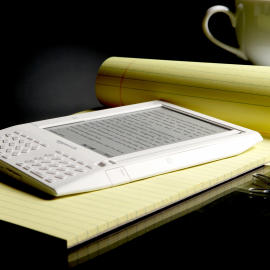
 Peter Burrows of BusinessWeek today wrote an even-handed post about the coming of Kindle 2.0, the much anticipated update to Amazon’s much ballyhooed eBook reader. And while he feels the Kindle revolution is “awfully evolutionary,” he also questions just how evolutionary it really is.
Burrows says he can confirm that McAdams Wright Ragen analyst Tim Bueneman [via Seattle Post-Intelligencer] has been saying recently: Amazon will unveil a larger-screen Kindle aimed at college students in the coming months. Burrows also says there will be an upgrade to the Kindle base model, which will be thinner, with a better screen, more stylish, and will include fixes to some of the user interface quirks from Kindle 1.0.
Burrows quotes a source who has seen Kindle 2.0 as saying it is a big leap from its predecessor as the iPod mini was from the first iPod. “They’ve jumped from Generation One to Generation Four or Five,” the source said. “It just looks better, and feels better.”
Wow. Kindle 2.0 must be one heck of a device.
But I, like Burrows, wonder.
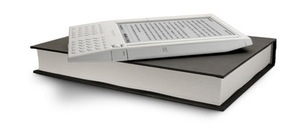 A larger-screen Kindle aimed at college students is nice, but if it’s too large it will cross the line with small laptops, which a majority of college students already carry. A larger Kindle may save students from hauling bulky, heavy books, but whatever savings they might realize from the eBook reader it will be eaten up by the cost of the device — expected to be $300-$400 — for at least a semester or two.
Also, from what I see and hear, students are asking for documents as Word docs or PDF files — so they can read them in their iPhones (or BlackBerry, Nokia, or Windows Mobile smartphones), which they already carry. While the Kindle offers the same mobile advantage as the iPhone (with a larger screen to boot), it’s also one more single-use device.
See also: Despite recent interest, eBook readers have a long way to go
An improved screen and user interface is always welcomed, and stylish colors may make the Kindle less bland and a bit more hip, but are these enough improvements to attract college kids other than lit majors?
“The Kindle revolution feels awfully evolutionary . . . if it exists at all,” Burrows writes. “I don’t see Kindles around in the real world [neither do I], and I’ve never heard anyone express the desire to own one [I have, but not at the current $349 price]. Even if Kindle matches the first year sales of the iPod . . . I can’t imagine the Kindle approaching the unit sales or cultural impact of Apple’s music player went on to have.”
If Amazon was to build on the pervasive wireless connection already in the Kindle, and if it offered improvements like a color touch screen, no digital rights management, and integrated support for Amazon-owned Audible.com (recorded books), then Kindle 2.0 might be worthy of the iPod Gen 1 to iPod mini comparisons.
As it appears, Kindle 2.0 is more 1.5.

I must admit getting an iPhone has lessened my desire for a Kindle. Though the iPhone still falls short in one huge one on this level (I haven’t used a Kindle)…The screen. Yeah, it looks nice, but its certainly not as easy on the eyes as the Kindle or Sony’s Reader.
I agree with the idea that single use devices aren’t that great – and I am most certainly for the centralization of most devices into one.
Reading books on an iPhone? you MUST be joking.
No way that tiny, backlit screen is going to be the way I read books. I’ve had a Kindle for over two months–I’ve never read more books. They’re easy to find, easy to buy, easy to carry. And the thing doesn’t need re-charging nearly as often as an iPod or phone.
If you read, the Kindle is an awesome device. If you’re a gadget fanboi, go play with the gadgets. Readers are already reticent to use Kindle, which has an awesome UI. No way they’ll read off their backlit iPhones, touchscreen or no.
Can Audible books be downloaded wirelessly to the Kindle or must one send such material to computer and then synch it? There some situations in which I want to listen but do not want the hassle of synching or carrying around a CD player in addition to Kindle.