
Archive for the ‘Mobile’ Category

What's next? Madonna in my corn flakes?

madonna hard candyRecord labels sure seem desperate these days to get their music in your hands any way they can. What’s next? Free music in your corn flakes?

Samsung, the No. 2 mobile handset maker, has signed a deal with Warner Music that will put Madonna’s upcoming album “Hard Candy” and video for the single “4 Minutes” preloaded on its F400 music phone.

Granted, the F400 comes with Bang & Olufsen speakers, but come on. What will any of the players gain here?

Will Madonna sell more Samsung F400 phones?

Will Warner Music sell more Madonna (or music from its catalog) just because it’s on the latest Samsung music phone?

Will Madonna sell more albums and ancillary content because she’s so cutting-edge mobile?

What’s Madonna demographics these days anyway? Aging pop fans with disposable income willing to buy yet another cell phone? Do the world’s youth even care about the Material Girl, even if she does say this next album “will kick your ass?”

In case you are one who does care, Madonna’s “Hard Candy” will be released April 29 — and the F400 is already available in the U.S. The F400 will be released in “early June” in France.

In other markets, carrier Vodafone and Warner Music have an arrangement that will make the new music and other content from “Hard Candy” available exclusively to Vodafone mobile customers prior to its general release.

But don’t expect Madonna in your corn flakes. At least not yet.

Nokia talks up 'Ovi' Web service and 'Comes With Music' plans

Nokia is hard at work repositioning itself as a provider of Web services and applications built around its hardware offering, rather than being thought of as just a handset maker — albeit, the world’s number one handset maker.
At the center of its ambitious plans is Ovi, the company’s consumer facing Internet brand (see our previous coverage). Ovi’s tag line is “the key that unlocks every door” (Ovi means “door” in Finnish) and initially consists of a desktop and mobile Web portal that gives one-stop access to Nokia’s current Internet services: maps, music downloads, games and photo/video sharing. Eventually, Ovi may also act as a gateway to other, third-party, Web services, such as social networking sites or competing media sharing services (e.g. YouTube or Flickr). Right now, however, it appears that Nokia only plays nicely with the rest of the Web to the extent that Ovi supports RSS and offers a few Flash widgets, so that content uploaded to the service can be syndicated on blogs, social networking profiles or eBay, for example. Likewise, Ovi can pull in similarly syndicated content from external sites.

Continue reading »

Whether people want it or not, AT&T will deliver live mobile TV in May

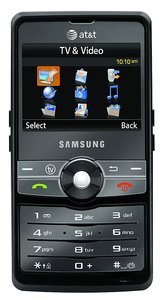
samsung att tvI asked the question in September, and I’ll ask it again: Do we really need live TV on our cell phones? AT&T, the largest U.S. carrier, says we do.

AT&T said Thursday it will offer live mobile TV service from MediaFLO in May through two handsets — the LG Vu and the Samsung Access. Subscribers willing to pony up the extra bucks (prices won’t be announced until later) will receive eight channels of live TV plus two exclusive channels in select markets.

AT&T offers everything from music to Web surfing is looking to live mobile TV as a way to earn additional revenue, something all the carriers desire as cell phone call prices continue to fall. Rival Verizon, the No. 2 U.S. carrier, already offers broadcast mobile TV through V-Cast.

Continue reading »

Motorola's decline in mobile industry has been coming for a long time

old motorola phoneI’m still shaking my head over this one. Motorola, one of the stalwarts of the mobile communications industry, will split into two publicly traded companies in 2009, one for its profitable infrastructure equipment, the other for its not-so-profitable mobile handsets.
How did this happen?

And what does it mean for the mobile industry?

I’ll let Wall Street debate the finer details of how Motorola’s crash-and-burn happened, but it comes as no surprise. I’ve been watching Motorola lose its grip in the mobile industry for almost three years, since the heady days of the Razr.

Back in 2005, Motorola introduced the Razr as an exclusive fashion phone costing $600 with a service plan, $800 without — and people complained that Apple’s iPhone was too expensive at its introduction. Like the iPhone, the Razr was the must-have geek toy of its time.

In 2006, however, Motorola allowed the Razr to enter the mass market as a mid-price (then super-cheap) phone, which lessened its must-have coolness and social impact. It seemed every snot-nosed kid at the mall had a Razr stuffed in a back pocket.

Continue reading »

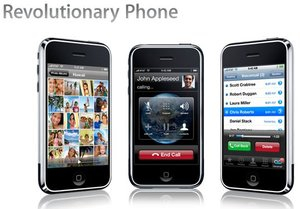
3G iPhone said to be imminent – will it help UK sales?

A 3G version of Apple’s iPhone could be on its way – literally – if one analyst’s sources are to be believed.

According to “sources in Asia”, Gartner’s Ken Dulaney says that Apple has placed a 10 million unit order for a 3G version of the iPhone — the handset’s first major hardware update since its launch last June. During a telephone briefing with iPod Observer, Dulaney also speculated that the updated iPhone would utilize OLED technology for the device’s display which should help improve battery life.

The lack of ‘3G’ – a mobile data technology that enables much faster Internet access on cell phones compared with the currently supported EDGE (2.5G) – is seen as a major shortfall of the iPhone, and is in part being blamed for poor sales in Europe. Hence Apple’s imminent move to a 3G iPhone, says Dulaney.

Other factors may also be at play.

Continue reading »

Jockeying for position is over: Time for the U.S. mobile industry to innovate

verizon wirelessThe jockeying for position is over. It’s time for the U.S. carriers, the world’s handset manufacturers, and third-party application developers to innovate the mobile wireless future.

Today the U.S. Federal Communications Commission announced that the big winners in the 700 MHz wireless spectrum auction were, indeed, Verizon and AT&T, the two biggest players in the industry.

Verizon won the coveted C-block for $4.74 billion, besting Google’s bid of $4.71 billion. Going into the spectrum bid, which began at the end of January, many industry followers had hoped that Google would take its bid seriously as a way to shake up a stagnant industry.

google springGoogle committed to bidding the minimum of $4.66 billion, which triggered a rule that the winner of the 700 MHz C-block spectrum would have to open its network to any device, any application. Just by bidding, Google dictated the new rules of the game — rules that Verizon must now follow.

at&tAT&T won 227 regional licenses around the U.S. Those licenses, along with the piece of the 700 MHz puzzle it already owned, allows AT&T to further enhance the quality and reliability of its existing network and wireless broadband.
“It means that the two big guys just got much bigger,” Rebecca Arbogast, an analyst with Stifel Nicolaus, told Reuters.

It also means that the jockeying for position is now officially over. The remainder of 2008 will be for the carriers, handset manufacturers, and application developers to introduce their initial products — and you can bet these will be far from perfect. There will be missteps, misfirings, false starts, claims of so-and-so being unfair, buggy software, crappy hardware, and disappointment, but these are the growing pains of an industry in transition

2009 is still the Year of Wireless.

For now, with the auction over, here’s how the U.S. wireless industry shapes up for the remainder of 2008.

Continue reading »

Who needs Flash on iPhone more? Adobe or Apple?

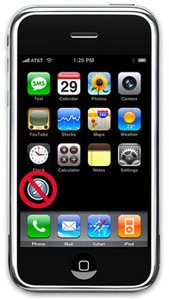
Adobe to investors: we're working on Flash for iPhoneUpdated: Adobe says it will need Apple’s support to bring Flash to iPhone (see end of post).
Adobe CEO Shantanu Narayen says that, with or without Apple, the company plans to develop a Flash player for the iPhone/iPod touch platform.

During yesterday’s earnings call (see SeekingAlpha transcript), Narayen told investors that that Flash was “synonymous with the Internet and frankly, anybody who wants to browse the web and experience the web’s glory really needs Flash support”.

Having evaluated the iPhone’s official Software Developer Kit, Adobe can “now start to develop the Flash player ourselves”, says Narayen. “…we think it benefits our joint customers, so we want to work with Apple to bring that capability to the device.”

With new research suggesting that the iPhone has already established itself as the No.1 mobile browser in the U.S., and No.2 in the UK, Narayen would say that.

However, only a week or so ago, Apple CEO Steve Jobs poured cold water on the idea of Flash on the iPhone/iPod touch, saying that the version designed specifically for mobile devices – Flash Lite – wasn’t good enough, and that Adobe’s more powerful desktop offering runs too slowly on the iPhone. What was needed is a “missing product in the middle”, argued Jobs.

Is Adobe committing itself to building the missing version of Flash that Jobs demands?

Or does Adobe really believe it can go-it-alone?

Continue reading »

Excitement continues: wireless auction ends in U.S., winners will be known within 10 days

fcc wirelessI know you can’t wait — it’s better than who is going to make it to the Final Four. OK, not really, but the largest and most lucrative wireless spectrum auction in U.S. history ended today, and we’ll know within 10 days who won the coveted C-block.
Presumably it’s Verizon, the No. 2 U.S. carrier, and not “telecom” upstart Google, but who knows? Maybe there is a surprise or two in the final results. Or not.

Even so, the auction will bring in $19.5 billion for the Federal Communications Commission, with $4.744 coming from the C-block winner. The winner can claim its prize within the year and start building that super-duper, next-gen, open-access wireless network we’ve been hearing about.

All in all, the event took 38 days to complete with 261 rounds of bidding. For a blow-by-blow account, see RCR Wireless News.

BBC podcasts target PSP and Nokia N95 users

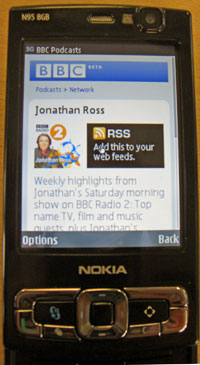
BBC podcasts target PSP and Nokia N95 users; iPlayer on iPhone boosts usage by 10%The BBC continues to ramp up its mobile efforts with targeted versions of its podcast directory for Sony’s PlayStation Portable (link) and Nokia’s flagship N95 handset (link), along with a new generic offering designed to work on most Internet-capable cell phones.

Specific to each device’s screen size and other technical specifications, the mobile versions enable users to stream rather than download any of the BBC’s podcasts, which can be browsed by radio station, genre or alphabetically. A similar version for Apple’s iPhone and iPod Touch was launched last November.

Continue reading »

Microsoft hedges bet, licenses Flash Lite from Adobe

adobeApple is gambling against Flash. Microsoft is hedging its bet.

Just two weeks ago, Apple CEO Steve Jobs said the scaled-down, cellphone-friendly version of Flash, dubbed Flash Lite, just wasn’t good enough for the iPhone because it would spoil the phone’s “full web experience”.

With so much Flash content on the Web — in the form of videos, ads, casual games — Job’s proclamation was viewed by some as a major disappointment in the evolution of the iPhone.

Today Adobe said it has licensed Flash Lite (and Reader) to Microsoft for use in smartphones operating the Windows Mobile OS. Microsoft does not manufacturer these phones like Apple does the iPhone; rather, it licenses Windows Mobile to cell phone makers like Samsung, LG, Motorola, and Sony Ericsson.

Continue reading »