The Google-led Android mobile OS continues its rapid development with version 2.0 nearing release. A 2.0 milestone is rarely insignificant and Android doesn’t disappoint. Perhaps the biggest enhancement isn’t an end user feature as such but a new API that will enable handset makers and other third-party developers to add additional ‘Cloud’ syncing capabilities to Android’s contact application, taking it far beyond the existing support for Google Contacts. This could be Facebook or any social network or web app and to the end user will feel very much like the contacts element of Palm’s Synergy feature, Motorola’s MotoBlur, the work that INQ have done or HTC Sense on the Hero and Tattoo, two existing Android-powered devices.
In other words, this whole cloud-savvy universal address book concept is already in wide circulation and now Google just made it even more pervasive.
Adobe has long talked up its ambition to have Flash running on all manner of screens, not just the humble PC, and today the company got a lot closer to walking the walk not just talking.
Through the Open Screen Project, Adobe was already known to be working with smartphone platforms from Palm (WebOS), Nokia (Symbian) and Microsoft (Windows Mobile), along with a raft of content providers, chip makers and consumer electronics companies. Today, the company added Google and Research In Motion to the list, with relation to Android and Blackberry-powered smartphones respectively, leaving Apple’s iPhone as the odd one out regarding planned support for full Flash (or any Flash support at all).
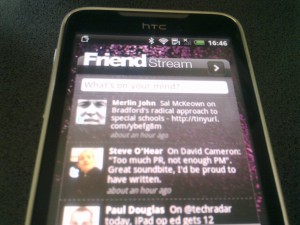
Yesterday I wrote a rant about a few of Android’s shortcomings but my faith in the Google-led OS has already been somewhat restored (not that it had waned completely). A few minutes after hitting publish, a helpful courier dropped off a review loan of the HTC Hero, courtesy of mobile carrier Orange. The Hero is the first Android-powered device to be heavily customized in terms of User Interface, with HTC’s Sense UI, something that we’re going to increasingly see handset makers do. Just last week, Motorola unveiled its own social networking-driven take on Android, and INQ, makers of the so-called ‘Facebook’ phone, have revealed plans to do the same.
But back to the Hero. A few notable improvements over the standard ‘out-of-the-box’ Android include…
Let me preface this by saying that there is a lot to like about Android and that the smartphones being powered by the Google-led OS are going to get better and better. I’m especially excited by the UI customization that HTC and Motorola, for example, have been developing on top of Android, testament to the mobile OS’s overall potential and, of course, openness.
(I’m expecting a loan of the social networking savvy HTC Hero later today, thanks to UK carrier Orange. A full review of the Hero should follow shortly.)
However, having lived with the Vodafone HTC Magic for a few months now, there are a few things that really bug me about the standard version of Android. Yes, this is going to be a bit of rant.
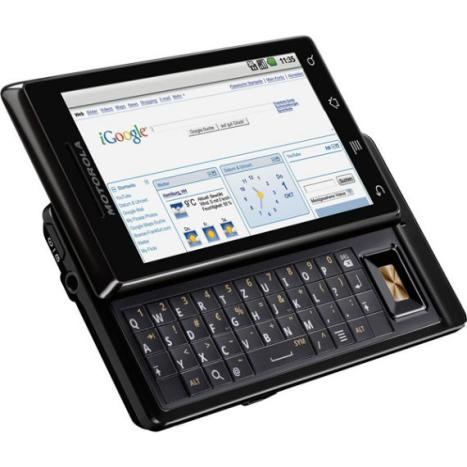
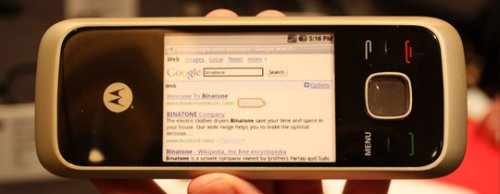
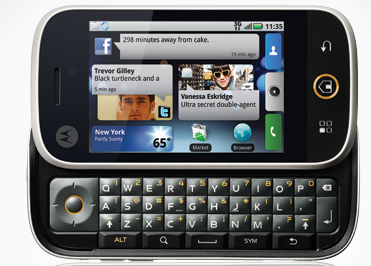
On stage live at GigaOm’s Mobilize 09 conference, Motorola just unveiled a large part of its comeback strategy (there seems to be a lot of “comebacks” in the handset market at the moment) based on a new smartphone powered by Android, the Google-led mobile OS, featuring a custom UI that puts social networking at its heart.
The phone, to be called the Motorola Cliq and offered exclusively on T-Mobile in the US, and the Motorola Dext in Europe, features 3G, WiFi, a 3.1 inch touch screen, slide-out landscape keyboard, and 5 megapixel camera, amongst its specs.
The stars were already aligned: a preemptive PR strike, a premium business model, and regulators questioning anti-competitive practices with relation to the iPhone’s app store — making it less and less surprising that Apple should give Spotify the green light.
As of today, the iPhone version of the music streaming service is available for download from Apple’s official App Store — UK, Sweden, Spain, France, Norway and Finland only (with the U.S. debut planned for sometime next year) — while a mobile client for the Google-led Android has also launched. The app is free for either platform but you’ll need to be a Spotify premium subscriber — £10 per month in the UK — to access the service.
SugarSync is my backup to the Cloud and sync service of choice (see How I replaced Apple’s MobileMe at half the price) and today the company added Android to its range of supported mobile phones. SugarSync was previously only available on iPhone, Windows Mobile and BlackBerry.
As readers will know, I recently jumped on the Google Phone bandwagon with the purchase of a HTC Magic (also also known as the T-Mobile myTouch in the USA) and so it’s pretty good timing to see SugarSync pushed out for Android shortly thereafter, although I’m still waiting for a S60 (Nokia) compatible version.
This is pretty interesting on the surface but misses a trick.
Creative, who has its roots in MP3 players and other portable media devices, have announced an Android-based media player platform. I say platform because the company may never release a consumer-facing device itself, but instead is touting its own reference design, software development kit and media processor to OEMs and developers.
Forget Chrome OS versus Windows (for now), there’s another Google / Microsoft battle taking place right in front of our eyes and Google’s winning. No, I’m not talking search. That war is over and Google was victorious a long time ago. I’m talking mobile. Android versus Windows Mobile to be precise, where Redmond is looking a little vulnerable to say the least.
Tech pundits like to talk endlessly about how Apple’s iPhone has shaken up the industry and that’s undeniable. But Android is a slow burner — don’t get fooled by the pig of a phone that was the T-Mobile G1 — the Google-led mobile OS is only now beginning to show its true potential. It’s not that consumers are flocking to Andriod — yet — it’s that handset makers right across the board are. And prior to Android, many of those handset makers were more than willing participants in Microsoft’s Windows Mobile eco-system. Less so now.
I’ve only owned an Android OS-based phone for a few weeks – the HTC Magic (see my review) – but even in this relatively short amount of time I’ve been hitting Google’s mobile app store, the Android Market, pretty hard in search for the best and most useful third party apps the platform has to offer. Overall, I’ve found that Android has a lot going for it in terms of third-party apps – the catalog is growing daily – but compared to the iPhone the apps themselves often lack polish and sometimes feel a bit unfinished. Having said that, there are in most cases, based on functionality alone, a comparable app on either platform. Here’s a list of the best 10 third-party apps (in no particular order) currently running on my HTC Magic.
It goes by many names. The HTC Magic on Vodafone here in the UK, Google Ion, when handed out as a freebie at the search giant’s developer conference, and the myTouch 3G on T-Mobile in the states. But, whichever way you slice it, the second Android-powered Google phone, manufactured by HTC, is an improvement over the original T-Mobile G1 in almost every way.
Where the original G1 is clunky, in part due to its death-trap of a slide-out keyboard – OK I exaggerate but only slightly – the HTC Magic is relatively slim with subtle curves and a much reduced “chin”, which is a universal complaint of the G1.
I knew it would happen, I’m just surprised it’s taken so long: Google’s Android has been given a major UI overhaul by a third-party handset maker.
At a press conference in London this morning, HTC unveiled it latest Android-based phone – dubbed “Hero” – but unlike the G1 and HTC Magic before it, the new handset has been given a major UI overhaul that the company is calling HTC Sense.