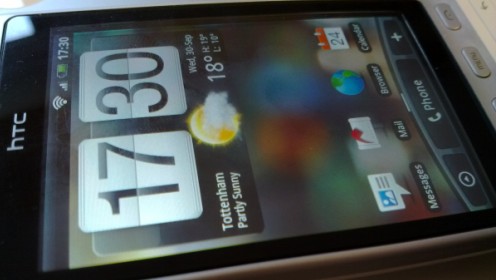
Way back when I reviewed HTC’s Windows Mobile-powered “Touch Diamond” smartphone, I gave props to the handset maker for trying to put a consumer and ‘finger-friendly’ face on Microsoft’s aging mobile OS, but ultimately concluded that the effort was in vein. Instead, I urged HTC build an OS of its own or more realistically, adapt the then up and coming Google Android platform to reflect the company’s own User Interface and UX ambitions. Enter the HTC Hero.
last100 is proud to be a media sponsor of this year’s NewTeeVee Live conference. Better still, readers qualify for a 10% discount on tickets to the event. Full details of how to get your discount and news of this year’s lineup below…
TV Everywhere is the one of the most important initiatives to date in the TV Industry. Understand what it is and what it’s impacts are at NewTeeVee Live.
Don’t miss this opportunity to meet and learn from the leaders in television. Your exclusive last100 10% discount on this year’s conference is available now!
Following yesterday’s news that mobile carrier Orange are to begin selling the iPhone here in the UK, Vodafone have announced that they too are jumping on the Cupertino bandwagon, albeit not till early 2010.
And with O2’s two-plus year monopoly on Apple’s iconic device therefore well and truly broken, overpaid analysts and most of the tech press/blogosphere have been quick to predict a pending price war for the iPhone and associated tariffs this side of the pond. However, I’m still not convinced that this will be the case.
Exclusive handset offerings are certainly good for carriers and are probably good for handset makers too as they help drive up the price during negotiations – presuming there is a demand for said device in the first place. But it’s hard to see how they are ever in the interest of consumers who end up paying more through higher tariffs via the subsidy merry-go-round.
That’s because exclusives create a monopoly by any other name. In the case of the iPhone, if you want Apple’s iconic device here in the UK, you have no real choice but to become a customer of O2. Thankfully, that’s set to change with rival carrier Orange announcing that they have partnered with Apple to officially offer the iPhone.
We knew the carrier: Telfonica-owned O2. We knew the time frame: before Christmas. Now we have the actual date and pricing for the UK release of Palm’s Pre smartphone, the company’s comeback device.
Set to go on sale on the 16th of October, the Pre will be “free” to customers signing up to a £34.26 per month, 24 month contract, or for those willing to move to the higher tariff of £44.05 or more on an 18 month contract. Otherwise the device will have an additional up front cost of £96.89. All of the tariffs feature varying inclusive minutes and texts, along with ‘unlimited’ data and WiFi hotspot access through The Cloud and BT Openzone.
Yesterday I wrote a rant about a few of Android’s shortcomings but my faith in the Google-led OS has already been somewhat restored (not that it had waned completely). A few minutes after hitting publish, a helpful courier dropped off a review loan of the HTC Hero, courtesy of mobile carrier Orange. The Hero is the first Android-powered device to be heavily customized in terms of User Interface, with HTC’s Sense UI, something that we’re going to increasingly see handset makers do. Just last week, Motorola unveiled its own social networking-driven take on Android, and INQ, makers of the so-called ‘Facebook’ phone, have revealed plans to do the same.
But back to the Hero. A few notable improvements over the standard ‘out-of-the-box’ Android include…
Let me preface this by saying that there is a lot to like about Android and that the smartphones being powered by the Google-led OS are going to get better and better. I’m especially excited by the UI customization that HTC and Motorola, for example, have been developing on top of Android, testament to the mobile OS’s overall potential and, of course, openness.
(I’m expecting a loan of the social networking savvy HTC Hero later today, thanks to UK carrier Orange. A full review of the Hero should follow shortly.)
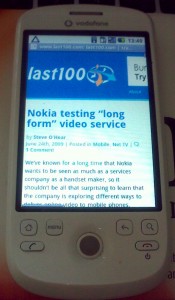
However, having lived with the Vodafone HTC Magic for a few months now, there are a few things that really bug me about the standard version of Android. Yes, this is going to be a bit of rant.
Dave Zatz: I’ve been tracking Microsoft’s hardware refresh as well, but given the capabilities of current flagship smartphones, I just don’t have a place (or pocket) in my life for a portable media player (PMP), web tablet, or gaming device that doesn’t integrate ‘cellular’ connectivity.
Here’s a summary of the last two weeks’ digital lifestyle action on last100. Note that you can subscribe to the weekly wrapups, either via the special weekly wrapup RSS feed or by email.
Opera, the Norwegian company behind the desktop and mobile web browser of the same name, wants to be a major player in the nascent Internet-connected TV space.
September 17th, 2009 | Posted in Net TV | Comments Off
A core remit of last100 is to cover the living room’s broadband revolution and Internet TV is playing a major part in this.
One blog that I read religiously to keep track of the Online Video industry is NewTeeVee from the GigaOM staple of tech blogs. NewTeeVee also puts on the respected NewTeeVee Live conference every year and it’s nearly that time again. And as with last year, we’re proud to be a media sponsor for the event. Full details after the jump…
I’m generally a fan of Nokia’s business focused Eseries smartphones, while for day-to-day use I require a device with a QWERTY keyboard (preferably a portrait one). Combine the two and the Nokia E71, released around 18 months ago here in the UK, is as close as I’ve got yet to the “perfect” smartphone — I even named it in my top ten Digital Lifestyle products of 08 — although, obviously, it’s far from perfect. Perfection is, of course, a moving target in the world of smartphones.
The subsequently released Nokia E75, which features both a traditional numeric keyboard and a generously large landscape slide-out QWERTY, came in at a close second andeven offers a few of improvements over the E71, such as a faster processor, updated software, better camera and a 3.5mm headphone jack.
I was therefore keen to try out Nokia’s attempt at a third QWERTY touting form factor, with the announcement of the E55. As you can see from the photo above, the device adopts the traditional candy bar shape by featuring something the handset maker is calling a “compact QWERTY”. Essentially housing two QWERTY letters per key (can I say half a QWERTY?) and utilizing predictive text to bridge the gap. But, in everyday use, how does the E55’s keyboard perform?
I’ve just got back from PlayBite in London, a press event organized by PR agency Bite. The mini press-only expo showcased products from a number of consumer tech brands, including Palm. In fact, the event was in part billed as the first chance for UK journalists to get a hands-on with the Palm Pre, and I got to do just that.