
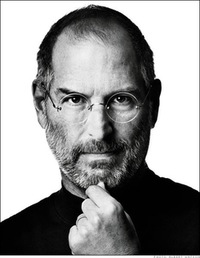
 What does Steve-o really mean when he says, “It doesn’t matter how good or bad the product is, the fact is that people don’t read anymore”? And: “The whole conception is flawed at the top because people don’t ready anymore”?
a) There’s no way in heck Apple is going to manufacture an electronic book reader like the mentioned-by-name Amazon Kindle or Sony Reader.
b) Based on past declarative statements made by Steve-o (remember, Apple’s not making a phone), the Cupertino company really is working on an ebook reader, only it’s not a reader but an ebook-sized tablet computer that can be used to read electronic content.
c) Who needs a dedicated ebook reader when you have the iPhone and iPod touch that third-party developers will be writing applications for when Apple’s software developer’s kit is released next month? Will a developer write an app to read books on the iPhone or touch?
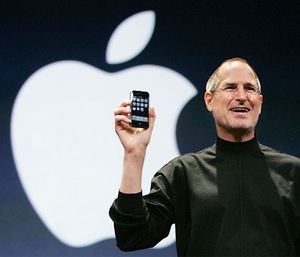 I agree with Apple CEO Steve Jobs when he said, in an aside with The New York Times at this week’s Macworld, that people don’t read anymore. In general, reading is down, residing somewhere between trashy summer beach novels and whatever Oprah recommends for her book club.
Overall, though, I mostly agree with “Print is Dead” author Jeff Gomez, who argues that people are reading — maybe not as many traditional books as in the past but they are reading electronic content like blogs, Web pages, PDFs, emails, text messages. Traditional books are in the mix but are giving way to the inevitable digital infiltration, just like the music and video industries are going through now. (last100 coverage.)
To contend outright that “people don’t read anymore” seems a bit flippant. Maybe it’s misdirection? Maybe a matter of semantics? After all, who needs a dedicated ebook reader when you have a spiffy tablet computer in the development oven and third-party applications on the way?
Speaking of those third-party applications for the iPhone and iPod touch, I do agree with Jobs that Android — the open mobile software platform developed by and pushed by Google — isn’t going to be a sure-fire winner.
“Having created a phone, it’s a lot harder than it looks,” Jobs said. “We’ll see how good their software is and we’ll see how consumers like it and how quickly it’s adopted.”
Maybe Google, as Jobs notes, already did a good thing by participating in the run up to the 700 MHz spectrum auction, to be held at the end of the month by the U.S. Federal Communications Commission. By being involved, Google has already helped push the stodgy FCC and Gibraltar-like U.S. carriers towards open networks, allowing any phone and any application to run on any network.
By bidding on the spectrum — and possibly winning some — Google will spark the tearing down of an in-need-of-repair industry and its rebuilding through fresh players and innovation at the handset, network, and application levels.
“It (Android) is just going to divide them and people who want to be their partners,” Jobs said. (see also last100.)

Since there’s no dirty trick that I wouldn’t believe Jobs capable of, I think this writer is right on. Jobs comments were intended to distract everyone until under great secreacy Jobs can announce an ebook reader at a time in the future of his choosing. No backlit computer will ever compete with the Kindle, which is infinately better to read, and has a huge battery life to go with it as well – something no portable computer can ever come close to.
His comment re reading being a lost art or cause is obviously plain stupid, and another lie to distract everyone from his real intention. Jeff Bezos, Amazon founder and CEO, obviously does not believe that, and has proven this to be wrong by becoming the largest bookstore in the world. And who better to produce the first ebook reader that will be hugely successful. I got mine on Dec. 4th, abslutely love it, and already have 72 books in my Kindle’s memory.
Charles Wilkes, San Jose, Calif.
I just blogged about my views about Steve’s comments
http://whydoeseverythingsuck.com/2008/01/steve-jobs-petulant-child-philosopher.html
As I said in my post, this was steve at his worst. Whining about how no one else makes phones because its harder than it looks. Thats just what palm and microsoft said when apple entered the biz. The truth is that there is *way* more room to innovate on cell phones.
Maybe if I had a bone to pick I would interpret Jobs comments as negatively as the previous commenters but the “nobody reads” stuff is an exaggeration that everyone understands.
Lots of tech commentors that really want Android to work have been poking holes in it. Jobs is going light on that topic, as far as I can tell.
In any case, I read constantly on and offline and I wouldn’t use the Kindle for that cause I LOVE BOOKS! Real books.
I would use the Kindle for things like reference resources and technical manuals and that could be a great thing.
But books are still the superior medium for extended in-depth reading, IMHO.
Regular cell phones can give dedicated eReaders a run for their money, they make fine free readers for novels and general prose. You can see the advantage of not having to carry or charge anything extra, and of course you can wirelessly install books on demand. You can get a good sense of the potential at http://www.booksinmyphone.com they give away hundreds of public domain and creative commons books. You can install direct to your phone from the mobile version of their site, or download and install via a PC.
Reading habits are going down and visual help is becoming more n more of importance.
@avagee: it’s just not comfortable to read on a phone….
Nanny To You is a free nanny jobs search service