
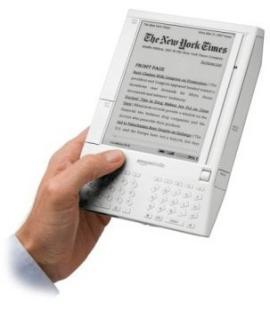
 As a voracious reader I am happy to see the success of the Kindle, Amazon’s electronic book reader. But no matter how many devices Amazon or others sell, the whole eBook reader thing is fundamentally flawed.
Let’s be honest. Electronic reading devices mostly suck. The platforms or ecosystems eBook readers are built on — from content purchase and management to DRM — are awful.
So when I read that Mark Mahaney of CitiGroup says that Amazon is expected to sell about 380,000 Kindles in 2008, I applaud. I desperately want eBooks and eBook readers to be as successful as the iPod — and that’s millions of units sold, not just a few hundred thousand.
But eBook readers will never be as successful as the iPod. Not the way that the publishing industry works today. Not the way eBooks are designed and manufactured.
 What’s to like about eBook readers
Even in their crude forms, eBook readers are fabulous. They’re small, lightweight, and readers can carry hundreds of books and periodicals with none of the weight and cumbersomeness of physical books.
Readers can change type size, going from small (normal-sized book text) to medium and large fonts, a popular feature for anybody over 40. The electronic ink screens used in most readers are greatly improved and easy on the eyes. Most people don’t even care that there is a slight flicker on the screen when a page is turned.
And with the Kindle, readers have a persistent computing device, meaning they have always-on access to the Internet via Amazon’s “whispernet.” They don’t need to be connected to broadband in the airport or doctor’s office to buy a book or periodical.
What’s not to like about eBook readers
The user interfaces are horrible, not only for navigating large libraries but through a book that might be 250 pages in physical form but 800 pages as an eBook. It’s nearly impossible to “thumb through” an eBook.
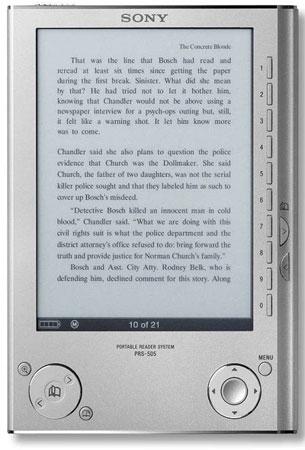
The selection of eBooks range from not bad (Amazon’s 150,000 titles) to horrible (Sony’s 40,000) and everywhere in between. Funny, but readers can find all sorts of classics and new releases, but when they’re looking for a certain book it never seems to be available in electronic form.
See also: Despite recent interest ebook readers have a long way to go
The eBooks readers purchase, and even some free content, cannot be moved easily between devices because of incompatible formats or digital rights management. Why can’t my Sony Reader have access to Amazon? Amazon wants me to buy a Kindle, but isn’t Amazon in the business of book-selling too?
What I think is the most flawed aspect of eBook readers is that I cannot read a book the way I want to. I don’t mean eBook readers should operate exactly like a physical book. But I should be able to do the things I want to do while reading a book — highlighting text, circling phrases and passages, annotating.
Not everybody reads a book cover to cover and leaves it in pristine shape. Books are meant to be read and used but not abused.
What I find most ironic is the tools of the digital age — like cutting and pasting text, the use of folksonomies like tagging, and search — are not well implemented in eBook readers. Text cannot be easily manipulated in physical books but should be usable (in a non plagiarism manner) in electronic books. Why can’t I select a passage and copy it to a file I’m assembling for a lecture or blog post?
Until eBook readers become dynamic devices that improve our reading experience, they will remain an expensive niche item selling 380,000 units a year.

I’ve got the eReader app on my iPhone, but I haven’t found an book I want to read yet (at Fictionwise). The interface is pretty basic, but seems fine – I think all book purchasing/searching is done through a web browser and my “library” on the device is updated over the net. I prefer converged devices – I probably give up some in terms of usability, but less devices to manage (and in theory cheaper, long term). I am VERY interested in seeing what the next version of the Kindle looks like. Though I’ve got to say my blogging hobby has pretty much killed my reading past time. :/
“But I should be able to do the things I want to do while reading a book — highlighting text, circling phrases and passages, annotating.”
“Why can’t I select a passage and copy it to a file I’m assembling for a lecture or blog post?”
The Kindle does all these things. Have you actually used one?
I just got the iPhone 3G and am looking forward to reading on it…even tried a little bit…the app. I’m using (whose name I can’t recall) is very basic and needs a lot of improvement. I really want a Kindle…and I want it to work well…Perhaps Apple will dedicate some of their significant skill to this task for the iPhone – then my iPhone can not only be my mobile internet device, phone, gps, gaming device, but also my electronic library…
I did just recently read Alice in Wonderland on my laptop from Project Gutenberg…and am now reading through Clement’s Epistle to the Corinthians on the CCEL (if you haven’t looked at the latter, I highly recommend it…while it is specifically Christian in nature, the interface is amazing – with tagging, user editing, highlighting, annotations, etc…its what I want my ebook reader to do).