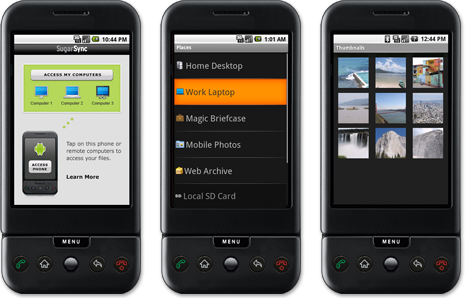
SugarSync is my backup to the Cloud and sync service of choice (see How I replaced Apple’s MobileMe at half the price) and today the company added Android to its range of supported mobile phones. SugarSync was previously only available on iPhone, Windows Mobile and BlackBerry.
As readers will know, I recently jumped on the Google Phone bandwagon with the purchase of a HTC Magic (also also known as the T-Mobile myTouch in the USA) and so it’s pretty good timing to see SugarSync pushed out for Android shortly thereafter, although I’m still waiting for a S60 (Nokia) compatible version.
This is pretty interesting on the surface but misses a trick.
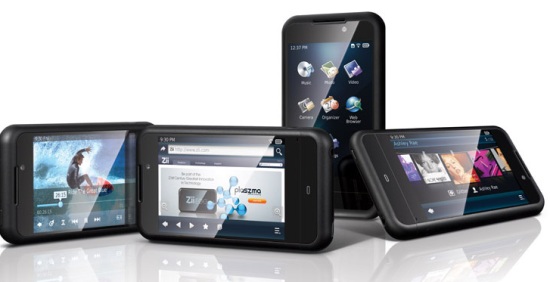
Creative, who has its roots in MP3 players and other portable media devices, have announced an Android-based media player platform. I say platform because the company may never release a consumer-facing device itself, but instead is touting its own reference design, software development kit and media processor to OEMs and developers.
The Symbian Foundation, Nokia’s ambitious open source project designed to give longevity to the Symbian OS, has launched a new blog inviting the ‘community’ to submit their own User Interface mockups.
UI of course is an area where Symbian is perceived to be lagging behind competitors, such as Apple’s iPhone, Android, and the Palm Pre’s Web OS. It’s also something so fundamental to the user experience that it seems odd, even in a small way, to farm this out to the community.
My fear is that, like many an open source project, you could end up with ‘design by committee’.
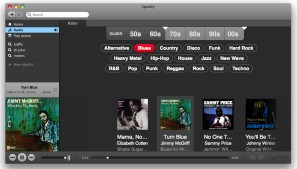
Spotify has submitted its iPhone app to Apple’s App Store and the company wants everybody to know it. An official blog post has gone up, demos of the app to select press have been given, and a YouTube video (see below) is doing the rounds.
Now the wait begins, however: Will Apple approve the music streaming service for distribution on its platform, a service that, when you dig a little deeper, appears to compete more directly with the company’s own iTunes Music Store than similar offerings, such as Last.fm and Pandora, both of which have already been given the go-ahead by Cupertino.
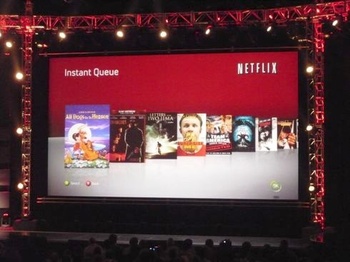
Forget channel surfing, Web surfing is the future of television, Netflix CEO Reed Hastings tells CNNMoney.com.
In five to twenty years, says Reed, “the way that consumers will interact on the big screen will be similar to the way they interact on a laptop screen.” Instead of switching channels, they’ll visit online video destinations as the web becomes “the universal paradigm that’s gonna subsume and embrace the User Interface on all of these systems” [PC, TV and Mobile].
“In the long term what we’ll see is a web browser like IE or Chrome or Safari or any of these in the television, and the way that consumers will interact on the big screen will be similar to the way they interact on a laptop screen. That is with a web oriented paradigm and they’ll go to CNN.com or Netflix.com or ESPN.com as apposed to specific channels. So think of websites, over time, replacing channels… Over maybe 5 to 20 years.”
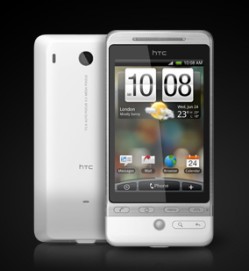
Forget Chrome OS versus Windows (for now), there’s another Google / Microsoft battle taking place right in front of our eyes and Google’s winning. No, I’m not talking search. That war is over and Google was victorious a long time ago. I’m talking mobile. Android versus Windows Mobile to be precise, where Redmond is looking a little vulnerable to say the least.
Tech pundits like to talk endlessly about how Apple’s iPhone has shaken up the industry and that’s undeniable. But Android is a slow burner — don’t get fooled by the pig of a phone that was the T-Mobile G1 — the Google-led mobile OS is only now beginning to show its true potential. It’s not that consumers are flocking to Andriod — yet — it’s that handset makers right across the board are. And prior to Android, many of those handset makers were more than willing participants in Microsoft’s Windows Mobile eco-system. Less so now.
July 20th, 2009 | Posted in Audio, Mobile | Comments Off
Spotify, which has become the talk of the town here in London, could launch in the US as early as September, reports the Observer newspaper. The music streaming service, which offers both ad-supported and subscription versions, is seen as not only a real iTunes contender but also compelling enough and the right side of “free” to wean users off of illegal file sharing networks.


I’m a big fan myself and am particularly excited about the up and coming Android, Symbian and iPhone mobile versions of the service.
Along with the incumbent iTunes — who offer a different model: ala carte downloads — Spotify will face much competition in the ad-supported and subscription streaming space. US-strongholds include services such as Pandora, iMeem, MySpace and Last.fm (ad-supported), along with Napster and Rhapsody (subscription).
One other competitor whom Spotify may or may not have had in mind when deciding to compete in the US is Microsoft (the underwhelming Zune aside). The Redmond giant is reportedly launching a similar service to European-based Spotify later this month.
Mari Silbey: Not only has much of the AFI collection never been seen before, but the Institute is allowing online visitors to embed clips in their own sites.
Mari Silbey: It’s interesting to watch a retailer trying to expand its business model in the digital world. Beyond that, however, it’s fascinating to see how the digital living room is evolving. Best Buy is throwing itself into the ring with the likes of Blockbuster, Amazon, and Netflix, but also with cable, telco, and satellite operators.
Users who are complaining that they can no longer access the online video site Hulu on through their PlayStation 3’s web browser are being given an official explanation. The short version: it’s not Hulu’s fault per se but the result of keeping content owners, who don’t want the service to compete with revenue generated by traditional television distribution, happy.

Bricks and mortar video rental chain Blockbuster were a decade ahead of the competition in terms of the move from physical media to digital. That lead, however, “never materialized into any real online video strategy over the next ten years”, writes industry veteran and EVP of StreamingMedia.com, Dan Rayburn.
“Without a doubt, Blockbuster should have been in the position Netflix is in today as they were the first movers in the market.”
Rayburn then goes on to paint Blockbuster as a digital headless chicken.
I’ve only owned an Android OS-based phone for a few weeks – the HTC Magic (see my review) – but even in this relatively short amount of time I’ve been hitting Google’s mobile app store, the Android Market, pretty hard in search for the best and most useful third party apps the platform has to offer. Overall, I’ve found that Android has a lot going for it in terms of third-party apps – the catalog is growing daily – but compared to the iPhone the apps themselves often lack polish and sometimes feel a bit unfinished. Having said that, there are in most cases, based on functionality alone, a comparable app on either platform. Here’s a list of the best 10 third-party apps (in no particular order) currently running on my HTC Magic.
The big news this week, of course, is that Google is developing its own Operating System dubbed Chrome OS. Cue the headlines about the search giant, once again, taking aim at Microsoft. And of course, on one level that’s absolutely correct. Just like any other newly launched OS needs to take market share away from Redmond in order to succeed. But it won’t be easy.
While Google says it wants to build an OS from the ground up in order to make it easier for users to get on the web and utilize web-based applications – and view more Google ads – managing user expectations will likely be the bigger challenge. For all the technical hurdles that Google will undoubtedly overcome – faster boot up times, greater security, support for next gen web standards (HTML 5 etc.) – weaning users off of Windows will be no easy task. The failure of existing Linux distros to become the defacto OS for Netbooks, despite getting a head start and backing from OEMs, doesn’t bode well for Chrome’s chances unless Google is able to redefine not just the OS but what users expect from their PCs.