 Buoyed by the success of last year’s March Madness on Demand and, presumably, its experiment with live streaming on Joost, CBS is making video coverage of the college basketball tournament available to owners of Apple’s iPhone and iPod touch. Available through a dedicated iPhone app, users will be able to view live games (WiFi only) and access real-time scores, stats, and other related content. Interestingly, the app isn’t free but costs $4.99 available through iTunes and the iPhone’s App Store, another example of media companies using Apple’s mobile software store as a way of charging for content.
Archive for the ‘Mobile’ Category
CBS to stream NCAA's March Madness on iPhone and iPod touch
March 12th, 2009 | Posted in Mobile, Net TV |  No Comments
Vodafone Music's DRM-free move makes Apple and Nokia look bad
March 12th, 2009 | Posted in Audio, Mobile | No Comments
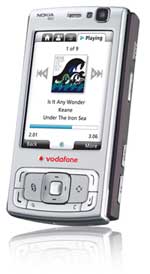 Vodafone, which currently operates music download stores in over 20 countries, is to become the latest company to jump on the DRM-free bandwagon, announcing this week that it will soon be transitioning its music catalog away from the copy-protected WMA format to standard MP3s. Additionally, customers will be able to covert their existing Vodafone purchases to DRM-free versions at no extra charge, unlike Apple’s current iTunes arrangement where users wishing to ‘upgrade’ are effectively asked to pay twice.
That’s the good news as far as Vodafone is concerned. The bad: only three of the four major record labels are on board – Universal Music Group, Sony Music and EMI – with Warner, for now at least, refusing to join in the fun, and the whole DRM-free deal only applies to a la carte downloads not Vodafone’s MusicStation all-you-can eat subscription service.
Continue reading »
Nokia ramps up music ambitions; three new handsets, Nokia Music Store and 'Comes With Music' expansion
March 11th, 2009 | Posted in Audio, Mobile | No Comments
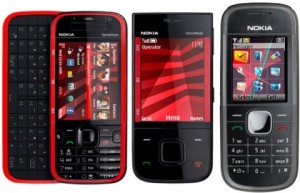 Perhaps to the disdain of mobile carriers, Nokia continues to ramp up its own music offering. Three new music-focused handsets were announced today, along with expansion of the company’s own music download store and all-you-can-eat ‘Comes With Music’ subscription-based offering.
Of the three new handsets, the most interesting is the higher end XpressMusic 5730 (available Q3, €280), which is Nokia’s first music phone to feature a full (slide out) QWERTY keyboard, and just like the 5800, runs the company’s Symbian S60 smartphone OS. The 5730 is being pitched as both a music-centric and messaging – think email, IM and social networking – device, featuring a redesigned home screen that gives shortcut access to the phone’s music library, and the socially-aware ‘contacts’ bar, which is able to pull in the latest communication and RSS feeds from up to 20 of a user’s most important contacts.
Continue reading »
Android-based G1 helping to prop up T-Mobile in the UK, but I've yet to see one in the wild
March 11th, 2009 | Posted in Mobile | No Comments
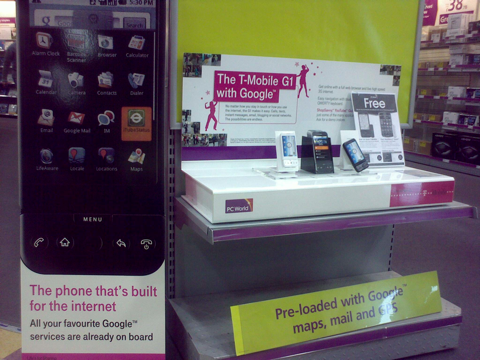
Apparently, the T-Mobile G1 now accounts for 20% of the carrier’s contract sales here in the UK, a figure that I find quite surprising considering I’ve yet to see a single handset in the wild (aside from on display) nor do I know anybody who’s bought one. This is in complete contrast to Apple’s iPhone, which seems to have spread like wild fire amongst my own social circle, and is quite a common site out in public.
The G1’s lack of visibility, I’d mistakenly attributed to poor sales, based on what I still believe has been lackluster marketing and a rather muddled ad campaign – something that can’t be said of the iPhone. Back in November I noted the lack of display advertising for the G1 at Carphone Warehouse, one of the UK’s largest mobile retailers on the high street. However, today I popped into a PC World, of all places, to find the G1 being heavily promoted, with a much clearer message than the current TV ad campaign: “The phone that’s built for the internet. All your favorite Google services are already on board”. A message that appears to be getting through.
Usability guru: Amazon's Kindle is great for reading novels, poor for everything else
March 10th, 2009 | Posted in Mobile, Other | 2 Comments
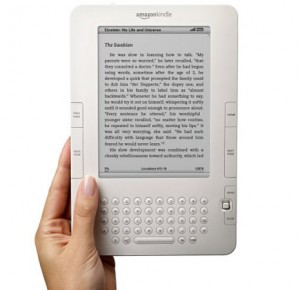 Usability guru Jackob Nielson has given Amazon’s Kindle eBook reader the once over. His conclusion: perhaps unsurprisingly, the device is great for linear reading – think books, and in particular novels – but falls down badly when consuming non-linear content, such as electronic versions of magazines or newspapers.
Additionally, Nielson says that although he has previously questioned the viability of eBook reading devices in general, the Kindle’s e-ink screen technology and his own reading speed using Amazon’s device (less than 0.5% difference compared to the exact same paperback) has changed his mind.
On the Kindle’s linear reading strengths, Nielson gives praise to the device’s dedicated page turn controls:
… turning the page is extremely easy and convenient. This one command has two buttons (on either side of the device). Paging backwards is a less common action, but it’s also nicely supported with a separate, smaller button.
The device thus offers good support for the task of linear reading — appropriately so, as Kindle’s design is centered on this one use case. While reading, your only interaction is to repeatedly press the next-page button.
However, “anything else is awkward”, writes Nielson.
Continue reading »
Will Apple's 'Netbook' be open or closed?
March 9th, 2009 | Posted in Mobile | 3 Comments
 Rumors of an Apple Netbook or Internet tablet have resurfaced once again. Predictably, tech pundits are debating the likely specs, not least if the device will feature the traditional clam shell form factor of current Netbooks on the market, all of which feature a physical QWERTY keyboard, or be an all touch screen device – think iPod touch only much bigger. However, perhaps the most important design decision for Apple will be whether to build the company’s future Netbook on an open or closed platform.
Continue reading »
Hands-on: Five things I like about Nokia's N85 smartphone
March 5th, 2009 | Posted in Mobile | No Comments
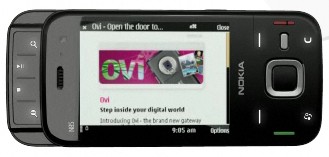 No sooner do I get my hands on Nokia’s N85 smartphone, and the Finnish handset maker announces its successor – the N86. However, since the two devices share so much in common – the most noticeable ‘upgrade’ being the N86’s 8 megapixel camera and improved optics – I thought I’d share five things that I really like about the Nokia N85.
Continue reading »
What Kindle on iPhone says about Amazon's eBook strategy
March 4th, 2009 | Posted in Mobile, Other | No Comments
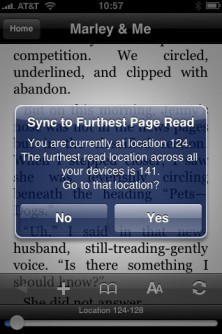 The news today that Amazon has released a Kindle client for Apple’s iPhone and iPod touch says a lot about the company’s eBook strategy. Amazon’s Kindle device has often been described as wanting to become the iPod of books, but unlike Apple it’s clear that the e-tailer sees itself in the business of selling content and not just to drive sales of hardware.
In terms of music and video sales, Apple’s iTunes Store exists purely to add value to and increase uptake of the company’s iPod and AppleTV devices, with the major record labels and Hollywood studios receiving the majority of revenue from any content sold. Until fairly recently, content from iTunes could only play back on Apple’s hardware – for movies and TV shows this is still the case – helping to lock customers into the iTunes/iPod ecosystem. In contrast, eBooks bought from the Kindle store are now able to be read on at least one non-Kindle device, Apple’s iPhone, with more to come. This suggests to me that Amazon is taking a large enough cut from each eBook sold to justify potentially diluting sales of the Kindle device itself.
Continue reading »
How I replaced Apple's MobileMe at half the price
March 2nd, 2009 | Posted in Comms, Mobile | 3 Comments

After years of pledging to do so, I’ve finally dumped Apple’s MobileMe web service in favor of a more cost effective and flexible solution, and one that is better suited to my own particular needs. MobileMe (formally dot Mac) is a great service (when it works) for those whose digital lifestyles almost entirely rely on Apple devices – iPhone, iPods, Macbooks etc. But step out of Apple’s ecosystem and it starts to look far less appealing and very overpriced. After a bit of research, and advice from friends and Twitter followers, moving forward, here’s how I intend to manage email, contact and calendar synchronization across devices, along with automatic backups of other critical data.
Continue reading »
Nokia and Skype partnership has carriers in a fit
February 27th, 2009 | Posted in Mobile | 4 Comments
 It’s always interesting to see the politics of business play out through leaks in the media, and I suspect that in the case of Nokia and its mobile carrier “partners” we haven’t seen the last of it. The Finnish handset maker’s recent announcement of a tie up with Skype has, predictably, rankled two carriers in the UK, reports Mobile Today.
See also: Nokia announces online music store – takes aim at Apple and mobile carriers
Both Orange and O2 are unhappy that a Skype client will be bundled with Nokia’s upcoming N97 and are threatening to boycott the device and the company’s future Skype-enabled phones, for fear that including the application will further reduce their role to that of being a “dumb pipe”. According to Mobile Today’s source:
“This is another example of them trying to build an ecosystem that is all about Nokia and reduces the operator to a dumb pipe. Some people like 3 may be in a position where it could make sense to accept that. But if you spend upwards of £40m per year building your brand, you don’t want to be just a dumb pipe do you?
Nokia have tried several ways to own the customer over the years and operators have had to say no.”
Owning the customer, of course, is something that Apple has managed to achieve, and which 02 seems to have accepted in return for iPhone exclusivity here in the UK. Nokia, with its aggressive move into providing various web services (music subscriptions, maps, email, IM and social networking) is also trying to have a more direct relationship with the customer, presumably hoping that said services will help lock them into a continuous cycle of Nokia handset upgrades. At the same time, both companies, like any handset maker, need the carriers to stay on side so that they’ll continue to subsidize and market their wares. That seems like a conflict of interest if there ever was one, and I can’t see the issue being resolved any time soon.
Continue reading »