Posts Tagged ‘Google’

Will Android be Motorola’s savior? Company confirms its interest in Google’s mobile OS

This comes as no shock, and it just might save Motorola’s cell phone hide.

According to BetaNews, Motorola has confirmed it is working on a new phone that utilizes Google’s mobile operating system Android. It’s no surprise because Motorola was a founding member of the Google-led Open Handset Alliance.

“We’re excited about the innovation possibilities on Android, and (we) look forward to delivering great products in partnership with Google and the Open Handset Alliance (OHA),” Motorola said in a statement.

Since the announcement of Android at the end of last year, HTC, Motorola, Samsung, and LG Electronics all have been rumored to be interested in manufacturing an Android handset. HTC is the first to deliver an Android phone, the G1, which will be available later this month and sold by T-Mobile in the U.S.

Other handset manufacturers have laid low, however, keeping their Android plans quiet. For its part, Motorola has been working diligently to solve its ailing cell phone business. Earlier this year it decided to spin off its troubled cell phone division from the rest of the company.

Continue reading »

The real power of Google’s phone: connecting us to people, places, and things

The real power of a Google phone and the Android mobile operating system isn’t just computing power, or search, or advertising, or maps. It’s the ability to connect people, places, and things like never before.

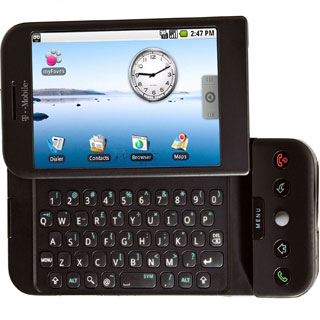
With the introduction Tuesday of the Google phone — dubbed G1 by wireless carrier T-Mobile — we’re  starting to see the potential disruption that Google and Android will bring in the coming year or two. It’s even greater than what Apple and the iPhone have already accomplished.

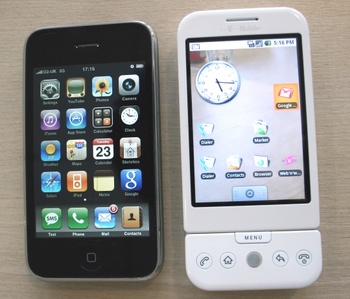
Together, the so-called Google phone and the iPhone are disrupting the mobile industry with innovative, powerful, handy devices, applications, and services.  Side by side, the Gphone and the iPhone have their differences but overall compliment one another, not compete with each other.

The iPhone is not unlike Apple, which is known for exquisitely designed hardware, user-friendly software, and a user experience like no other. The iPhone has a consumer, digital lifestyle feel to it, just like Apple products.

The Google phone, on the other hand, is not unlike “PC” in the famed “Mac” vs. “PC” television ads. This is not to say, however, that Google is Microsoft. Far from it.

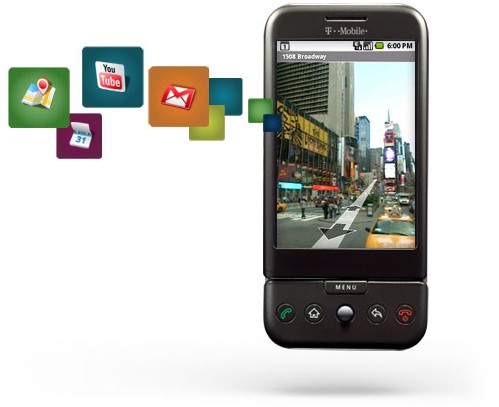
The G1 — at least from what we’ve seen so far — has a “productivity” air to it, which is expected due to the nature of Google. The Android operating system, and the phone’s hardware, was developed first and foremost to showcase what Google does best — search along with Web applications like Maps, YouTube, Google Reader, Gmail, Calendar.

Continue reading »

The roundup of roundups: Everything you want to know about the Google phone (with links!)

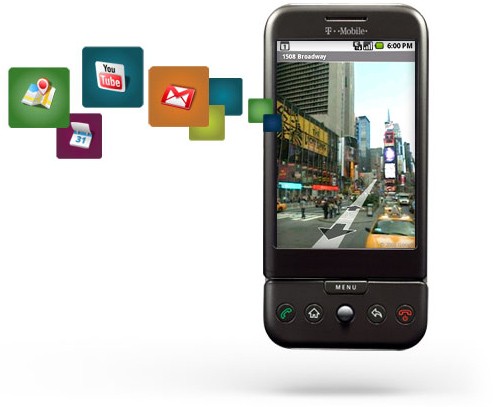
In case you haven’t heard, T-Mobile announced the world’s first — and for the time being, only — cell phone powered by Google’s open-source, mobile operating system today amid much pomp and circumstance.
Cue the band.

You can spend hours thumbing through your bookmarks or RSS feeds looking for and reading about the new T-Mobile/Google phone, dubbed the G1. Most everybody is writing about the same thing — the specs, the looks, the apps, the Android operating system.

But there are a few posts out there looking at the G1 from various other perspectives — advertising, search, what’s missing, and so on. To save you a few minutes, we’ve combed through the basics, looked under the hood just a bit, hit on the basic apps, and compiled other posts of interest for your reading pleasure.

So off we go.

Continue reading »

Time for the big reveal: T-Mobile to introduce first Google Android phone

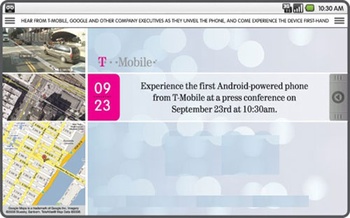
In the language of reality TV, it’s time for the big reveal. Ladies and gentlemen — drum roll please — T-Mobile presents the first cell phone powered by Google’s much-ballyhooed mobile operating system, Android.

Formal introductions will be made at 10 a.m. EST in New York. But, unlike the super-secret debut of Apple’s iPhone in June 2007, lots is known about the so-called Google phone even before its reveal.

It will be known as the G1, but popular culture is sure to call it the first Google phone, gPhone, or Gphone. So, without further delay, here’s the Gphone brought to you by the carrier T-Mobile and hardware manufacturer HTC.

G1 Specs

No surprise here: The G1 will sell for $199 (the same as the iPhone) with a low-cost data plan (which remains to be detailed).

According to TmoNews, the phone is 4.6 x 2.16 x 0.63 inches, weighs 5.6 ounces, an features a 480 x 320 HVGA display. Of course it uses the 3G network, has built-in GPS, has a 3.1-megapixel camera, has 8 GB of memory, has five hours of talktime and 130  hours of standby (we’ll see about that).

Continue reading »

The Google phone is on its way: a checklist for success

The long-awaited Google phone will be announced next Tuesday, so says the Wall Street Journal, Reuters, and the rest of the Web. The phone, which features the first release of the Android operating system, will be available near the end of October.

Coincidentally, Google today showed off a fairly polished version of Android and its HTC-manufactured hardware at Google’s Developer Day conference in London. Check out the YouTube demo video for details.

The upcoming news conference and the nearing release date got me thinking about what I’d like to see in the first Google phone. What I want isn’t a wish list, per se, but more of a checklist.

Here goes.

Continue reading »

“Family Guy’s” MacFarlane debuts “Cavalcade of Cartoon Comedy” on Web

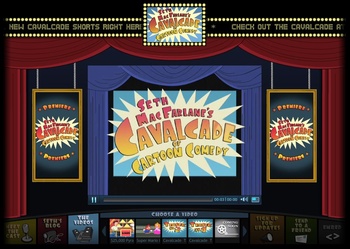
Seth MacFarlane, the creator of “Family Guy,” launched his Google-distributed “Cavalcade of Cartoon Comedy” today in which Super Mario rescues the Princess, who refuses to kiss him for his trouble.

It wasn’t bad. The sketch was short, bite-sized, and worth a laugh or two at the end. If it follows MacFarlane’s work with “Family Guy,” the “Cavalcade of Cartoon Comedy” will only get funnier and, most likely, crude and rude.

What’s interesting about the “Cavalcade of Cartoon Comedy” — available at sethcomedy.com and the show’s sponsor Burger King’s YouTube channel — is that it’s a part of the Google Content Network, which is a part of Google’s AdSense Network.

The Google deal calls for 50 mini-episodes, ranging from a minute to no more than two. For now, the two available episodes feature a pre-roll sponsorship ad from Burger King animated in MacFarlane’s “Family Guy” style of animation.

MacFarlane and Google expect the “Cavalcade of Comedy” shorts to populate the Internet as fans can embed their favorite episodes on thousands of Websites and blogs. As Ars Technica notes, the interesting part of the MacFarlane-Google experiment is revenue distribution.

Each time someone clicks on a “Cavalcade” video or ad, advertisers will pay a fee that is split between MacFarlane, Google, Media Rights (the production company), and the site hosting the video.

MacFarlane’s “Cavalcade” is a notable experiment in original Internet distribution for a content creator, Google, and the TV industry. It’s the first series with major advertising and production funding.

And it doesn’t hurt to have MacFarlane behind the art board.

Why Chrome is a win-win for Google

For those that have been off-line for the last few days and without access to a television or other forms of old media, Google has announced and released the first version of its own web browser called Chrome (see ReadWriteWeb’s extensive coverage).

But do users and developers alike really need another browser? Google says that Chrome recognizes and builds on the best innovations of its competitors, but more importantly has built a web browser from the ground up to cope with the shift towards cloud computing in which the web has “evolved from mainly simple text pages to rich, interactive applications.”

“What we really needed was not just a browser, but also a modern platform for web pages and applications, and that’s what we set out to build”, says Google.

A few examples of how Google has put this into practice with Chrome include a faster JavaScript engine called V8, and “multi-threading” so that if a web app running in one tab crashes it won’t impact on the performance of other open pages/apps.

It’s highly debatable, of course, whether Google can be any more successful than others who have tried to grab market share from Microsoft who bundle its own Internet Explorer with the various flavors of its Windows operating system.

It could be argued, however, that whatever Chrome’s eventual market share, it serves as a win-win for Google. Here’s why:

Continue reading »

Android Developer Challenge winners appear polished, ready for sale

It looks like Google may have made the right move with the Android Developer Challenge after all.

The winners of the first developer challenge, announced this evening, appear polished, well thought out, and ready for the first Android-powered phones to hit the streets in the not-too-distant future.

The Android Developer Challenge provides yet another contrast to Apple and its iPhone. Apple announced a software developers kit (SDK) for the iPhone this spring and a few months later the first iPhone/iPod touch applications went on sale at the App Store July 11.

While many of the iPhone applications performed flawlessly, many felt rushed and suffered from buggy behavior. Subsequent releases worked out the kinks.

Google certainly has had its share of problems with the Android SDK and cranky developers, but these Android apps seem tight, well developed, and ready for sale. Of course, final judgment cannot be levied until we actually have working Android phones in our hands and these applications running.

Of the 50 applicants that emerged from Round 1 of the ADC, 10 were awarded $275,000 each for their efforts, with another 10 receiving $100,000 each. A complete listing of winners and entrants is here.

The $275,000 winners include:

Continue reading »

What’s in a name? Google’s announces the Android Market, not the Android Store

The choice of name says it all: Android Market, not Android Store.

By design, Google is preparing the equivalent of an open-air marketplace for applications that will run on Android-powered smartphones. Google, which announced the Market late this afternoon through its Android developer blog, believes that developers should have an “open and unobstructed environment to make their content available.”

It’s a stark contrast to Apple’s App Store, where developers must submit applications for approval before release. The process has miffed many developers because their iPhone and iPod touch programs may take days, or weeks, before they show up for sale in the App Store.

Like a market or bazaar, Android developers can show up, set up shop, and sell their wares hassle free. Developers can submit applications to the Market using three steps: register as a merchant, upload and describe the content, and publish it.

Continue reading »

Why Google should have developed its own Gphone

It’s been almost a year since I wrote “The Gphone is coming; how Google could rewrite the rules.” And during this time I’ve wanted to give Google the benefit of the doubt for choosing its Android strategy over developing the phone itself.

But I can’t. It’s the wrong strategy.

Whether the Google phone comes out in September, or later this year, or sometime in early 2009, it really doesn’t matter. All this bickering over supposed hardware delays, software issues, and hurt developer feelings has me wondering how Google would have fared if it had taken a different path and developed the Gphone on its own.

Why should Google do this?

Continue reading »

Report: HTC’s Android-powered “Google phone” may be delayed after all

I hate to say I told you so, but I told you so. Developing a phone — even if it is just an operating system — is not something you do overnight with a bunch of cajoled software developers.

Just a week after High Tech Computer (HTC) said it was on schedule to deliver Android-powered cell phones by the 4Q of 2008, another report surfaces Thursday that says HTC is “having structural problems to incorporate Google’s demand feature set” and “demanding a guaranteed minimum revenue surety from Google,” according to Barron’s Tech Trader Daily.

Barron’s picked up a research note from Trip Chowdhry of Global Equities Research saying his “contacts” contend that HTC’s Android handset — the so-called Google phone — will be delayed until the first quarter of 2009.

Additionally, Chowdhry’s “contacts” tell him that another problem Google is having is attracting software developers to the platform. They’re too busy writing code for Windows Mobile, Nokia (Symbian), Research in Motion (BlackBerry), and Apple’s iPhone.

That’s no surprise. These guys actually have phones, real working phones, to develop for and test.

Continue reading »

Q&A: Nicolas Gramlich of anddev.org talks Android, Google’s developer relations, and more

Talking down Google’s Android mobile operating system has become pretty easy of late: An incomplete and buggy SDK, favoritism towards select developers, a general lack of transparency, and valid concerns that the platform could become fragmented and that Google has ceded too much control to carriers.

Yet, for the most part, the initial excitement and optimism over the long term potential of Android remains. Not least for 21 year-old Nicolas Gramlich, a computer science student at the University of Applied Sciences Mannheim in Germany, and founder of anddev.org, an online community for Android developers. “Android’s main attraction is its simplicity”, says Gramlich, which enables the rapid development of “feature-rich applications”.

See also: Interview: zintin CEO talks iPhone, Android and mobile future

“One can create an application that uses Google Maps, get the current GPS-position or read out the accelerometer within 10 lines”. The integration with Google Maps is especially tight, he says, something that doesn’t currently exist on other mobile platforms. And Gramlich should know. His first Android effort is a free navigation app called AndNav!.

In a short Q&A with last100, Gramlich discussed the slow progress Google appears to be making in updating the Android SDK, the company’s relationship with the developer community, competition from iPhone, and more. Read the transcript, edited for space and clarity, after the jump.

Continue reading »