Archive for the ‘Other’ Category

What if Apple re-enters the console gaming market through the iPhone?

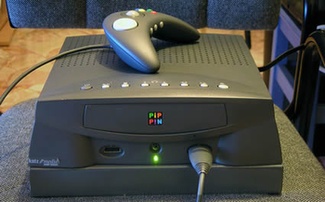
apple\'s pippinI’m going out on a limb here because I’m more of a casual gamer than hardcore. But lately I’ve been wondering, with the coming iPhone 2.0, third-party applications, and expected mobile games, might Apple return to the game-console market?

I know: That’s crazy talk. Apple’s last foray into console gaming was 1996’s Pippin, named as the 22nd worst tech product of all time in a 2006 story in PC World magazine. Since then, we’ve seen the advent of Sony’s PlayStation, Microsoft’s Xbox, a slew of Nintendo consoles, and no new attempt by Apple to introduce a game console.

But Terrence Russell of The Industry Standard wonders, like I have, that maybe Apple might be following a different path into gaming — through the mobile market.

“Consumers are already ga-ga over Apple’s mobile devices to begin with,” Russell writes, referring to the success of the iPhone and iPod line of products, “so whether they should be re-imagined as gaming gadgets is more of a marketing issue.

“But with the developer community in a tizzy to create the next great Apple-friendly game, it’s only a matter of time before Cupertino announces that it’s ready to connect the dots.”

Maybe.

Continue reading »

Sony's PS3 DVR PlayTV launch date and price confirmed

Piece by piece, Sony’s PS3 has the potential to be one of the best, if not the best, media centers on the market.

Ability to stream content from a Windows PC (or Mac) to a television? Check.
DivX support? Check.

Blu-ray player? Check.

USB device support? Check.

Portable integration? Check (via the PSP).

DVR functionality? Announced.

Movie download store? Coming soon.

It’s just that most consumers don’t know it.

Perhaps that will change this September, in Europe at least, when the PS3’s DVR add-on finally goes on sale.

Continue reading »

More to the story: Apple announces new movies available for purchase from all major studios

movies to buy from itunesLess than 24 hours later, we find that there’s more to the new-release movies-on-iTunes story.

Today Apple announced that new movie releases from major film studios are available for purchase on the iTunes Store the same day as their DVD release.

The day before, Jeff Bewkes, the Time Warner chief executive, let slip on a conference call that Warner Brothers studio will now release movies for video-on-demand systems the same day they are released on DVD.

Joining Warner Brothers are 20th Century Fox, The Walt Disney Studios, Paramount Pictures, Universal Studios Home Entertainment, Sony Pictures Entertainment, Lionsgate, Image Entertainment, and First Look Studios.

Continue reading »

"31 Days of the Dragon", a super duper HP notebook giveaway

We’re pleased to announce that we’ve been selected to be one of thirty one blogs taking part in a super duper giveaway courtesy of HP. Dubbed “The 31 Days of the Dragon“, beginning this week 31 blogs that cover gadgets and the digital lifestyle will start giving away a HP HDX Dragon 20inch notebook each, loaded with “stuff”, every day for 31 days. The HP HDX dragon is a seriously high-end entertainment machine, and not for the feint hearted, sporting a 20.1″ display, Intel Core 2 Extreme x9000, 4GB of Ram, Blu-Ray drive and lots more including a good few games and Blu-Ray movies to get you started (total retail price approx $5,000).

Please note: the competition is now closed.

The winner has been announced.

Each participating blog will be running its own contest (with total freedom to set to the rules) that will be open for seven days with the first contest kicking off this Friday (May 2nd).

More importantly, last100 will open its giveaway on the 16th of May (a Friday), with the winner announced one week later. You’ll have to wait till then to find out how you can enter, but rest assured it should be fun and relatively painless 🙂

Continue reading »

Five companies that sold customers down the DRM-filled river

Five companies that sold customers down the DRM-filled riverThe news last week that Microsoft plans to turn off its verification servers for its now-defunct MSN Music store, is a stark reminder of the potential pitfalls customers face whenever they purchase content crippled by Digital Rights Management (DRM) software. Any digital store that sells or loans you content in a copy-protected format makes you a hostage to that store or format’s commercial success. The Microsoft example, however, is just one of many. Here are five cases where companies have sold their customers down the DRM-filled river.

Continue reading »

Microsoft's "Mesh" wants to be your digital hub

Microsoft's Yesterday, Microsoft unveiled its much rumored “Mesh” platform, a service designed to be the hub of our digital lifestyles: “Imagine all your devices—PCs, and soon Macs and mobile phones—working together to give you anywhere access to the information you care about”.

Mesh – currently in limited Beta – “synchronizes data across multiple devices (currently just Windows computers, but theoretically it will extend to mobile and other devices in the future) as well as to a web desktop that exists in the cloud”, writes Josh Catone over at our sister blog ReadWriteWeb. The service also has a social aspect too, enabling collaboration and sharing. “It can sync data across devices used by a single user, as well as create shared spaces for multiple users”.

Continue reading »

Sony delays Home a second time; it's now a year behind schedule

sony homeLast100 editor Steve O’Hear asked me today why, in a post about Sony’s movie/TV download service for the PlayStation yesterday, did I use the phrase “may launch” in the headline.

I thought about it, and I guess it was an oversight. I should have been more concrete: Sony is launching a movie/TV download service for the PlayStation.

But I explained that there is something deeper in my psyche that probably chose “may launch”: I don’t trust Sony these days. This movie/TV download service isn’t the first one the company has tried, and it’s not the only one that’s been on the drawing board.

Today comes along the news that Sony is delaying the debut of Home, its Second Life-like 3D virtual online community service for the PlayStation 3. See what I mean? Home has now been delayed twice and is now at least a year behind schedule.

Sony now expects a test version of Home to be available this summer for a limited number of users in Japan, the U.S., and Europe. After getting user feedback and making tweaks, Sony will release a beta of Home for all PS3 owner to try this fall.

Continue reading »

Where do you get your recommendations on the Web? From a service like The Filter? Or from friends?

It’s hard to fault Peter Gabriel’s logic: We are overwhelmed by the amount of information and choice we have on the Web. But is his solution — a recommendation engine called The Filter — really the answer?

Of course Gabriel, the genius behind the British rock band Genesis and the solo artist who gave us such tunes as “Solsbury Hill,” “Exposure,” and “Games Without Frontiers,” thinks so as he and England’s Eden Ventures have invested $8 million in The Filter. They believe people are overwhelmed by the Web and can’t find good content because it’s buried out of sight.

“When you drown people in an ocean of information, you’ve got to give them navigation tools,” Gabriel told News.com. “I know that there is better stuff out there than what I generally am exposed to . . . So if I have a sort of intelligent ally working with me 24 hours a day, I think I have a much better chance of getting stuff that will entertain, excite, and inspire me.”

The Filter, originally launched as a music recommendation service about a year ago in Europe, re-launched today in private beta as a more complete solution. It will be available to the public sometime in May.

But there’s something about The Filter that bugs me. What separates The Filter from any of the other algorithm-based recommendation engines out there, whether a human is a part of the process or not — Amazon, iTunes, lastFM, Netflix, Imeem, Digg, Pandora, and many more?

Continue reading »

FUD permeates analog-to-digital TV conversion in the U.S.

It seems like a straight forward proposition, but there’s FUD — fear, uncertainty, and doubt — swirling around when it comes to the upcoming U.S. digital TV conversion.

By Feb. 18, 2009, all broadcasters in the U.S. will be required to unplug their analog signal to broadcast solely on the digital spectrum. Considering the government just auctioned off freed-up spectrum, there’s no turning back.

This far into the 2000s, this far into the digital age, you’d think the Big Switch would be a minor inconvenience for most people — that their primary TV sets are new enough to handle a digital signal, that whatever analog sets are in use are connected to a TV delivery service like cable, satellite, or fiber, and what analog sets connected to an antenna are located in spare bedrooms or the garage.

But the digital TV conversion is surprisingly controversial with government bodies, industry and consumer advocacy groups, trade organizations, manufacturers, marketing researchers, and consumers pointing fingers and forecasting doom and gloom.

In February, at the one-year-to-go mark, politicians and a Federal Communications Commissioner were putting the heat on the government to get its act together before it’s too late. Jonathan Adelstein, the commissioner, warned there would be a “state of mass confusion” if various Federal agencies don’t coordinate their efforts to inform the public sufficiently that Feb. 17, 2009, is the last day of analog broadcasting.

The next day, an estimated 21 million households with TV sets that receive only over-the-air signals will go dark.

FUD, indeed.

Continue reading »

Chumby gets $12.5M… here's why it's taking off

This post is syndicated from ReadWriteWeb.

Chumby Industries, makers of the Wi-Fi video and widget displaying device, the Chumby, have just announced $12.5 million in Series B funding today. The company notes that this new financing is going to be used to “accelerate growth of the company, and expand and broaden the Chumby Network to other screen-based Internet connected devices.” How did this little gadget get so popular? And why would you want one? Read on to find out.

Continue reading »