Author Archive

The mobile web isn't dead. It's just starting.

mowserThe mobile Web is dead! The mobile Web is dead! The mobile Web is dead!

Or says Chicken Little, aka Russell Beattie, the founder of Mowser, a Menlo Park, Calif., startup focused on mobile Web browsing. Beattie delivered the news Monday that Mowser “is at the end of its life in its current form.”

For that, I am truly sorry. Beattie, who has invested everything he has in Mowser for the past year, is a gutsy entrepreneur who knows a little something about mobile. From November 2004 to September 2006, Beattie worked at Yahoo! creating mobile products and content.

Beattie left to launch Mowser, a Web site focused on content adaption for mobile phones. You can read about his experiences on his blog, but what it all comes down to after a year of intense work is that “I don’t actually believe in the ‘Mobile Web’ anymore” and the market “is limited at best, and dying at worst.”

Continue reading »
FUD permeates analog-to-digital TV conversion in the U.S.

It seems like a straight forward proposition, but there’s FUD — fear, uncertainty, and doubt — swirling around when it comes to the upcoming U.S. digital TV conversion.
By Feb. 18, 2009, all broadcasters in the U.S. will be required to unplug their analog signal to broadcast solely on the digital spectrum. Considering the government just auctioned off freed-up spectrum, there’s no turning back.

This far into the 2000s, this far into the digital age, you’d think the Big Switch would be a minor inconvenience for most people — that their primary TV sets are new enough to handle a digital signal, that whatever analog sets are in use are connected to a TV delivery service like cable, satellite, or fiber, and what analog sets connected to an antenna are located in spare bedrooms or the garage.

But the digital TV conversion is surprisingly controversial with government bodies, industry and consumer advocacy groups, trade organizations, manufacturers, marketing researchers, and consumers pointing fingers and forecasting doom and gloom.

In February, at the one-year-to-go mark, politicians and a Federal Communications Commissioner were putting the heat on the government to get its act together before it’s too late. Jonathan Adelstein, the commissioner, warned there would be a “state of mass confusion” if various Federal agencies don’t coordinate their efforts to inform the public sufficiently that Feb. 17, 2009, is the last day of analog broadcasting.

The next day, an estimated 21 million households with TV sets that receive only over-the-air signals will go dark.

FUD, indeed.

Continue reading »

In a departure from business as usual, ESPN syndicates video content on AOL

espn on aolIn a significant departure from business as usual, ESPN for the first time is syndicating its short-form video content through AOL Video.

ESPN currently syndicates video on mobile devices but has restricted video clips to its own Internet properties. ESPN says the strategy has been successful as fans viewed ESPN.com videos more than 1.2 billion times in 2007, a 54 percent increase over 2006. On average, fans viewed more than 105 million videos per month last year.

So why get involved with AOL?

Despite the fact that ESPN was the 13th largest distributor of video on the Web in February (according to Nielsen’s VideoCensus), ESPN will get more distribution and exposure for its video through AOL — and the ad revenue that goes along with it. AOL gets more content to differentiate it from other video aggregators.

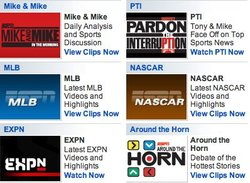
Videos via an embedded ESPN video player will include highlights from games and major sporting events, breaking news, as well as clips from ESPN’s original programming, including “SportsCenter Right Now,” “Mike and Mike in the Morning,” and “Around the Horn.”

NHL's broadband effort is strategic, organized, and not so piecemeal

nhl networkBack in December we noted how the professional sports leagues in the U.S. were displacing traditional media as a first-stop source for all your major-sports needs. At that time, the NFL, Major League Baseball, the NBA, and the NHL were all over the map with their online offerings.

While content was dizzyingly plentiful, it often felt like the sports leagues were throwing everything they had at the Web. Sometimes an overall strategy was apparent. Most of the times there was none.

The National Hockey League (NHL) is tidying up its broadband efforts by introducing a new higher-quality video player for nhl.com, a bunch of new channels, and more advertising options just in time for the Stanley Cup playoffs, which begin Wednesday.

Continue reading »

What's next? Madonna in my corn flakes?

madonna hard candyRecord labels sure seem desperate these days to get their music in your hands any way they can. What’s next? Free music in your corn flakes?

Samsung, the No. 2 mobile handset maker, has signed a deal with Warner Music that will put Madonna’s upcoming album “Hard Candy” and video for the single “4 Minutes” preloaded on its F400 music phone.

Granted, the F400 comes with Bang & Olufsen speakers, but come on. What will any of the players gain here?

Will Madonna sell more Samsung F400 phones?

Will Warner Music sell more Madonna (or music from its catalog) just because it’s on the latest Samsung music phone?

Will Madonna sell more albums and ancillary content because she’s so cutting-edge mobile?

What’s Madonna demographics these days anyway? Aging pop fans with disposable income willing to buy yet another cell phone? Do the world’s youth even care about the Material Girl, even if she does say this next album “will kick your ass?”

In case you are one who does care, Madonna’s “Hard Candy” will be released April 29 — and the F400 is already available in the U.S. The F400 will be released in “early June” in France.

In other markets, carrier Vodafone and Warner Music have an arrangement that will make the new music and other content from “Hard Candy” available exclusively to Vodafone mobile customers prior to its general release.

But don’t expect Madonna in your corn flakes. At least not yet.

A reminder for hoops fans: Final Four is broadcast "in the cloud" this weekend

ncaa march madness on demandJust in case you get stuck working this weekend, or you’re at the office late Monday night, don’t despair. For the first time ever, CBS College Sports Network and the NCAA will broadcast the Final Four over the Internet — also the first time that a major U.S. sporting event championship has been shown live online.

The Final Four will be available via the NCAA March Madness on Demand video player.

CBS and the NCAA have made each stage of the tournament available online with great success. From the First Round through the Elite 8, which sets up the Final Four, there have been 4.33 million total unique visitors to the NCAA March Madness on Demand video player, a 147 percent increase over 2007. (tvover.net)

Not only that, but CBS and the NCAA note that 4.5 million hours of live streaming of video and audio have been consumed in the first eight days of the tournament, surpassing the entire 2007 total.

Since NCAA March Madness on Demand began in 2003, the first 56 games have been available online, but the Final Four has not. By the time that one team walks off the court with the championship — let’s hope it’s UCLA — all 63 games of the tournament will have been broadcast over-the-air and “in the cloud”.

Live and in concert: Why MySpace music has a chance against iTunes

myspace musicAt the Family Force 5 concert tonight, the lead singer of the warm-up band The Maine said to the thousands of kids in attendance, “This next song is ‘Count em one two three’, and it’s out on MySpace.”

The significance of John O’Callaghan’s statement is astonishing, especially in light of the official announcement today of the formation of MySpace Music. MySpace, the social networking site that boasts 30 million registered users, has formed a joint venture with Universal Music Group, Sony BMG, and Warner Music Group to make their entire digital music catalogs available for downloading and listening at a new site, which will be introduced later this year. (WSJ, NYT)

EMI, the fourth major label, is not taking part in MySpace Music yet but is expected to at some point. (Previous last100 post.)

MySpace Music will offer paid-for, DRM-free MP3 downloads (no details on pricing or quality), ad-supported music and video streaming, ringtones for cell phones, concert ticket sales, and merchandise. When it’s up and running, MySpace Music will be a direct competitor to iTunes, now the No. 1 music retailer in the U.S., as well as other online music stores such as AmazonMP3.

Analysts are noting that MySpace Music is a step in the right direction for music companies, but that “Apple will not be affected for the first few years because Apple’s iTunes store lives on the strength of Apple devices,” Forrester Research analyst James McQuivey told Reuters.

That may be true. For now. But do not underestimate the influence of MySpace on bands and their fans.

Continue reading »

Paid downloads account for 30% of U.S. music sales; iTunes unseats Wal-Mart as No. 1 retailer

itunes 85Here is a stat I thought I would see one day, I just wasn’t sure when. Paid downloads accounted for almost 30 percent of all music sold in January, bringing even closer the day when the sale of digital music outpaces the physical product.
Here is another stat I thought I would see, I just wasn’t sure when. Apple’s iTunes Store has surpassed Wal-Mart as the No. 1 music retailer in the U.S., according to the NPD MusicWatch Survey (via Ars Technica).

Pretty amazing, considering iTunes opened for business almost five years ago (April 18, 2003). MP3.com, Cductive, eMusic, and others, were attempting to sell digital downloads before Apple, but it was the arrival of iTunes — in conjunction with the sale of iPods to Mac and Windows users — that legitimized online music.

Continue reading »

Whether people want it or not, AT&T will deliver live mobile TV in May

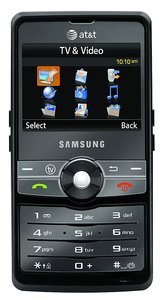
samsung att tvI asked the question in September, and I’ll ask it again: Do we really need live TV on our cell phones? AT&T, the largest U.S. carrier, says we do.

AT&T said Thursday it will offer live mobile TV service from MediaFLO in May through two handsets — the LG Vu and the Samsung Access. Subscribers willing to pony up the extra bucks (prices won’t be announced until later) will receive eight channels of live TV plus two exclusive channels in select markets.

AT&T offers everything from music to Web surfing is looking to live mobile TV as a way to earn additional revenue, something all the carriers desire as cell phone call prices continue to fall. Rival Verizon, the No. 2 U.S. carrier, already offers broadcast mobile TV through V-Cast.

Continue reading »

Motorola's decline in mobile industry has been coming for a long time

old motorola phoneI’m still shaking my head over this one. Motorola, one of the stalwarts of the mobile communications industry, will split into two publicly traded companies in 2009, one for its profitable infrastructure equipment, the other for its not-so-profitable mobile handsets.

How did this happen?

And what does it mean for the mobile industry?

I’ll let Wall Street debate the finer details of how Motorola’s crash-and-burn happened, but it comes as no surprise. I’ve been watching Motorola lose its grip in the mobile industry for almost three years, since the heady days of the Razr.

Back in 2005, Motorola introduced the Razr as an exclusive fashion phone costing $600 with a service plan, $800 without — and people complained that Apple’s iPhone was too expensive at its introduction. Like the iPhone, the Razr was the must-have geek toy of its time.

In 2006, however, Motorola allowed the Razr to enter the mass market as a mid-price (then super-cheap) phone, which lessened its must-have coolness and social impact. It seemed every snot-nosed kid at the mall had a Razr stuffed in a back pocket.

Continue reading »