Author Archive

CBS to introduce new online video player with promising social features

cbs logoCBS Interactive is launching a new online video player this week, with more features to be added throughout the summer. It’s one we may actually end up cheering about.

Our normal reaction to news that a traditional media company is releasing a new online video player might go something like this: Big deal. They’ll just cripple it so we spend time watching shows on their network.

No so fast buckeroo.

AdAge wrote today that the CBS player will use a content and advertising engine powered by technology acquired in the purchase of Last.fm, the popular streaming music site. The new player will include an HD viewing experience that does not require a separate download, sharing features, and social viewing rooms that let people watch and discuss content together.

Continue reading »

Catching up with Time Warner Cable, Blockbuster, TiVo, iTunes UK, and Netflix

time warner cable logoAnother day, another set-top box.

This one comes courtesy of Time Warner Cable CEO Glenn Britt, who told those at the Stanford C. Bernstein Strategic Decisions Conference in New York that the company planned to market equipment to its subscribers to make it easier for them to watch Internet video on their televisions.

Naturally, Britt offered few details, other than to say:

“Right now it’s pretty hard to get Internet stuff on your TV,” Britt said [via Reuters]. “We’re actually going to have equipment we make available to subscribers. It’s actually going to be a new wireless cable modem that will allow you to network everything in your house.”

Naturally, Britt didn’t elaborate or say when the set-top box would be available to subscribers.

“Within a relatively short time . . . it’s going to be very easy to get Internet TV on your big screen TV.”

OK. So Time Warner is throwing its hat into the ring with the likes of Apple and the AppleTV, TiVo, Netflix/Roku, Vudu, Microsoft, Sony, the cable companies, and seemingly hundreds more. As long as we’re watching the vendor sports between these players, we might as well throw Time Warner’s set-top box scheme into the mix.

Catching Up

After the break, a few stories of interest from the just-concluding week.

Continue reading »

Sony's agreement to use tru2way technology will eliminate set-top boxes, but not right away

sony logoDon’t count out the set-top boxes just yet.

The news this week that Sony has signed a deal with the National Cable and Telecommunications Association (NCTA) is essentially good. The agreement will allow people to rid themselves of clunky, mostly ugly, space-consuming set-top boxes and still receive “two-way” cable services such as pay-per-view and video-on-demand movies.

tru2wayTo do this, Sony will incorporate a cable TV technology called tru2way in new televisions. Tru2way is an open java-based platform that allows developers to create all sorts of applications like games, eBay notifications, or interactive guides.

Continue reading »

Google demos Android again; it's full of promise, but we're still waiting for the real deal

android ioGoogle demonstrated its Android operating system again, this time at the I/O conference in San Francisco. And, well, it’s still full of promise, just in case you were wondering.

As you would expect from the company that brings you search and Google Maps, Android handles information delivery, location and navigation extremely well — or so we think. There’s still no actual Android phones to play with.

The coolest feature shown was a “compass” tool that automatically roams with the phone while a user looks at photos of a city map.

But the rest of what was shown was, well, underwhelming or just plain expected.

Continue reading »

Finally! Somebody (Vudu) extends movie-rental deadline beyond 24 hours

vuduSeemingly lost in the news of iTunes, the AppleTV, Amazon’s forthcoming online video streaming service, and the newly available Netflix set-top box from Roku, is Vudu.

Vudu, the movie-on-demand service with its own set-top box, has upgraded its software to version 1.5 — ho hum — but this upgrade includes the ability to extend the rental past the 24-hour deadline.

Yipee!

One of the loudest complaints from people who rent or stream video content over the Internet is that they’re given 24 hours to watch a movie once it has started. If the baby interrupts and you can’t get back to “Atonement” in time, tough. You’ve got to rent it again to finish.

Vudu now allows you to extend the rental period for $2 off HD movies and $1 off regular flicks. The option is available for a week after the movie expires; once chosen, you have another 30 days to watch, 24 to 48 hours (depending on the film) after you hit play. The extension is available only once, although we wish it was without an additional cost [Ed. all rentals should be viewable for 48 hours at no extra cost. The studios are just being plain greedy and demonstrating that they still don’t understand viewing habits. Have they never heard of “no late fees”?].

It’s a reasonable amount of time to finish what you started, or watch again. It’s also something that others — ahem, iTunes — should offer as soon as possible.

Details are scant, but Amazon will be launching online video streaming service soon

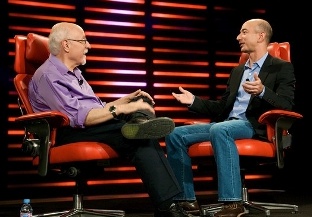
bezos at all things dThe details, unfortunately, are scant. This is what we know:

Amazon, the world’s largest Internet retailer, will be launching an online streaming video service in the next several weeks, Amazon CEO Jeff Bezos said a little too matter-of-factly at the D: All Things Digital conference. (Reuters)

One detail: The streaming service will start immediately for viewers, unlike Amazon’s Unbox product, in which users are required wait a period of time as content downloads.

Another semi-detail: The streaming service will operate a-la-carte, but we don’t know what this means exactly. Can viewers stream movies on a pay-per-view basis, presumably at the industry standard $3.99 per rental? Or will this service operate ala Netflix, where people pay a monthly subscription fee (like $15) for a certain number of movies?

We’re sure additional details will be forthcoming in the coming days, or weeks.

Continue reading »

Location-based services like Whrrl on iPhone to usher in Internet of people, places, and things

kocb logoGet ready for the Internet of people, places, and things. Thanks to the iPhone and Android, it’s just around the corner — no pun intended.

BusinessWeek reports that Kleiner Perkins Caufield & Byers, the venture capital firm behind the iPhone funding program iFund, have chosen two companies as its top picks to date — Whrrl from Pelago and Home Security 2.0 from iControl Networks.

Kleiner Perkins, a big fan of location-based services, has extended an offer to one other startup and are “seriously considering” 10 others, whatever that means.

whrrlWhrrl combines the mapping capabilities of the iPhone with the ability to find information on your friends, where you’ve been, where anybody has been — in essence, connecting people, places, and things. Whrrl currently works on the BlackBerry Pearl and Curve.

iControl’s application isn’t as sexy as Whrrl — it is home automation after all — but it gives users the ability to communicate to the places and things important in their lives, namely their homes or businesses and what’s in them like door locks, air conditioners, lights, and so on.

Add these programs to the applications being developed as part of the Android Developers Challenge (Bread Crumbz, LifeAware, Beetaun) and you can see a locations, locations, locations trend forming. In Wired lingo, it would be:

  • plain old voice communications: “expired”
  • mobile Internet surfing: “tired”
  • using mobile devices to interact with people, places, and things: “wired”

“There’s going to be a ‘what’s going on around me right now’ button,” Kleiner Perkins partner Matt Murphy told BusinessWeek. “You’re always one button away from that immediate context.”

Continue reading »

Viacom seems to have cooled on Joost; is it headed to the Deadpool?

joost logoIt looks as though the once high-and-mighty Joost is running out of juice.

Joost, the peer-to-peer Internet TV service that once raised $45 million in 2006 from investors such as CBS, Viacom, and Sequoia Capital Index Ventures, is revamping its tech platform [last100] with a Web-based service that requires only a plug-in to play in browsers. It’s due sometime this summer.

Currently Joost requires a downloaded desktop client to play peer-to-peer content. It works with Microsoft operating systems XP and Vista and Apple’s OS X (but Intel processors only).

The Web plug-in is clearly a move to stay afloat and relative amid the success of an online streaming site like Hulu, but two of Joost’s biggest investors, CBS and Viacom, have little to say about the service these days.

Viacom CEO Philippe Dauman was less than enthusiastic about Joost in an interview with paidContent, which asked: “Is the service where he [Dauman] thought it would be?”

“We come at Joost or any other platforms from the point of view that we cannot predict — nor did we in that case or any other case — predict which ones are going to be hugely successful, moderately successful, which won’t work,” he said.

OK then.

Continue reading »

Forrester sees picture frames, clock radios, remote controls, and house calls in Apple's future

forresterThis is why the analysts make the big bucks. Predictions. Forecasts. Gazing into crystal balls to come up with . . .

  • Digital picture frames.
  • A clock radio.
  • A remote control.
  • A media server that’s not called a “server.”
  • House calls.

This is Apple’s future, according to Forrester analysts J.P. Gownder and James McQuivey [via Wall Street Journal].

Gownder and McQuivey predict that Apple, who brought us the OS X operating system, elegant computer products, the iPod line of digital music players, the iTunes store, and the iPhone in the past eight years, next will come up with products and services that will connect computers to content throughout the digital home by 2013 [Wired].

Forrester thinks that, judging by Apple’s performance under CEO guru Steve Jobs, the company is set for radical change over the next five years.

But a wall-mountable digital picture frame — even if it looked like a MacBook Air display? A clock radio that pipes music across a home network? An “AppleSound” universal remote control with a touch-sensitive screen? A media storage something-or-other that’s not a “server” because the word “server” scares the average person? And house-call technical assistance from mobile “Genius Bar” workers?

This is a joke, right?

Continue reading »

AT&T says its 3G network is nearing completion; we're not so sure

AT&T says that its rollout of a speedier 3G mobile network is nearing completion in the U.S.

Bull.

AT&T says all it needs to do is add six more markets by the end of June and deployment of High Speed Uplink Packet Access technology — faster access to data networks for mobile phones, for those who could care less about tech speak — will reach more than 280 markets.

So? Will you get 3G speeds where you live or work?

A few miles away from me, in Southlake, Texas, there’s an Apple Store where bunches of people will wait in line, probably in near 100 degree heat, to secure the highly anticipated iPhone 2.0. If they live in the affluent Dallas and Fort Worth suburbs of Southlake or Colleyville or the more modest ‘burbs of Grapevine, Keller, the Mid Cities, Justin, Lewisville — the list goes on — the new iPhone may not receive 3G coverage.

And this is according to AT&T’s own coverage viewer list, which you can review here.

Click on a neighboring city and drill down by zip code, and AT&T’s coverage viewer shows 3G is in every nook and cranny whether a specific city or suburb is listed or not.

Which is it?

Continue reading »