
 There are a vast number of portable media players on the market. They come in all different sizes, colours and configurations, each hoping to capture the greatest market share. The iPod, which has dominated the market since its launch in October 2001, is synonymous with the portable media player, in much the same way as the Walkman and the Hoover are for the personal stereo and the vacuum cleaner. Apple have maneuvered themselves into this position by being early adopters in the market (although they were by no means the first) and by innovating with their design, features and marketing.
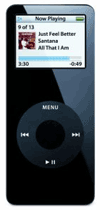
Personally, I own a 2GB iPod Nano (1G). It is great! I use it every day and to be honest if I had to choose I would pick it over my mobile phone. However, it is starting to show its age, not just because of wear and tear, but also because of its design and technical capabilities. This got me thinking as to what features I would like in a media player, and why they’re not available yet. I’ve tried to show no bias towards Apple (or any other manufacturer) but comparisons to other media players are inevitable.
Shape/Size
- Small case
- Soft corners
- Lightweight
There is a trade off with between size and usability — if it’s too big then it’s unwieldy, offers little portability and can be heavy, but if it’s too small then it makes it easier to lose and harder to operate. This is, of course, dependent on the interface chosen for the unit, the resolution of the display and size of the hardware itself. I think the iPod Nano is a good size — I’ve never had any problems with the thickness (or lack of) and the weight is negligible. However, the screen size lacks for video. If the screen was the full width of the unit, the unit a little taller and the screen fitted the 16:9 ratio then this would be more suitable. The soft, rounded corners make sense – no-one wants ripped pockets. My main criticisms are the easily scratched case (the anodized casing on the 2G models may have solved this) and the equally susceptible screen.
Storage
- Large capacity (at least 64GB)
- Solid state/flash memory
- Fast (at least 50MBps read/write)
My music collection in iTunes, which is only a handful of downloads and two thirds of my CDs (ripped at an OK bitrate) is just over 20GB in size. Add to that 2GB in podcasts. Then allow for the rest of my CD collection, and for it all to be ripped at near lossless, then my 2GB device is hardly adequate, and doesn’t even allow for videos, photos or any other media. I’ve listed 64GB above because at the moment that is the largest flash drive that can be bought, although I expect that to change quickly with the market driving it. I think flash memory is the only way to go for media devices; it is smaller, more reliable and less power hungry. I know hard drives are getting smaller (in size), but flash drives are getting larger (in capacity), and by being solid-state they are much, much less prone to crashes and physical damage. Hard drives, however, are much faster than flash drives, although Wikipedia reports that “a South Korean company called Mtron claims the fastest SSD (Solid State Drive) with sequential read/write speeds of 100 MB/80 MB per second.”
Connectivity
- USB2
- Wi-fi
- Wireless USB
 Obviously, any media device needs to have media loaded onto it for it to be of any use to anyone. And for that to happen it needs some sort of interface to an external source. I’ve listed USB2 because its the de facto standard for peripheral connections, plus its fast and reliable, and I think a wired connection should be included as a backup to any wireless system. Wi-fi connectivity would be a must-have inclusion for iTunes-style media purchases direct from the internet and for networking with other machines for retrieving media. It would also allows for streaming ala AppleTV of film and TV content from the device to a remote receiver. However, this may be usurped by wireless USB, the emerging standard for connecting devices at speeds of 480Mbps within a 3m radius.
Compatibility
- All video/audio formats
- Identical software for any platform
Ideally any media player will be compatible with any media format, and could be easily expanded to cover any new formats via software updates. Also, I think that the application used to manage the media player (e.g. iTunes, MusicMatch, WinAmp, etc.) should be identical on any OS. This makes the transition from machine to machine much smoother should the device be used on any other.
Interface
- Touch screen
- Navigation buttons
I’m obviously influenced by the iPhone’s interface here (although I haven’t actually used it) but the idea of a touch screen for browsing and organising media makes sense. Being able to manipulate albums and photos like they were physical objects is appealing and easy to get used to. However, I like the idea of easily placed navigation buttons for back/forward for easy flicking from track to track when in your pocket or maybe handheld while jogging.
Software
- Internet browser
- Intelligent playlist organisation
 The basic software of any media player, which allows you to browse and selects tracks to play, leaves little room for improvement. However, I think that playlist management can be improved massively. With a large storage capacity, a portion should be set aside which monitors the users listening/viewing patterns and recommended media based on previous activity, i.e. they’re skipping any fast tracks, plus they’ve manually selected some jazz tracks, so lets try suggesting some more laid back jazz. With a large media library it becomes very difficult to just suggest tracks at random and achieve a great degree of accuracy to the users tastes without some sort of intelligent filtering. I also think that the unit should have some sort of web browser included, but tailored to music sites, with seamless in-browser media playing and linked to the intelligent playlist software (“Ah, they’ve browsed the U2 site – lets try offering The Fly”.)
Verdict
In conclusion, many of the features described above are available or are in development. It is only a matter of time before the cost of components comes down enough to make it possible for my ideal media player to become a reality — at a mass market price point.

I would argue that 3G connectivity would be nice for ubiquitous music streaming and downloading.
@Coleman
That’s a good call, if it weren’t for the mob. networks getting in the way. On the other hand, a beefed up iPhone with proper third-party dev support would quickly match the spec for an ideal PMP that Ryan has outlined. With 3G a possibility too.
NERDS!
I can tell you that yes, there are SSD drives that can read/write at those speeds. I work
in hardware test/develop and have testyed these drives. Can’t wait to create my own
media player using one of these drives.
Yeah everyone wants one of these because it is unrealistic at this time. To have all of these specs and keep the size and price down is an absurd idea. Stories like this are bring digg down. Thanks for making digg a dumber site.
Much love
I already have most of this using a Dell Axim, (although any handheld would probably work) with a compact flash card and an SD card. I use TCMP to play almost anything, and it only takes a few seconds to pull the card out of my Axim, jam it into the computer and load any file I want.
I just wish I could use something better than Windows mobile POS software on it.
as far as flash card size, the only problem is $. it takes a bunch of dollars to get to 64GB. personally I wish I could put in a SATA laptop drive, but I also wish I could hook up a printer. then I wouldn’t need a laptop.
The closest I’ve ever come to the perfect player was the iRiver iHP-120. It was a player years ahead of its time:
– Support for MP3, WAV and Ogg Vorbis
– Remote control with LCD that replicated all the functionality of the player
– Integrated microphone, with recording function in MP3 and WAV
– OPTICAL LINE IN AND LINE OUT. No other player has ever had this!
– Support for playlist, database, and file navigation
– Actually decent body that doesn’t get scratched by your jeans’ cloth (iPod I’m looking at you)
– Integrated radio.
– 20 GB capacity. Nowadays you can replace the drive for 60 GB.
Of course it’s very think by today’s standards, and the interface was in black and white. But the general idea as far as features went is still unmatched today, more so now that it can run the custom Rockbox firmware that adds even more features.
I doubt that support for “all” video is of any use. Is it really desirable to play DV or high-def content on a portable device? What I would like to see is a simple plugin system for formats, similar to how Winamp accomplishes the task.
All audio/video formats? You realize that the only way portables have good battery life for playback is when they have dedicated hardware decoder chips, right? I’d put your little fantasy device at least 10 years away- 6 years for the technology to come and another 4 to get the interface right.
Stop whining. I will give an analogous example of my ideal car:
Styling: sleek lines, unique look, excellent aerodynamics from low-profile design.
Performance: 500hp gas engine 100mpg with hybrid drivetrain of 300 mile battery-only range. Cornering should be above 1g on skidpad, 4-wheel drive too.
Features: Must carry family of 8 and 4×8 sheets of lumber while towing my boat. Must have 8″ ground clearance for my off-road trips. Entertainment system should sound like I’m in a concert hall even when I’m tearing up a dirt trail.
Maybe if you understood anything about how portable players are designed you could know the difference between being realistic and just naming every feature you can think of. A device with everything you ask for has already been made. They’re called laptops.
Worst article. Ever.
A few of your software-related complaints (mainly file format support) can be addressed by using RockBox (http://www.rockbox.org/), a 3rd-party OS/firmware for many PMP’s. I actually have a 4GB 1st-gen nano, use Rockbox, and LOVE it. Support for the 1st-gen nano is almost flawless. The screen is so small that you’ll need a magnifying glass to watch video on it, though.
I totally agree, though I think that 64gb is a bit overkill. 2gb of podcasts ? Sorry but you’re just weird if you have that many that you have yet to listen to, or just way too much time on your hands.
Drag and drop functionality is indispensable for me and too few players have it. I don’t want iTunes crap on my computer.
It absolutely, positively, without a doubt must have a stereo line-in jack and be able to record to stereo 128kb MP3 or to 44.1/16bit WAV/AIFF. Preferrably with a built-in stereo mic as well.
That’s why I love my Neuros, even though it’s huge and arcane.
Yeah, I don’t understand the point here, I admit. If you are basing the specs for your ideal music player on what is *currently* available, then your player is going to wind up at least as large as a Zune, which everyone will agree is too large. On the other hand, if you are ignoring what is currently available, then I I feel sorry for your lack of imagination. If your ideal player is pure fantasy, then why not ask for a projection screen, noise cancelling (mic + dsp processing), and a dancing hula girl that pops out of the screen on rainy days to make sweet love to you?
I must say that an internet browser that uses the wifi would be awesome, I had a PSP and I used the built-in browser almost daily, it was great.
http://www.archos.com You can even draw a little i in front of the name if it makes you feel better….
check out the HTC TyTN
If you want the perfect Video PMP, you should check out the Archos 605 WIFI 4GB. It is flash based, plays all video formats (ie DIVX), has Wi-Fi, and a touch screen. And it is only $229!
http://www.archos.com/products/gen_5/archos_605wifi/
http://www.amazon.com/ARCHOS-605-4GB-Flash-slot/dp/B000S5UY1M/
BTW, Walkman was a bad example. Xerox or Kleenex would have been better.
Fail. Epic fail.
My old karma has 20gb of space, 16+ hours of battery life, support for mp3/aac/ogg/FLAC/wav, an excellent eq, great sound quality and a nice interface. It’s a little fat, but aside from that it kicks any ipod’s ass.
All you iFanboys make me sad.
This piece is pretty unimaginative. I’m obsessed with the pull between small size and big screen, and I think the near-term answer is a device that folds. The distant answer being a device that displays content close to or perhaps directly on your eyes.
I like BlackBerry actually..
How about Nintendo DS w/ and R4
Nice summary of needed features, hopefully we’ll see a product with all those features in the near future.
To me, iPod nano remains the most lightweight portable player in the current market.
It is so easy to say….I want 64GB memory, light weight and portable, should play all types of music files….”
I work for a chip company and man what you get is the best ..it can’t get any better. It is not just the question of price as you can see with Apple iphone, but it is the question of having all the features in a good design.
Apple might be considering ipods with full screen and touch controls…that ‘t the max you can get…wake up to the real world my friend….
I can’t believe anyone would admit to using iTunes. Are you sad enough to still be using a mac or were you just dropped on your head as a child.
whhhoooaaaa, narly dude, to nurdish for me, im out
I can tell you that yes, there are SSD drives that can read/write at those speeds. I work
in hardware test/develop and have testyed these drives. Can't wait to create my own
media player using one of these drives.