
Users who are complaining that they can no longer access the online video site Hulu on through their PlayStation 3’s web browser are being given an official explanation. The short version: it’s not Hulu’s fault per se but the result of keeping content owners, who don’t want the service to compete with revenue generated by traditional television distribution, happy.

After rumors of a third change in direction, Joost, the Internet TV startup that just won’t seem to die, has announced plans to focus less on its own online video portal and instead tout the company’s newly launched white label service to “media companies, including cable and satellite providers, broadcasters and video aggregators.”


In other words, the company, which was founded by Niklas Zennstrom and Janus Friis of Skype fame, has conceded that ad-revenue alone can’t pay the bills and, instead, hopes that Old Media will.
Interestingly, on the same day as Joost’s announced change it direction, it’s been reported that rival Hulu alone boasts 10 percent of the online video ad market.
Based in the UK, I don’t have access to the US-only video site Hulu. But if I did I’d no longer be able to access the studio-backed Internet TV service on my PlayStation 3.
That’s because, following the Boxee fiasco, the game console has become the latest means by which to conveniently watch Hulu content on a television to be blocked, reports Engadget.
Users who try to visit the site via the PS3’s built-in web browser are being greeted with the message: “Unfortunately, this video is not available on your platform. We apologize for any inconvenience.”
You’ll remember when Hulu decided to block desktop Internet TV browser Boxee for having the audacity to provide a better user experience for playing back the online video site’s content on a television. Content that originates on TV in the first place! At the time Hulu defended the decision, citing the requests of content owners not the policy of the site itself. And yet today, Hulu have made available their own desktop application (Mac and Windows) that features a “ten foot” user interface designed specifically for operating with a remote control, providing a much better experience when viewing Hulu content via a PC connected to a TV.
Hulu Desktop is a lean-back viewing experience for your personal computer. It features a sleek new look that’s optimized for use with standard Windows Media Center or Apple remote controls, allowing you to navigate Hulu’s entire library with just six buttons.
You can download the Hulu desktop app from the site’s new “Labs” section. Don’t think about running Hulu Desktop on anything other than a PC, however, such the AppleTV set-top box, unless you’re cool with breaking the software’s terms of service (via NewTeeVee).
March 12th, 2009 | Posted in Net TV | Comments Off
Right in time for its first anniversary, video site Hulu has announced that it is dipping its toe into social networking. Similar to competitors CBS-owned TV.com, Joost and Sling.com, the NBC Universal and News Corp. joint venture is rolling out a feature its calling ‘Hulu Friends’ whereby users can create profiles and, optionally, share their viewing activity with other members of the site. Contacts/friend-lists can be imported from both Facebook and MySpace, along with popular web-based email services, such as GMail.

The upside for Hulu, presuming they can persuade users to join yet-another-social network: As paidContent notes, “the direct sharing of video preferences and content within Hulu will make it much more easy to track what individuals are watching and hence, make them more targetable for ads.”
The news that Hulu has asked Boxee to remove access to its content is ridiculous on many levels.
Not least is the fact that, in relation to Hulu, technically speaking Boxee is just a web browser that happens to be optimized for a ‘ten foot’ or TV-like viewing experience rather than for when you’re sat directly in front of the PC. And crucially, since Boxee has yet to license its software to set-top box makers or build a box of its own, the only way to get Boxee content onto a TV is via a PC (aside from running Boxee on a hacked AppleTV). Once the PC is using the TV as its monitor, any content can be displayed on the television, including using a standard web browser such as Firefox, IE or Safari to access Hulu or any online video site. All Boxee has done is design a better browsing experience for when you’re sat further away. In other words, Boxee alone doesn’t enable Hulu to be viewed on the TV, it just makes it more convenient.
October 10th, 2008 | Posted in Net TV | Comments Off
We wouldn’t call YouTube a sleeping giant necessarily, but when it comes to long-form video the world’s dominant video-sharing site certainly seems to be cat-napping.
Other sites such as Hulu, the joint venture between Fox and NBC, have been getting much of the long-form video attention and name recognition, whereas YouTube remains known for short-form content that lasts 10 minutes or less.
Google, YouTube’s parent, is seeking to change this as it has added select full-length content from CBS in an attempt to take on Hulu and attract other network content to YouTube. [YouTube blog]
Available full-length shows include 20- to 48-minute episodes from CBS’s past and present lineup, including “Star Trek,” “MacGyver,” and “Beverly Hills 90210.” The season premiers of “Dexter” and “Californication” and current episodes of “Young and Restless” will also be shown on YouTube.
Say goodbye (and good riddance) to Amazon Unbox and say hello (and welcome) to Amazon Video on Demand.
Amazon launched its new video streaming service Thursday. After a quick downloading and viewing of the TV show “Eureka,” we say Amazon Video on Demand is a worthy contender to Apple’s iTunes.
For one, Amazon’s new video service works where Unbox failed — it plays on Macs. And, another plus, the video starts steaming instantly. A big improvement over the boxy Unbox.
At the time we liked the fact that a TV exec, Bruce Rosenblum, got the whole TV-on-the-Web thing. “We can’t stick out head in the sand and not acknowledge that there’s an evolution taking place,” he said in April.
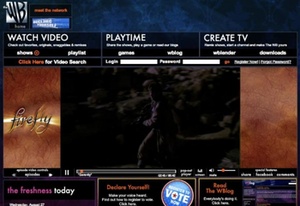
TheWB.com is rich on content if you like older programs such as “Friends,” “The OC,” “Veronica Mars,” “Buffy the Vampire Slayer,” and “Angel.” It even has full shows of “Friends,” “Gilmore Girls,” and “Veronica Mars” that cannot be found on Hulu, the joint-venture online video site from the NBC and Fox networks that will compete with TheWB.com for viewer attention.
There were many skeptics, myself included, when Hulu first launched in March. But since then, the online video site owned by Fox and NBC has continued to impress and gain viewers.
According to new stats from Nielsen [via paidContent], Hulu now ranks No. 8 among the Top 10 online video sites, generating more than 105 million streams to more than 3.2 million unique viewers during July.
There is a reason they call it the dog days of summer. It’s hot. TV is all repeats. Except for blockbuster weekends like Memorial Day and July 4, summer movie releases can be pretty bad. The kids, off school, even get bored watching YouTube.
Hulu, the increasingly popular online video venture brought to you by NBC and Fox, is fighting the dog days of summer with Hulu Days of Summer, introduced this week. From now until mid-August, Hulu will release a “premiere” program each weekday, hoping to entice viewers to drop by to see what’s new.
Having been the first out the gate among major U.S. broadcasters when it started streaming full-length episodes back in 2006, ABC is learning a thing or two from Hulu, the new video kid on the block backed by NBC and Fox.
This fall ABC.com plans a major upgrade to its video offering by adding features including “full-screen viewing, closed captioning and the ability to send video links that can be embedded on blogs and social networks”, reports Hollywood Insider. In contrast, Hulu has offered users the option to embed videos elsewhere on the Web (albeit for a limited time period) and full screen viewing from Day One. Closed captions are also available for some of Hulu’s content — although not nearly enough.