Author Archive

SlingBox: television networks' friend or foe?

SlingMedia logoIt’s common for new technology to press the boundaries of what’s permissible under current intellectual property laws or to challenge existing business models — or both — and Sling Media’s SlingBox is no exception. The futuristic looking device connects to a home’s TV signal (cable box, digital tuner or PVR) and then ‘slings’ that signal over a broadband connection to either a PC or cell phone, or in theory, any Internet connected device that can run the SlingPlayer software. While the ability to re-stream television for personal use is popular with customers, television networks and content producers aren’t so impressed.

SlingMedia’s SlingBox

Continue reading »

iPhone release date; ad campaign begins

iPhone release date; ad campaign beginsWhen Walt Mossberg interviewed Steve Jobs on-stage at last week’s D: All Things Digital conference, he pressed the Apple CEO for an exact release date for the iPhone. “Late June” replied Jobs. “Like the very last day of June?”, countered Mossberg. “Err, yeah”, Jobs confirmed with a broad smile. Well, it’s now official. The iPhone will hit Apple and at&t stores in the US on June 29th.

Now armed with an exact release date, last night Apple kicked off its television advertising campaign. Three commercials have been produced (available on the company’s website) giving us a good insight into how Apple plans to market the device. Here’s a break-down of the three ads, and how they attempt to position the iPhone.

Continue reading »

Weekly wrapup, 28 May – 1 June 2007

Here’s a summary of the week’s digital lifestyle action on last100. Note that you can subscribe to the weekly wrapups, either via the special weekly wrapup RSS feed or by email.

Enter your email address:

Top digital lifestyle news

This week was dominated by the D: All Things Digital conference, which saw a number of big announcements from Microsoft, Apple, Palm, and RealNetworks.

Continue reading »

YouTube to re-encode videos for AppleTV (and iPhone?)

YouTube logoWhen Steve Jobs demoed the AppleTV’s new YouTube functionality at this week’s D: All Things Digital conference, host Walt Mossberg inevitably asked about picture quality, noting that YouTube content doesn’t always look that great on a PC let alone a big screen television. “The biggest thing that limits the quality is the source…”, replied Jobs. “You get what you get.” Or in the AppleTV’s case, you get what Jobs gives you.

Perhaps leveraging Apple’s ‘special’ relationship with Google (who acquired the video sharing site late last year, and whose CEO Eric Schmidt sits on Apple’s board), Steve Jobs has managed to get YouTube to re-encode their entire back catalogue using the higher quality — and AppleTV compatible — H.264 codec, rather than make do with Flash.

Continue reading »

RealPlayer wants to be 'TiVo' for the web

RealPlayer logoAt yesterday’s D: All Things Digital conference Real announced a new version of their streaming video player ‘RealPlayer’, which aims to be like ‘TiVo’ for the web. The new version which will be out in Beta later in the month (PC only, with a Mac version to follow “later in the year”) will enable users to download or ‘record’ any video on a website where the content isn’t copy protected.

When a user visits a website with embedded video (Real, Flash, QuickTime or Windows Media), a floating tab appears giving them the option to download the file or ‘record’ it in the case of a live stream. Users can then burn the video onto a VideoCD or if they upgrade to the paid version (RealPlayer Plus) they can create a DVD. The legality of this new feature is bound to be tested once it’s released, as downloading and storing video from sites like YouTube may actually break their Terms of Service.

Continue reading »

iTunes hides account details in DRM-free downloads

iTunes logoUsers who purchase DRM-free tracks from Apple’s iTunes Plus store and then ‘accidently’ share those files with friends or via peer-to-peer networks, maybe in for a shock. Arstechnica is reporting that user account details (in form of full name and email address) are stored inside every track sold, making it possible to trace any copies back to the original purchaser — although it’s unlikely that such evidence would stand up in court, as in theory the data could be spoofed. So why is Apple doing this? The obvious answer is to make people think twice before sharing their music, and yet the company doesn’t seem to be informing customers that their details are embedded in the tracks they’ve bought.

Arstechnica suggest that another possible reason is that the company is helping the recording industry monitor so-called ‘casual’ piracy:

That said, it would be trivial for iTunes to report back to Apple, indicating that “Joe User” has M4As on this hard drive belonging to “Jane Userette,” or even “two other users.” This is not to say that Apple is going to get into the copyright enforcement business. What Apple and indeed the record labels want to watch closely is: will one user buy music for his five close friends?

Rather than being concerned with going after individual users who infringe copyright, it could be that the company wants to aggregate such data in order to analyze how much sharing of paid-for DRM-free music, actually takes place.

Either way, Apple should better inform customers of this practice, and also what they plan to use this hidden data for. It’s also worth remembering that it’s quite common for peer-to-peer file-sharing applications to ‘share’ a user’s music folder by default — so take note.

Steve Jobs: AppleTV is a hobby

(All quotes in this post are either taken from Engadget’s excellent live-blogging coverage or the edited video published on the D: conference website).

Steve Jobs“We’re in two businesses today, we’ll very shortly be in three, and a hobby”, Apple’s CEO Steve Jobs told Walt Mossberg in an on-stage interview at yesterday’s D: conference. The first two are computers and digital music (iPod/iTunes), and the third will be the cell phone market which Apple will enter next month with the launch of the iPhone. And the hobby? The company’s recently released set-top-box, the AppleTV.

“The reason I call it a hobby is a lot of people have tried and failed to make it a business. It’s a business that’s hundreds of thousands of units per year but it hasn’t crested to be millions of units per year, but I think if we improve things we can crack that.”

Later on in the Interview, Mossberg describes solving the problem of connecting the PC/Internet to the TV as a holy grail, and asked Jobs again why he referred to the AppleTV as a hobby. While admitting it was a purposely provocative statement, Jobs continued to play down the significance of the device, saying that for now we should think of it as the entree not the main course. “Coming from the PC market you first think about getting content from your PC to your living-room. I’m not sure that’s really what most consumers want”.

Jobs then went on to demonstrate the device’s new capability: watching YouTube videos streamed directly from the Internet. Perhaps a hint of what’s yet to come; the main course as it were. The company had lots of other ideas for the AppleTV, he said, including pulling in other content from the Internet. Although he all but ruled out adding a web browser to the device. “I think a normal web browser is not necessarily what people want in their living room”, he said.

In conceiving the AppleTV, Jobs said that for a long while the company wanted to produce a set-top-box, but didn’t want to have to deal with the Cable companies, and the different technical standards required to do so. It just didn’t make sense. Then he realized that there were a lot more DVD players in existence than traditional set-top-boxes.

“… we just want to be a new DVD player for the Internet age. And that’s what we can be. So our model for the Apple TV is like a DVD player for the Internet.”


Official: YouTube comes to AppleTV

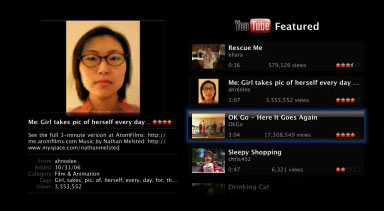
AppleTV YouTubeWe recently wrote about the plethora of unnoficial AppleTV hacks to have surfaced on the Internet, including a plug-in that brought YouTube access to Apple’s set-top-box. As of today that particular hacker can take a well earned rest (or move onto another cool project) because Apple will soon release an update which enables the device to browse, search, and playback YouTube content.

From the press release:

Beginning in mid-June, Apple TV will wirelessly stream videos directly from YouTube and play them on a user’s widescreen TV. Using Apple TV’s elegant interface and simple Apple Remote, viewers can easily browse, find and watch free videos from YouTube in the comfort of their living room.

Also of note is that users will be able to log-in to their YouTube accounts from the AppleTV so that they’ll be able to view and save their favorite videos.

YouTube on AppleTV

YouTube support on the AppleTV is something that I’ve called for right from the start, and in many ways I’m not surprised to see Apple add this new feature. One of the reasons that the hackers have had so much joy developing unofficial add-ons is because the AppleTV’s software already has a plug-in architecture — suggesting that Apple always intended to roll out new functionality. (What upgrades do you think we’ll see next? Let us know in the comments.)

In more AppleTV-related news, Apple now offers a build-to-order version of its set-top-box with the option of a 160GB hard drive — priced at an extra $100 ($399). Nice!

Palm introduces Foleo – mobile phone companion

Palm Foleo Jeff HawkinsSporting a 10inch screen and full-size keyboard, Palm’s new device called Foleo — which the company’s founder Jeff Hawkins talked up as a new product category in itself — is essentially a note-pad-sized laptop, designed specifically to dynamically sync with and compliment the computing power of a smart-phone. The problem that Palm is attempting to solve is that no matter how powerful cell phones have become, there are times when a larger screen and proper keyboard makes more sense — such as composing emails, editing a spreadsheet, or using web apps.

Continue reading »

Livescribe, a computer in a pen

Livescribe logoThe second big announcement at the opening day of the D: All Things Digital conference (following Microsoft’s unvieling of Surface, its gesture-based UI) is a new mobile computing platform called Livescribe. Taking the shape of an ordinary ball-point pen, the device can digitize notes written on special miniature-dotted paper, as well as record and playback audio. Then comes the clever bit — double tap on a word you’ve written and the smart-pen will replay a portion of audio at the exact point the notes were taken, so for example, a few keyword notes can be tied to a place in a recorded lecture or interview. Later on the synced data can then be downloaded to a PC where it can be “replayed, saved, searched or sent”.

Continue reading »