February 20th, 2008 | Posted in Other | Comments Off
Microsoft’s announcement today that it is starting a new online service for the Xbox 360 to showcase games made by independent developers was met with three cheers for the developers, ho-hum for everybody else.
I’m not so sure about that.
The so-called experts believe that Microsoft opening up the Xbox 360 to more casual gaming will have a greater impact on game development and distribution than to mass-market consumers, who are not inclined to buy expensive, powerful consoles like the Xbox 360 or Sony’s PlayStation 3 just to play Taxi Gone Wild, Dress Shop Hop, and Speed Racer.
“This would appeal to the more independent developers, people who want to break into the market, and get them started on the Xbox,” Colin Sebastian, an analyst for Lazard Capital Markets, told the Associated Press. “It makes the development and distribution of video games more accessible.”
Sebastian doesn’t think the Xbox download service, announced at the Game Developers Conference in San Francisco, will appeal to mass-market consumers.
This is a guest post by Gerd Leonhard: Music & Media Futurist, author of “Music2.0“, co-author of “The Future of Music”, CEO of Sonific.com, speaker and advisor.

Last week I wrote a response to the now (in)famous Paul McGuinness speech at MIDEM in Cannes. In his otherwise quite misdirected talk, Paul briefly referred to the so-called ‘digital music flat rate’ (Ed. something we’ve been calling a “music tax”) and so I wanted to make sure I specifically address this topic in a separate guest post here at last100.
Paul’s MIDEM speech sadly reflects the current situation: a music industry still run by yesterday’s managers, executives and (mis)leaders that are still obsessed with control, more than with anything else. Many of them (with some notable exceptions) still can’t seem to face the fact that despite a long, hard struggle to desperately (re)gain some kind of control over what people do with their music, the industry has in a most spectacular fashion in fact totally lost control over the distribution of its product. And good riddance: this development is neither new nor does it need to be the cause of doom and gloom. Rather, the bizarre part is that the most popular and widespread uses of music are still not blessed with permission i.e. a LICENSE. 10 years after Napster and still no real progress – this amazing ineptitude of the music industry to actually adapt has now led to a ‘music is free, period’ attitude among the Digital Natives and the Net Generation.
The longer the likes of Paul McGuinness wait to accept the basic fact of control-loss, the less likely they are to survive this shift to a new ecosystem or maybe even prosper in a Music 2.0 world – and the less likely the artists and writers are to get paid anytime soon.
So why would the flat rate for digital music solve the rampant music sharing ‘problem’?
A version of the BBC’s UK-only TV catch-up service, iPlayer, will be available to iPod Touch and iPhone users within “the next few weeks”, reports The Register.

Optimized for streaming over Wi-Fi rather than O2’s slower EDGE network, the new version of iPlayer will employ the iPod-friendly H.264 video codec, according to the report. While this would limit iPlayer use on the go, the BBC has a partnership with UK-wide hotspot provider The Cloud to deliver free Wi-Fi access to the BBC’s website.
DVD Jon and his company, doubleTwist, released beta software today that’s designed to allow users to share digital media files — music, video, pictures — across devices regardless of type or copy protection.
In other words, if you have a copy-protected song in your iTunes library and want to play it on a PlayStation Portable or Nokia phone instead of an iPod — or you want to send it to friends to play on the devices they own — you can do it with the doubleTwist desktop application.
The software automatically plays song files, regardless of copy protection, in the background. doubleTwist re-records the songs as MP3 files, which can then be sync’d to any device attached to a Windows computer using the doubleTwist application. (It’s not available for Apple computers yet, although a Mac version is in the works.)
doubleTwist is essentially doing the same process as when a user “rips” a CD onto a computer. doubleTwist allows only music already purchased and authorized (like iTunes) to be processed. It says 100 songs can be converted in about half an hour, with about a 5 percent degradation in sound quality.
Says doubleTwist’s Jon Lech Johansen, aka DVD Jon, “We’ve built a format agnostic solution that handles the complexity of file and device compatibility so consumers don’t have to.” (Reuters.)
It’s official: Toshiba, the leading partner in the HD DVD camp, has waved the white flag. The next generation DVD format war is over. Blu-ray wins.
The move to stop production of HD DVD players and recorders was an “agonising decision”, according to Toshiba president Atsutoshi Nishida, but one that the company had to take after “judging that there is no way of winning the competition.”
February 18th, 2008 | Posted in Net TV | Comments Off
Unfortunately, the juiciest detail to us in the U.S. is not known.

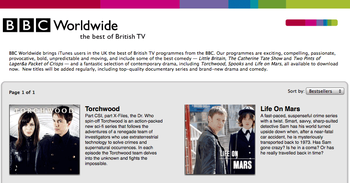
The Register reports that BBC Worldwide will soon offer its content on iTunes, presumably through the iTunes UK store only.
The Register’s “TV industry” source says that BBC Worldwide digital media director Simon Danker has contacted the BBC’s third-party production partners to inform them of the new distribution channel.
However, The Register provided no additional details.
Rats.
At the same time, Ashley Highfield, the director of BBC Future Media and Technology, indicated on the BBC Internet Blog that the iPlayer may become available via the AppleTV set-top box. The iPlayer is the BBC’s on-demand television service that allows UK residents to watch programs broadcast in the last seven days online for free.
Here’s a summary of the week’s digital lifestyle action on last100. Note that you can subscribe to the weekly wrapups, either via the special weekly wrapup RSS feed or by email.
Top digital lifestyle news
This week saw the Mobile World Congress (MWC) take place in Barcelona, and as a result there was lots of news and announcements related to mobile. The biggest of which is that Microsoft is purchasing Danger Inc., makers of the consumer smart phone known as Sidekick. The move is a clear signal by Microsoft that, perhaps following the success of the iPhone, the company is to enter the consumer smart phone market. Whether this will be through rolling out a software platform for existing hardware partners or involve Microsoft building a device of their own is yet to be seen (Zune phone anyone?).

February 15th, 2008 | Posted in Mobile | Comments Off
Shame on you Nokia.
Shame on you Samsung.
Shame on you Motorola.
Shame on you Sony Ericsson.
Shame on all you mobile handset manufacturers.
You let Apple, a computer turned consumer electronics company, steal your show at the Mobile World Congress this week in Barcelona. Except for the curiosity factor of Google’s open-source mobile operating system Android, does anybody but mobile techies and the media (Macworld roundup) even remember what new models, services, or strategies were introduced by the world’s leading handset makers?
February 14th, 2008 | Posted in Net TV | Comments Off
The news wasn’t exactly “stop the presses!” worthy, but it’s interesting nonetheless to see what the folks at YouTube are thinking about and how they are looking to improve their product.
At an invitation only event last night in New York dubbed “Videocracy,” YouTube gave advertising moguls a sneak peak at some upcoming initiatives. In this day and age is it even possible to give a “sneak peak” of anything? Deep Focus CEO Ian Schafer jotted down a few notes, which he shared on his blog.
February 14th, 2008 | Posted in Net TV | Comments Off
PlayTV, Sony’s digital TV tuner and DVR add-on (see last100’s earlier coverage) is still on track to launch in Europe later this year.
After being privy to a private demo of PlayTV at Sony’s UK offices, BBC News correspondent Darren Waters reports: “The hardware itself is uninteresting – it’s the software and features that are worth talking about”:
“PlayTV is a small black box which connects to a USB port on the machine and has an aerial port in (and a pass through port) to pick up digital terrestrial signals.”
“It’s a very slick piece of user interface design. The Electronic Programme Guide and menu systems are well designed and laid out.”
“Just like a PVR, you can pause and rewind live TV, as well as record programmes. The PlayTV has a dual tuner so you can record one channel while watching another.”
However, the feature that got Waters most excited about is the “ability to watch TV on your PlayStation Portable from anywhere in the world using PlayTV, turning the PS3 into a Slingbox on steroids.”
One limitation that surely must be resolved: You can’t record TV in the background while playing a game on the PS3. According to Waters, “the software developers are working hard to add the feature. If it isn’t available at launch, the feature could be added later as a software update.”
And that sums up the PS3 in general. It has so much future potential as a home entertainment hub. Bit by bit that potential is slowly being realized, either through software updates (like the recently added DivX support) or through hardware add-ons such as PlayTV.
Of course, Microsoft, Apple, Sling Media, TiVo et al. aren’t standing still either. The battle for the digital living room has only just begun.
According to at least one source, Netflix has been conducting some very specific market research with regards to its Internet TV service being delivered on Sony’s PlayStation 3 and Microsoft’s XBox 360.
An online survey asks: “If as part of your Netflix membership you could instantly watch movies and TV episodes on your TV with your PS/3 or XBOX 360, how likely would you/anyone in your household be to do that?”
February 13th, 2008 | Posted in Net TV | Comments Off
I’ve been waiting 330 days for this. With the release of the AppleTV Take 2 software update, the original AppleTV finally resembles the device it should have been on Day 1, the day I purchased it.
Since then, I’ve put up with the jeers of friends, home entertainment enthusiasts, HD TV and movie nerds, and less-than-pleased media pundits. I knew when I bought the AppleTV it wasn’t a perfect device, but I purchased it on the belief that Apple would nurture it along and improve the limited set-top box because it had to.
The device was Apple’s entry into the lucrative-but-cutthroat living room, the heart of our digital lifestyle. The battleground is fierce: Microsoft’s Media Center, TiVo, DVRs, cable and teleco video-on-demand, game consoles, laptop computers (and YouTube, Joost, Hulu), Vudu, and so many more are bashing it out for our attention and entertainment dollars.
Except for ease of setup and use, the AppleTV has been a disappointment — I readily admit it — and I’ve watched as competitors continue to improve their offerings. Meanwhile, Apple was messing around with something called the iPhone and gaining entrance into the wireless world.
With the release of AppleTV Take 2, Apple is arguably on near-equal footing with everybody else, but before we go comparing apples and oranges let’s take a brief look at the “new” AppleTV.