
Now you have no excuse for missing that Golden State Warriors game. You will be able to watch all games televised by ESPN and TNT this NBA season no matter where you are and what equipment you have on hand.


Thanks to new digital rights, ESPN and TNT will start the NBA season by streaming games live on their broadband outlets — ESPN360 and TNT Overtime (available on TNT.tv and NBA.com). You can watch games on TV, on your phone, or on a computer. (MediaDailyNews.)
We’ve been waiting a long time to hear from Google about its mobile plans and the so-called Gphone or Google-powered phones. According to one report, that wait may be over soon.
The Wall Street Journal today said Google is expected to announce within the next two weeks advanced software and services that would allow handset makers to bring Google-powered phones to market by next summer. Google’s goal is to make applications and services as accessible on cellphones as they are on the Internet.
To compliment the WSJ’s story, Reuters noted that Google is in active talks with Verizon, the No. 2 carrier in the U.S., about putting Google applications on phones it offers.
October 30th, 2007 | Posted in Other | Comments Off
Forget Google vs. Microsoft. Or MySpace vs. Facebook. The real action these days is NBC Universal vs. Apple.

The latest verbal volleys — and these are doozies — come from Jeff Zucker, NBC Universal’s president and chief executive officer. Zucker, who was interviewed by the New Yorker’s Ken Auletta at a benefit for Syracuse University’s Newhouse School (Variety report), is obviously still pissed at Apple and its CEO, Steve Jobs.
At the root of the school-girl spat is NBC’s insistence that Apple increase the price of the TV shows it sells on iTunes, from $1.99 to $2.99. Jobs has stubbornly resisted, insisting on uniform pricing for music (99 cents) and TV downloads. This disagreement has led Zucker to pull NBC U content off iTunes by the end of the year.
For the most part, the Zucker-Jobs rift has been civil, with both sparring friendly and respecting each other’s position while publicly disagreeing. Now, as they say, the gloves are off.
The handset itself won’t win any prizes on the style-front. It’s a bog standard candy-bar design, with a slightly cheap looking trim. This isn’t a phone for the tech-savvy early adopter crowd to rival the iPhone, but is squarely aimed at younger, more general, price conscious consumers.
This could be one of those defining moments. You know, the kind that change an industry. Like the iPod, for instance. Only this time it’s a phone. Not the Google phone, but the Skype phone.
See, the Skype phone, introduced today in the U.K., has the potential to be revolutionary, not evolutionary, if done well. People will place calls using the Internet, or what’s known as Voice over Internet Protocol (VoIP). The calls are essentially free, or very low cost to the end user, because they use the Internet and not a service provider’s network.
Until now, most Skype calls have been made from computers attached to fixed-line Internet connections. Users call each other around the world wearing uncomfortable microphone headsets that, for the most part, look like something an air traffic controller would wear. Skype has gotten a bit more mobile in the past year — at least around the house — with the advent of Skype-enabled phone-to-computer bridges and portable handsets.
But Skype users have never left home with an actual Skype phone. Until now. Skype and 3, the fifth-largest mobile carrier in the U.K., have teamed together to launch a new affordable handset that lets people make free Skype-to-Skype calls and send Skype instant messages at no cost. It’s the first time an operator has offered a mass market phone tailor-made for free calling over the Internet.
October 29th, 2007 | Posted in Net TV, Other | Comments Off
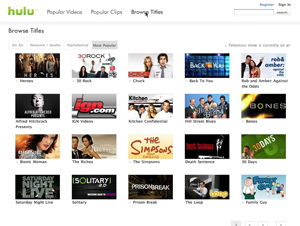
As expected, the so-called YouTube killer known as Hulu debuted today in limited form. Reaction around the Web from those who got to play with it (or just viewed a demo) was encouraging, if not cautious.
Liz Gannes provided one of the best, most thorough preview looks at Hulu for NewTeeVee. She notes that Hulu is as different of a Web video service as can be from YouTube, the market leader. Hulu, known first as “NewSite” when parents NBC Universal and Media Corp. announced their joint venture in March, was initially touted as a YouTube killer.
Gannes notes a number of weaknesses. Hulu just offers Web-based advertising-supported streaming. It also shuns user-generated content — meaning that only its professionally-produced, TV Land content is available — and misses on opportunities for viewers to participate through ratings, reviews, and playlists.
However, Gannes and other say, Hulu has an impressive library of old and new content that’s easy to view using Hulu’s Web interface. Uniformly applauded, but not completely understood, is giving viewers tools to embed clips or full-length episodes and movies wherever they want. Since Hulu only makes available a show’s last five episodes, what happens to the embedded links once the show is no longer on the site?
Streaming media West is a three day conference that runs from November 6-8 in San Jose, CA. In their own words, Streaming media West:
… covers both the business of online video and the technology of streaming, downloading, Webcasting, Internet TV, IPTV, and mobile video. Covering both corporate and consumer business, technology, and content issues in the enterprise, advertising, media and entertainment, broadcast, and education markets, Streaming Media West is about more than just streaming!
NewTeeVee Live
Organized by the team behind the superb NewTeeVee blog (edited by Liz Gannes and part of Om Malik’s GigOm Network), NewTeeVee Live is a one day event to be held on November 14 in San Francisco. In their own words, NewTeeVee Live is:
… a premier event showcasing the online video industry’s hottest topics, most talented video producers, promising technologies, leading innovators and top funding executives. The keynote and panel speakers for this event have been selected by the editorial team behind GigaOM and NewTeeVee.
At last100 we hope to bring coverage of both events (either in person or virtually), and if any of our readers are attending and would like to contribute reports, get in touch!
Here’s a summary of the week’s digital lifestyle action on last100. Note that you can subscribe to the weekly wrapups, either via the special weekly wrapup RSS feed or by email.
Top digital lifestyle news
Lots of PC-to-TV news this week, as companies continue to battle it out trying to solve the “last 100 feet” problem.
SanDisk launched its TV-friendly USB stick and video download service. Taking a much simpler approach compared to the many media extenders on the market, the Sansa TakeTV player forgoes the need for a home network. Instead, content is physically shuttled from a PC to a TV via a dedicated USB stick and docking station. “No confusing WiFi set-ups, no waiting to burn DVDs”, boasts the Sansa online store. To support its TakeTV device, SanDisk has also rolled out a Beta version of a new video download service called Fanfare, which will offer paid-for, and eventually, ad-supported content from various partners. Of note, CBS and independent film-store Jaman are among the first to have signed on.
We asked at the start of the month if Hulu’s impending debut is already too late. Well — drum rolls please — Hulu is set to open its doors, at least in beta form, on Monday. And lining up are even more critics.
Investor’s Business Daily writes that the “picture isn’t pretty” for the launch of NBC Universal’s and News Corp.’s online video joint venture, according to people in the industry.
“Some observers foresee failure,” Brian Deagon writes for IBD. “They say it suffers from not enough content and from having two partners that are rivals with poor track records in partnerships.”
October 25th, 2007 | Posted in Net TV, Other | Comments Off
Time to get out the proverbial salt shaker and look upon these poll results with a wary eye.
On the one hand, more than half of U.S. residents sampled want the government to regulate Internet video, according to a just-released poll by 463 Communications, a Washington, D.C., public relations firm that specializes in high tech issues.
463 works with Zogby International on periodic polls asking “quirky” questions about technology and the Internet (463 Blog). Sometimes these surveys yield interesting results, like the regulation of Internet video.
Twenty-nine percent surveyed said Internet video should be regulated just like TV content, and another 24 percent said the U.S. government should push for an online rating system similar to the one used by the movie industry. Not surprisingly, only 33 percent of 18-to-24 year-olds support government-regulated video content, while 72 percent of those over 70 years old do.
“I was really shocked that people look at the Internet the same way they look at TV,” said Tom Galvin, a 463 partner. “People see (online video) as spiraling out of control, and they want the government to do something about it.”
On the other hand, quirky polls leave you shaking your head, wondering about the validity of the overall effort.
A little over fifty days after Vudu launched its set-top movie box and download service (see our review), the company has slashed the price of its hardware from $399 to $250.
Will the price cut give Vudu a much needed boost in the face of increasing competition? I’m not so sure. But it’s a start.
The company still faces a real challenge in persuading consumers to pony up the cash needed to buy the Vudu box in the first place, on top of renting the movies themselves. Instead, Vudu should bundle a number of rentals free with every box purchased. Or better still, turn Vudu into a subscription service similar to Netflix, with a minimum contract — say twelve months — and give the box away for free.
October 25th, 2007 | Posted in Net TV | Comments Off
Last week we stated the case for why we might see Netflix roll out its own dedicated set-top box in the not too distant future. However, during the company’s Q3 earnings call with investors, CEO Reed Hastings talked up more ambitious plans including the possibility of putting Netflix’s online video service onto next generation games consoles, XBox 360 and PS3, along with networked DVD players and other set-top boxes.
“Our goals in online video over the coming years are three-fold: one, to expand the content we offer online; two, to make it inexpensive and easy for consumers to view that content on the television; and three, to understand what the financial model for the hybrid service will be in the long-term.”
In terms of making it easier for consumers to view online video on a television, Reed says that Netflix are working with a “variety of partners” to explore options including Internet connected, high definition DVD players, Internet connected game consoles, and dedicated Internet set-top boxes.
“In the meantime, laptop computers are, for the younger generation, one of the primary ways video of all sorts is being enjoyed, and our online viewing is up dramatically quarter over quarter.”