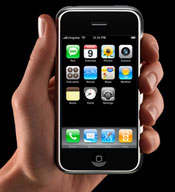
 Update: news has just come out about the product described below, officially named Surface. It’s a lot bigger than the iPhone, but uses similar multi-touch technology. Here is our write-up.
Over at ZDNet, Mary Jo Foley reports on the imminent unveiling of Microsoft’s own multi-touch technology — code-named ‘PlayTable’ — which could prove to be the company’s answer to the iPhone. Also known as the Milan Project, the technology is designed to “allow users to navigate and manipulate data inside a browser or application using gestures”, says Foley. “Think pinches, pushes, waves, etc”. Even more intriguing is that the announcement could come as early as tomorrow, when Bill Gates is set to take the stage with his old rival, Apple CEO Steve Jobs, at the Wall Street Journal’s D: All Things Digital conference.
Foley notes that the project has been developed by Microsoft’s Mobile and Entertainment Division (MED), which is the same business unit responsible for the Xbox, Zune and Windows Mobile devices.
It’s easy to see how Microsoft might incorporate the Milan multi-touch capability into Zunes or Windows Mobile phones. In fact, one source told me that Microsoft has been pitching Milan to various wireless carriers, with the hopes that they will support a Milan-enabled Windows-Mobile phone in the not-too-distant future.
Of course Microsoft doesn’t have the greatest track record when it comes to marketing consumer electronics — XBox being the exception — and Foley says that the company sees additional markets for ‘PlayTable’.
Multi-touch/gesture-recognition technology also would be a natural fit in medical (think of several doctors collaborating over a shared medical file); architectural (shared schematics), educational, hospitality and lots of other applications, Microsoft is hoping.
Whether Gates tries to get one up on Apple at tomorrow’s event (where Jobs will undoubtedly show off the iPhone), what is clear is that Apple isn’t the only company that’s been working on bringing a gesture-based user interface to market. At this point it’s also worth noting that when Jobs announced the iPhone he boasted that Apple had over two hundred patents relating to the device.

 Apple’s World Wide Developer Conference (WWDC) kicks off on Monday with a keynote speech from the company’s founder and charismatic CEO, Steve Jobs. As is usual in these matters, the web is full of rumors and pundit-driven premonitions of what might be announced. Not to be outdone, after scouring the Internet and tapping the minds of all of my Apple-connected colleagues (OK, I hassled a few people on IM), here are last100’s five WWDC predictions.
  After debuting first in Asia, and then Europe — this week Nintendo DS users in the USA can finally get their hands on a version of the
 It’s common for new technology to press the boundaries of what’s permissible under current intellectual property laws or to challenge existing business models — or both — and
 When Walt Mossberg
 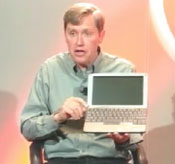 Sporting a 10inch screen and full-size keyboard, Palm’s new device
  The second big announcement at the opening day of the D: All Things Digital conference (following Microsoft’s
 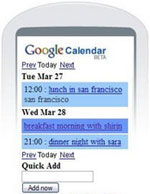 Although most modern cell phones have a built-in calendar application, trying to sync your appointments (or remembering to do so) between different devices, such as a smart phone and desktop computer, can be a hassle. An increasingly viable alternative — as mobile web access becomes ubiquitous and more affordable — is to store your data ‘in the clouds’ by using web applications such as those provided by Google and Yahoo. But for this to work requires those companies to create a mobile-friendly version of their web app — which for email, both companies have done, but until now, only Yahoo (out of the two) offered a mobile-friendly version of their calendar app.
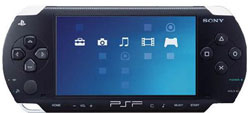 BT and Sony have inked a four year deal that will see the two companies bring voice calls, video conferencing, and IM functionality to PlayStationPortable (PSP) users across Europe. The partnership intends to integrate the PSP with BT’s existing broadband video and voice ‘softphone’ products, and in the following months, additional features will be launched to enable calls and messages to PCs, fixed lines and mobiles. The service will initially roll-out in the UK, with other parts of European to follow.