March 11th, 2009 | Posted in Mobile | Comments Off
Apparently, the T-Mobile G1 now accounts for 20% of the carrier’s contract sales here in the UK, a figure that I find quite surprising considering I’ve yet to see a single handset in the wild (aside from on display) nor do I know anybody who’s bought one. This is in complete contrast to Apple’s iPhone, which seems to have spread like wild fire amongst my own social circle, and is quite a common site out in public.
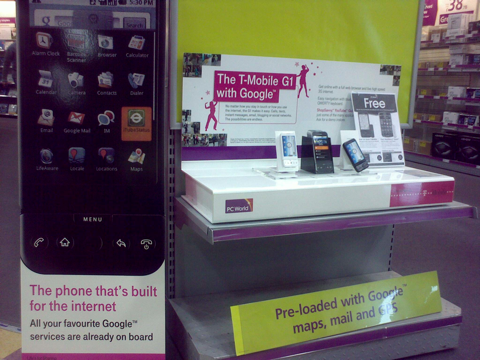
The G1’s lack of visibility, I’d mistakenly attributed to poor sales, based on what I still believe has been lackluster marketing and a rather muddled ad campaign – something that can’t be said of the iPhone. Back in November I noted the lack of display advertising for the G1 at Carphone Warehouse, one of the UK’s largest mobile retailers on the high street. However, today I popped into a PC World, of all places, to find the G1 being heavily promoted, with a much clearer message than the current TV ad campaign: “The phone that’s built for the internet. All your favorite Google services are already on board”. A message that appears to be getting through.

We already knew that the iPhone’s App Store has been a resounding success. And that’s before Apple began running newspaper ads boasting of 10,000 apps available and 300 million downloads since its launch just five months ago. Part of that success can be attributed to the way in which the iPhone as a platform has galvanized developers, while a second major factor is the simplicity of the App Store itself. For example, don’t underestimate the significance of having the store bundled with the handset, supported by over-the-air downloads. The result is that Apple has popularized the notion of third-party software on a mobile phone like never before — how many people do you know with a smartphone from Nokia, RIM or others, who haven’t installed a single third-party application?
While attracting developers is easier said than done, creating an App Store equivalent, especially in hindsight, should be a no brainer. Having spent nearly a week with the T-Mobile G1 — the so-called GPhone — I’m glad to report that Google has done a good job replicating the iPhone experience with the Android Market.
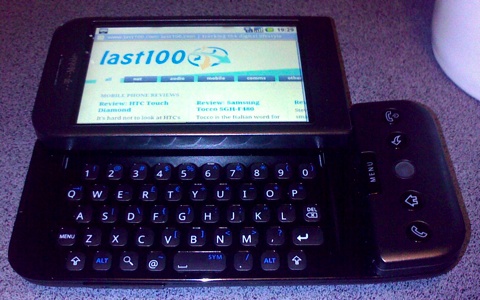
I’ve been playing with the T-Mobile G1 for a few days now — the so-called Google phone — and I’m really impressed with the Android operating system. The touch-friendly User Interface is intuitive and very responsive, although not as ‘pretty’ as the iPhone, an inevitable comparison. And the included suite of native Google apps (Gmail, Google Maps and YouTube), along with the expanding list of third-party software available through the Android Marketplace, already make the G1 a very capable device — my only caveat so far is the drain on battery life that Android’s always-on connectivity and the G1’s large screen seems to impose.
However, where Android really rocks is the bundled web browser. It’s fast, renders the full web flawlessly (aside from the lack of Flash support), and does a fantastic job of re-flowing text when you zoom in on a specific part of a web page, therefore eliminating the need for horizontal scrolling despite browsing on such a small screen. If the mobile browser is more important than the operating system, then Android has it covered. This is a really big deal in my opinion and good news for mobile web developers everywhere, since we’ll see a plethora of Android-based phones release next year and beyond, at a very competitive range of price points.
View a short video I shot of the T-Mobile G1’s Android web browser in action after the jump…