 In a classic DRM U-turn, customers of Microsoft’s now-defunct MSN Music store are being given at least three more years in which they can be sure that the music they’ve purchased will continue to play, even after an operating system re-install or upgrade, and when transfered to a compatible device. That’s because the company, having weathered a storm of negative PR and complaints from customers, has relented on its decision to shut down the service’s verification servers used to implement that store’s copy-protection technology. Continue reading »
MSN Music DRM servers get three year stay of execution
June 20th, 2008 | Posted in Audio |  No Comments
Seesmic to release bi-directional mobile client in four to six weeks
June 19th, 2008 | Posted in Comms, Net TV, Other, Social | No Comments
 There’s a lot to like about Seesmic, the so-called video equivalent of Twitter, besides the charismatic founder Loic Le Meur, “in cloud” talent like Sukhjit and Giselle, and the people you meet “face-to-face” through video posting and commenting.
But there is one thing not to like: the lack of take-it-with-you mobility. To use Seesmic you’re mostly tethered to a desktop or laptop computer with a Webcam. You can use a cell-phone workaround like Shozu, but it can be cumbersome, working for some, not for others. Many people are hyper-mobile and participating in Seesmic is difficult, at least during the day.
This is all about to change. Over the next four to six weeks, Le Meur said following the Supernova conference, Seesmic will release its own bi-directional client for the Nokia series-60 phones including the N95. A hack for the iPhone 3G (jailbreaking it) will soon follow, as will a client for phones running Windows Mobile (and, it can be assumed, Android when they become available).
“In a few weeks we will have our own mobile client, which will let you have a full Seesmic experience,” Le Meur said.
The full Seesmic experience includes a two-way conversation. You record and upload video posts to the Seesmic Website (as well as other leading video sharing sites like YouTube and social network sites like MySpace and Facebook) that others can follow like Twitter. The community, including friends and strangers from all around the world, can comment on your post, and you on their’s. Continue reading »
@Supernova: Evidence developers are just as interested in Blackberry as they are iPhone, Android
June 18th, 2008 | Posted in Comms, Mobile | No Comments
 While the Supernova conference is mostly about the future of the network, a part of that network is mobile. And if you listen to most attendees, the two most important mobile players right now are Apple and the iPhone and Google and Android.
Oddly, it’s as if two other established players — Nokia and Research in Motion — have been relegated to the sideline as also-rans. One conference attendee even asked during a discussion about the future of mobile, “Is Blackberry dead?”
Hardly. Continue reading »
Loopt: a location aware mobile social network
June 17th, 2008 | Posted in Mobile, Social | 1 Comment
This post is syndicated from ReadWriteWeb.
 Loopt is the third location aware mobile social network to become available for the majority of U.S. smartphones . It joins fellow competitors Whrrl and Brightkite, both of which have already started to gain traction (see ReadWriteWeb coverage of Brightkite). However, this is not a market where the first one to debut on the smartphone will be the ultimate winner. Instead, in the wild west of the mobile social networks, the key will be adoption. This is an area where Loopt is making headway, having recently announced deals with all the major U.S. carriers and support for Blackberry smartphones. Continue reading »
Joost in a browser is "weeks away"
June 17th, 2008 | Posted in Net TV | 2 Comments
 A new version of Joost, the much hyped p2p Internet TV service from the founders of Skype, that will run in a Web browser is just weeks away, says CEO Mike Volpi in an interview with Silicon Alley Insider published today.
When Joost was first conceived of in 2006 it was pitched as the antidote to YouTube: an Internet TV service geared towards major content owners who required guarantees around copyright protection, and providing viewers with a higher quality “TV-like” experience. However, since then the online video landscape has changed dramatically, with many competitors syndicating professionally produced and network TV content online, on a mostly non-exclusive basis. And unlike the current version of Joost, the majority of competing services, such as Hulu, run in the browser and don’t require a separate download. Continue reading »
@Supernova: Getting a glimpse of mobile's future without the iPhone and Android
June 17th, 2008 | Posted in Comms, Mobile | 1 Comment
 The mobile buzzwords at Supernova 2008 are plentiful: location, social networks, iPhone, Android, the cloud. But these are so . . . now.
At Supernova on Monday we got a glimpse of what’s next for mobile and our digital lifestyles and quite frankly, it has squat to do with hardware like the iPhone, software like Google’s open-source operating system Android, mobile platforms put forth by Apple, Google, Nokia, Research in Motion, and the carriers.
What’s coming is life profound: Put billions of sensors in cell phones, regardless of hardware, operating system, or carrier, and affect the way we understand traffic or the weather. With continued advances in chipsets, accelerometers, compasses, we can change the way we interact virtually with the physical world around us. We can turn monthly cell phone bills, which are difficult to use beyond paying, into living information integrated into our working and personal lives and social networks.
“We’re just getting started,” said Bob iannucci, Nokia’s chief technology officer. Continue reading »
Motorola launches movie store for cellphones, but will anybody bite?
June 16th, 2008 | Posted in Mobile, Net TV | 1 Comment
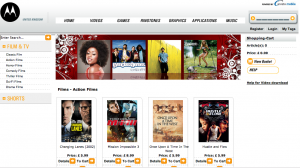 Amid all the iPhone 2.0 hype, we missed the news last week that Motorola has launched a full-length movie store for its mobile phones. Before you ask: “Who wants to watch a feature film on their tiny cellphone screen, anyway?” Here are a few of the details.
The service is available first in the UK-only, but will eventually extend to France, Italy, Germany and Spain. The catalog is currently restricted to forty titles from one studio — Paramount Digital Entertainment — including “The Italian Job”, “Star Trek” and “Team America: World Police”, priced at between £5.99 and £8.99 per movie.
Unsurprisingly, movies can’t be downloaded ‘over-the-air’ directly to handsets but instead the service requires “side-loading” whereby content is downloaded to a PC first and then transfered onto a mobile phone. Motorola says this is so that customers avoid potentially expensive data charges but it also means that the service can bypass carriers who may offer a competing service. Users will still need to be able to connect their phones to the Internet, however, as each side-loaded movie has to have its DRM certificate verified online, and each device must be registered with Motorola’s store. Continue reading »
Weekly wrapup, 9-13 June 2008 (iPhone 2.0 coverage)
June 15th, 2008 | Posted in last100 weekly wrapup | No Comments
Here’s a summary of the week’s digital lifestyle action on last100. Note that you can subscribe to the weekly wrapups, either via the special weekly wrapup RSS feed or by email.
Apple WWDC news and analysis
This week was dominated by Apple’s World Wide Developer Conference and news of iPhone 2.0…
It’s official: iPhone 2.0 is 3G, supports GPS, integrates with MobileMe, and is $$$ cheaper
Dan Langendorf kicked off with an excellent blow-by-blow account of Steve Jobs’ keynote speech including the much rumored iPhone 2.0 with support for 3G data speeds, GPS, enterprise features, and third-party apps. Continue reading »
The App Store: Can it be worth $1 billion to Apple by 2010 with 70 percent free apps?
June 13th, 2008 | Posted in Comms, Mobile, Other | No Comments
 As with everything else iPhone, there’s been a great deal of speculation following the Worldwide Developers Conference regarding the App Store, where Apple intends to sell and distribute third-party applications.
There’s been talk of the grand opening being in July and at the end of June. Details continue to trickle out about how the store will operate. And “overnight” polls indicate the App Store will mean hundreds of millions of dollars in revenue, perhaps even a billion, for Apple by the end of 2009.
One thing puzzles me, though: How can Apple potentially make $1 billion from the App Store by the end of 2009 when it’s estimated by some that 70 percent of the third-party applications will be free?
Go figure.
For now, here’s a quick look back at some of the App Store news following the WWDC keynote. Continue reading »
Video: Mozilla demos Firefox Mobile concept
June 12th, 2008 | Posted in Mobile | 2 Comments
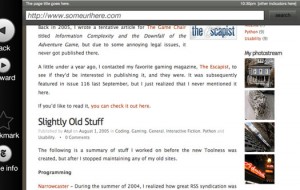 Mozilla Labs’ head of user experience, Aza Raskin (son of Mac pioneer Jef Raskin) has published a short video demonstrating a user interface concept for the upcoming mobile version of web browser Firefox. The version on show is designed for touch screen devices, though not multi-touch like the iPhone — a decision Mozilla took because “Firefox should be able to run on the least common denominator of touch devices”, explains Raskin.
Although, like the iPhone, “the interface should be operable with a finger. Switching between input methods is time-consuming and annoying, so the user shouldn’t have to switch to a stylus or other secondary form of input.” Continue reading »