Archive for the ‘Mobile’ Category

Leave your laptop behind with iPhone Web apps

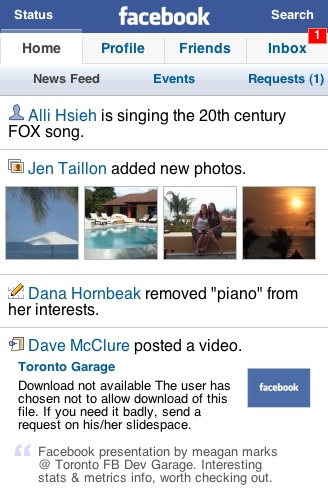
facebookI feel naked. I go someplace and all I have with me is my iPhone.

My laptop is at home or in the backpack in my car. The Moleskine I used to carry to take quick notes is probably in the backpack, or left on the desk. When I get takeout for the wife and the kid, I leave the paperback or magazine on the coffee table because I know I have something with me to occupy idle time.

This past weekend I realized I do most of what I want on the Web with my iPhone. I don’t mean editing web pages, updating blog posts, downloading photos and such, but for the basics of checking email, updating Facebook and Twitter accounts, sending instant messages, reading RSS feeds, making a list, taking a quick picture and emailing it to my flickr account, and listening to music or a book, I’m covered.

I never felt this way with my Blackberry.

Continue reading »
Are European carriers playing hardball with Apple?

iPhone boxWith the iPhone’s pending European release expected before the year’s end, a week hasn’t gone by without new rumors of which carrier has secured an exclusive distribution deal with Apple — with the latest reports suggesting that Vodafone may now be leading the charge. However, perhaps more interesting is speculation that the European carriers are playing hardball with Apple, demanding that the company fix a number of shortcomings with the iPhone, which they believe could otherwise stifle sales.

Continue reading »

Apple and Google alliance just got stronger

Apple and Google alliance just got strongerYesterday’s Apple press event saw the unveiling of new iMacs and major updates to the company’s iLife and iWork software suites. But it also provided further insight into the cosy relationship developing between Apple and Google, with greater integration between the two companies’ product lines.

What’s new? iMovie ’08 adds the ability to upload video direct to YouTube, and iWeb (Apple’s web page creation software) now integrates with Google Maps and YouTube, along with support for Adsense.

Combine these efforts with the existing iPhone tie-ins — Google Maps, YouTube, Gmail — along with AppleTV’s recently added support for YouTube, and we can see how the Apple/Google alliance is strengthening.

And there’s more to come.

Continue reading »

NBC Universal: long-term greedy, not short-term greedy

nbc universalGeorge Kliavkoff, NBC Universal’s chief digital officer, calls it like he sees it. Appropriate, considering he came to NBC Universal from Major League Baseball.


In an interview with Forbes.com, Kliavkoff said that video distribution on cellphones in the United States is a broken business model and that the carriers and NBC Universal (as well as other big-media content providers) are “long-term greedy, not short-term greedy.”

No argument here.

In this country, if you look at the gross revenue of content distribution on mobile phones, 9 percent of the gross revenue goes to the content owners, 70 percent stays with the carriers, and 21 percent goes to content aggregators and other middlemen. We think over time that’ll get fixed. I believe the carriers are like us, long-term greedy, not short-term greedy.

Continue reading »

Internet and mobile video not safe from censors

V-chip - Internet and mobile video not safe from censorsIt was reported this week that some members of the U.S. Senate believe that the rating system used in US televisions needs to be taken further. There are moves to power-up the controversial V-Chip so that it can be embedded into more devices — such as computers, games consoles and mobile phones — which will, in turn, give parents greater control over what their children are able to watch.

The V-Chip, which has been compulsory in all televisions sold in the States since January 2000, allows parents to set filters which will block out content above certain rating levels. These levels are then encoded into television programs broadcast in the U.S.

Continue reading »

Google gets half of what it seeks for wireless auction

Now what will Google do?

googleThe Federal Communications Commission voted today to approve rules governing an auction of 700MHz wireless spectrum that could alter the U.S. wireless industry’s competitive landscape. The commission voted to give consumers more choice and freedom with their cell phones and wireless devices. The “open access” provision will allow customers to use whatever phone and software they want on one-third of the network to be auctioned.

Now that the rules are finalized, possible bidders in the auction include Verizon, AT&T, Vodafone, and maybe a new player, Google.

Continue reading »

eMusic to partner with AT&T mobile

eMusic to partner with AT&T mobileThe New York Times reports that eMusic has signed a deal with AT&T to sell ‘over-the-air’ music downloads to the telco’s millions of mobile phone users. eMusic is the second largest provider of paid-for music downloads (iTunes is number one) and specializes in selling tracks from independent record labels, DRM-free. The company also pioneered a subscription-based service where users pay a monthly fee which entitles them to a certain number of downloads, which they then get to keep, even if they cancel their subscription.

Under the deal, AT&T mobile customers will be able to purchase tracks as a bundle, starting at $7.49 for five tracks, which is significantly more expensive than the regular version of eMusic’s service, whereby users get 30 tracks for a monthly fee of $9.99. The increase in price is being justified based on the additional cost of sending tracks directly to a user’s mobile phone, as apposed to “side-loading” via a PC.

Continue reading »

Poll: Email addiction — where do you check your email?

I don’t have a “crackberry” problem, as I don’t own a Blackberry. But I do check my email from bed, sometimes in the middle of the night — and I’m not alone. According to a survey carried out by AOL, email “addiction” is on the rise, with 40% of respondents admitting to checking their email while in bed. 53% say they check when in the bathroom; 37% are checking email while they drive; and 12% admit to checking email in church. Perhaps, more alarmingly, 15% of those surveyed, proclaimed themselves as email addicts.

Overall, mobile email usage has doubled since 2004.

Sound familiar? Just out of curiosity, we’d like to know if you’ve checked your email in one of these places? 🙂
[poll=6]

Sony and Sky to deliver video-on-demand to PSP

Sony and Sky to deliver video-on-demand to PSPSony Europe and News Corp-owned Sky have announced the formation of a Joint Venture company which will deliver video-on-demand content to PlayStation Portable (PSP) owners in the UK and Ireland.

Focusing exclusively on delivering video content to the PSP, the Joint Venture will initially provide a wealth of video and film content to the more than 2.3 million PSP owners in the UK and Ireland. The two companies are already in discussions with entertainment content providers across Europe to facilitate future introduction of the service to European PSP owners.

The new venture follows a recently announced partnership between BT and Sony which will see the two companies bring voice calls, video conferencing, and IM functionality to PSP users across Europe.

Continue reading »

Can the iPhone change the face of the U.S. mobile-phone industry?

Can the iPhone change the face of the U.S. mobile-phone industry?The iPhone is far from perfect, but it has potential to change the U.S. mobile-phone market unlike any smart phone/PDA/cell phone I’ve used.

Whether you like the iPhone or not isn’t important. What Apple has done is succeed in wresting an unprecedented amount of control from a carrier — in this case AT&T — in designing the device, determining its applications and mindset of use, and how to price the phone and service. At a minimum, the iPhone could impact future design for all phone manufacturers as they offer more features and functions — and a new platform — based on the way people are living their digital lives. At the extreme, the iPhone could inch the powerful carriers in the U.S. mobile-phone industry to update their 1980s business models, sort of like what the iPod is doing to the music industry.

Apple, Nokia, and Google are already working toward breaking down barriers.

Continue reading »