 The eBook is nothing new, and nor are hardware-based eBook readers — I’ve even read a number of eBooks over the years on various Palm devices, for example. However, later today Amazon is set to unveil the latest stab at an dedicated eBook device and accompanying service called the “Kindle”.
Richard MacManus, editor of our sister blog Read/WriteWeb, has the details:
This week, wrote Steve Levy in a rapturous article in Newsweek, Amazon will release the Kindle – an e-reader that uses E Ink and will have Internet connectivity. The latter point is what will differentiate the Kindle from its chief competitor currently, the Sony eReader that was launched in 2006.
Levy wrote in Newsweek that the Kindle ” will change the way readers read, writers write and publishers publish.” He unleashes other doozies of hyperbole too: “the iPod of reading” and “the first ‘always-on’ book”.
The Kindle will cost USD399, which is $100 more than the Sony eReader. But the wireless Internet connectivity easily makes the increased price worth it. The wireless is via a system called Whispernet – which according to Newsweek is based on the EVDO broadband service offered by cell-phone carriers, allowing it to work anywhere and not just Wi-Fi hotspots.
The Kindle will be able to hold 200 books, with new releases being offered for just $9.99. Also, apparently blogs will be part of the service – at a cost of either 99 cents or $1.99 a month per blog.
There are quite a few issues that might hold back adoption of the Kindle, namely the tricky balancing act that is DRM and eBook formats, the user experience of the device itself, and the age-old question of whether people really want to read books — most of which aren’t time sensitive — electronically.
I also have a feeling there maybe another issue at stake.
Continue reading »

 The U.S. Wireless Wall is crumbling. This time next year, the wall may have fallen.
 Now that Google has jumped into the deep end of the pool, what are its plans for the upcoming wireless spectrum auction? Is Google playing to win? Is this a bluff? Do we as consumers want Google to win? Should we care?
 Color
Color 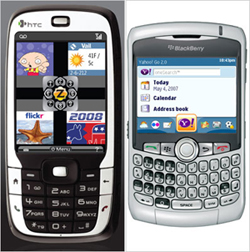 Three recent posts on the Web discuss the coming of the Mobile Web. One thing we can all agree on: It’s a big deal. What we don’t agree on is this: When will it get here, and
  Microsoft’s Xbox Live has come a long way since it launched in November of 2002. Xbox Live started out as a multiplayer gaming network, but today the 8 million users with Live accounts do much more than just play games. Users can download movies and television shows, chat with friends, and more. Even Microsoft now describes the service as a “comprehensive unified online entertainment network”. Marketing-speak at its finest, but it’s true – Xbox Live is a key component of Microsoft’s connected entertainment vision. In this post we look at the state of Xbox Live today, and explore some of the ways Microsoft will likely enhance it in the future.
  First up is a look at the opening keynote by Ralph de la Vega, the group president in charge of mobility for telecom powerhouse AT&T. De la Vega shared his company’s vision for the future of IP television, and it’s clear that AT&T sees IPTV as critical to its overall strategy of connecting people with whatever content they want, when they want it, on whatever device they want to use. And charging them along the way, of course.
  It feels like there’s a music download store on every virtual street corner.
  I’m all for
  It’s clear that Google,
  As expected, Google did not announce it was delivering an actual branded phone, dubbed the Gphone. Instead Google is leading a broad industry partnership known as the